
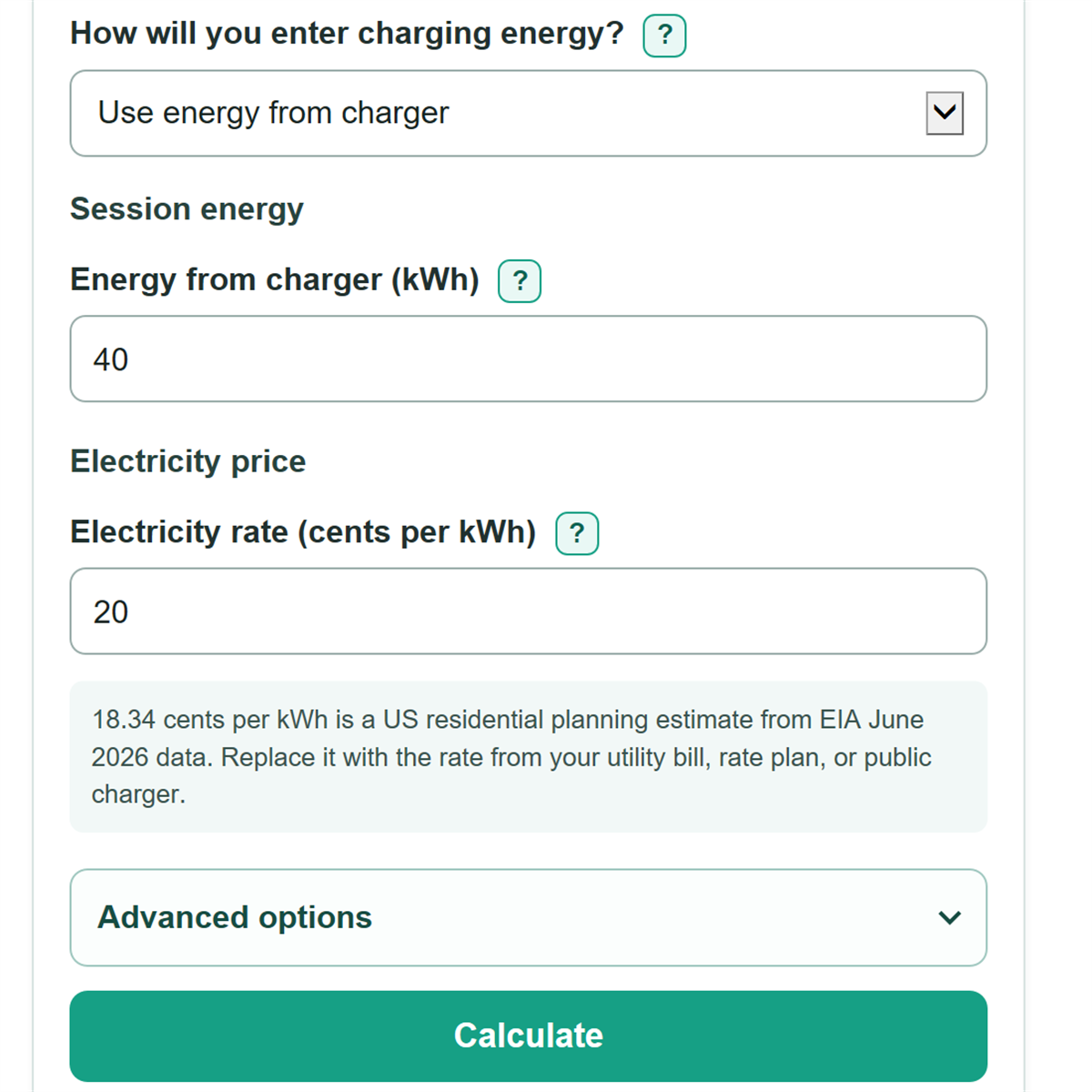
Enter charger energy or battery charge details and an electricity rate to estimate the cost of one EV charging session.
Session energy
Electricity price
Advanced options
Utility bill rate helper
Table of contents
How to use our EV Charging Cost Calculator
- Choose "Use energy from charger" if your charger, vehicle, or charging app reports session energy in kWh. Choose "Estimate from battery" only if you need to estimate the session energy from battery details.
- Enter the electricity rate for the time and place you charge. A plain number is cents per kWh; enter a marked value such as $0.20/kWh if your rate is written in dollars.
- For a battery estimate, enter usable battery capacity, starting charge, target charge, and charging efficiency. Use usable capacity, not gross pack capacity.
- Open Advanced options if you need to calculate a rate from a utility bill. Enter the variable charges and billed kWh from the same bill period, leaving out fixed monthly customer charges.
- Before using the cost, check that the wall kWh and rate used match the charger record, charging receipt, utility plan, or bill you intended to use.
Definitions
kWh (kilowatt-hour): A unit of electrical energy. Utilities and charging providers commonly bill energy by kWh.
kW (kilowatt): A measure of charging power or speed, not total energy. It cannot determine charging cost without charging time.
Energy from charger: Energy drawn from the wall during the session, measured in kWh. This is the energy multiplied by the electricity rate.
Usable battery capacity: The battery energy available for driving, measured in kWh. It can be less than the gross pack capacity.
Charging efficiency: The share of wall energy stored in the battery. At 90% efficiency, storing 45 kWh requires 50 kWh from the wall.
Variable electricity charges: Utility-bill charges that rise with each kWh used, including applicable supply and delivery charges billed by kWh. Fixed monthly customer charges are excluded.
Electricity rate: The price per kWh applied to this session. The default is a US residential planning estimate from EIA June 2026 data; replace it with the rate on your bill, rate plan, or charger display. [1]
Common mistakes and quick fixes
Mistake: Entering charger power in kW as though it is session energy in kWh.
Fix: Enter the kWh for the session. kW measures charging speed, while kWh is the energy used to calculate cost.
Mistake: Entering charging efficiency after using Energy from charger (kWh).
Fix: Use measured charger energy directly because it already includes charging losses. Use efficiency only with the battery estimate.
Mistake: Using gross battery capacity instead of usable battery capacity.
Fix: Use the usable kWh in the vehicle manual or manufacturer specifications when it is available.
Mistake: Mixing up cents per kWh and dollars per kWh.
Fix: A plain entry of 20 means 20 cents per kWh. Type $0.20/kWh when the rate is written in dollars.
Mistake: Including fixed customer charges in the utility bill helper.
Fix: Include only supply and delivery charges that change with kWh. Leave out fixed charges, late fees, and unrelated services.
Mistake: Using a general rate even though your utility has time-of-use pricing.
Fix: Enter the rate for the hours you normally charge, such as the off-peak overnight rate.
Limitations & Key Assumptions / Boundary Conditions
- The result is an estimated incremental energy cost for one charging session, not a share of the full monthly utility bill.
- Fixed monthly customer charges are excluded because one additional session does not usually change them.
- Public charging session fees, parking fees, idle fees, taxes, and other charges are excluded unless they are included in the rate you enter.
- For time-of-use, tiered, or seasonal utility plans, the applicable rate may differ from the average rate on a bill.
- Battery-based estimates depend on the usable capacity, displayed charge percentages, and charging-efficiency estimate. Actual wall energy can differ.
- A target charge below the starting charge is not a charging session for this calculator. Equal starting and target charges are valid and produce zero energy and zero cost.
Methodology
Calculation method
The calculator uses wall energy, which is the energy billed by a utility or charging provider. In charger-energy mode, the entered kWh is used directly. In battery-estimate mode, it first calculates energy stored in the battery, then divides by charging efficiency to estimate wall energy.
battery energy added (kWh) = usable battery capacity (kWh) * (target charge (%) - starting charge (%)) / 100
wall energy (kWh) = battery energy added (kWh) / (charging efficiency (%) / 100)
Charging efficiency is used only in battery-estimate mode. Applying it to measured charger kWh would count charging losses twice.
If both utility-bill helper fields are filled in, the calculator divides variable bill charges by billed kWh and uses that calculated rate instead of the main rate field.
bill rate (cents per kWh) = variable bill charges ($) * 100 / billed electricity (kWh)
session cost ($) = wall energy (kWh) * electricity rate (cents per kWh) / 100
Worked example
A 75 kWh usable battery charged from 20% to 80% stores 45 kWh. At 90% charging efficiency, the estimated wall energy is 50 kWh. At 18.34 cents per kWh, the estimated charging session cost is $9.17. The calculation uses variable per-kWh charges only; use the local rate for your charging time when a utility plan has different prices by time of day. [2]