
Estimate how long your EV will take to charge using battery size, starting charge, target charge, charger power, and losses.
Table of contents
How to use our EV Charging Time Calculator
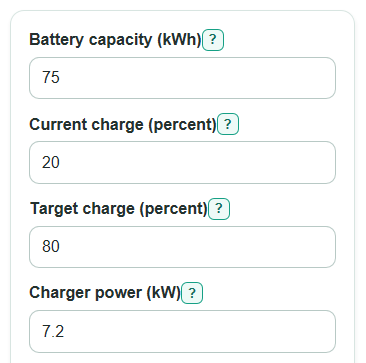
- Enter Battery capacity (kWh), Current charge (percent), Target charge (percent), and Charger power (kW).
- Check Charging efficiency (percent); use the default if you only need a quick estimate, or replace it if you know your charger or vehicle data.
- Open Advanced options if you know Vehicle max charging power (kW), Electricity price ($ per kWh), or Driving efficiency (miles per kWh).
- Click Calculate and read Estimated charging time first, then check Power used for the estimate to see whether the charger or the car limited the speed.
- Sanity-check the result: a larger battery gap, lower Charger power (kW), lower Charging efficiency (percent), or lower Vehicle max charging power (kW) should make Estimated charging time longer.
Definitions
Battery capacity (kWh): The amount of energy the EV battery can store. If you know the usable battery size, use that because the car may not let you use the full pack.
Current charge (percent): The battery percent shown by the car before charging starts.
Target charge (percent): The battery percent you want after charging. It must be the same as or higher than the current charge.
Charger power (kW): The charger's output rate in kilowatts. Higher kW can charge faster only if the car can accept that much power.
Vehicle max charging power (kW): The highest charging power the vehicle can accept in the situation you are estimating. The calculator uses the lower of this value and Charger power (kW).
Charging efficiency (percent): The share of wall electricity that becomes stored battery energy. The rest is lost as heat and charger overhead.
Energy added to the battery (kWh): The stored battery energy gained between Current charge (percent) and Target charge (percent).
Energy drawn from the wall (kWh): The electricity used before losses. This is the better number for cost estimates.
kW and kWh: A kilowatt (kW) is a power rate, while a kilowatt-hour (kWh) is an amount of energy.
Common mistakes and quick fixes
Mistake: Using the car's full advertised pack size for Battery capacity (kWh) when you know the usable battery size is lower.
Fix: Enter the usable Battery capacity (kWh) if your vehicle data shows it; otherwise use the listed pack size as an estimate.
Mistake: Entering Target charge (percent) lower than Current charge (percent).
Fix: Set Target charge (percent) to the same number or a higher number than Current charge (percent).
Mistake: Treating Charger power (kW) as the guaranteed power your car will accept.
Fix: If you know your car's limit, enter Vehicle max charging power (kW) so Power used for the estimate is capped correctly.
Mistake: Leaving Charging efficiency (percent) blank or entering 0.
Fix: Use a value above 0 and up to 100 for Charging efficiency (percent); 90 is a reasonable editable starting estimate for many quick checks.
Mistake: Using Energy added to the battery for cost instead of Energy drawn from the wall.
Fix: Use Electricity price ($ per kWh) with Energy drawn from the wall, because charging losses mean wall energy is higher than stored battery energy.
Mistake: Reading Estimated miles added as a guaranteed range.
Fix: Enter your real Driving efficiency (miles per kWh) and treat Estimated miles added as a rough estimate that changes with speed, weather, tires, and terrain.
Limitations & Key Assumptions / Boundary Conditions
- The result assumes steady charging power. Real charging can slow because of battery temperature, charger limits, shared station power, or the vehicle's charging curve.
- DC fast charging often slows near high battery percentages, especially above about 80 percent, so high Target charge (percent) estimates can be optimistic.
- Vehicle max charging power (kW) is a simple cap. It does not model changing power minute by minute as the battery fills.
- Battery capacity (kWh) should be the usable battery size when known. Using a gross pack size can overstate Energy added to the battery and Estimated charging time.
- Charging efficiency (percent) is an estimate. Cold weather, battery conditioning, charger type, and cabin loads can change Energy drawn from the wall.
- Estimated charging cost uses Electricity price ($ per kWh) only. It does not include idle fees, session fees, demand charges, taxes, subscriptions, or free charging credits.
- Estimated miles added depends on Driving efficiency (miles per kWh). Actual range can change with speed, weather, elevation, tires, and driving style.
Methodology
Core calculation
The calculator first finds the battery percent gap, then turns that gap into stored battery energy. It then limits the charger power by Vehicle max charging power (kW) when that optional value is entered. Finally, it applies Charging efficiency (percent) so the time uses power that effectively reaches the battery.
energy_added_kwh = battery_capacity_kwh * (target_soc_percent - start_soc_percent) / 100
raw_power_kw = min(charger_power_kw, vehicle_max_power_kw) when vehicle_max_power_kw is entered
raw_power_kw = charger_power_kw when vehicle_max_power_kw is blank
effective_power_kw = raw_power_kw * charging_efficiency_percent / 100
time_hours = energy_added_kwh / effective_power_kw
If Target charge (percent) equals Current charge (percent), the energy gap is 0, so Estimated charging time, Energy added to the battery, and Energy drawn from the wall are 0. The calculator still shows Power used for the estimate because that describes the entered charger setup.
Wall energy, cost, and miles
Energy drawn from the wall is larger than Energy added to the battery when Charging efficiency (percent) is below 100. Cost uses wall energy because that is the energy a meter would measure.
wall_energy_kwh = energy_added_kwh / (charging_efficiency_percent / 100)
cost = wall_energy_kwh * electricity_price_per_kwh
miles_added = energy_added_kwh * miles_per_kwh
Estimated charging cost is shown only when Electricity price ($ per kWh) is entered and valid. Estimated miles added is shown only when Driving efficiency (miles per kWh) is entered and valid.
Mini-example
Suppose Battery capacity (kWh) is 75, Current charge (percent) is 20, Target charge (percent) is 80, Charger power (kW) is 7.2, and Charging efficiency (percent) is 90. The battery energy added is 75 * (80 - 20) / 100 = 45 kWh. With no vehicle cap, raw power is 7.2 kW and effective power is 7.2 * 90 / 100 = 6.48 kW. The time is 45 / 6.48 = 6.944 hours, which is about 6 hours 57 minutes. Wall energy is 45 / 0.90 = 50 kWh.
Validation choices
Battery capacity (kWh) and Charger power (kW) must be greater than 0. Current charge (percent) and Target charge (percent) must be from 0 to 100, and the target must not be lower than the current charge. Charging efficiency (percent) must be greater than 0 and no more than 100. Optional numeric inputs may be blank, but if they are filled in, Vehicle max charging power (kW) and Driving efficiency (miles per kWh) must be positive, while Electricity price ($ per kWh) must be 0 or higher.