
Enter appliances that may run together to find the minimum continuous and startup-surge inverter ratings you need in watts.
Table of contents
How to use our Inverter Size Calculator
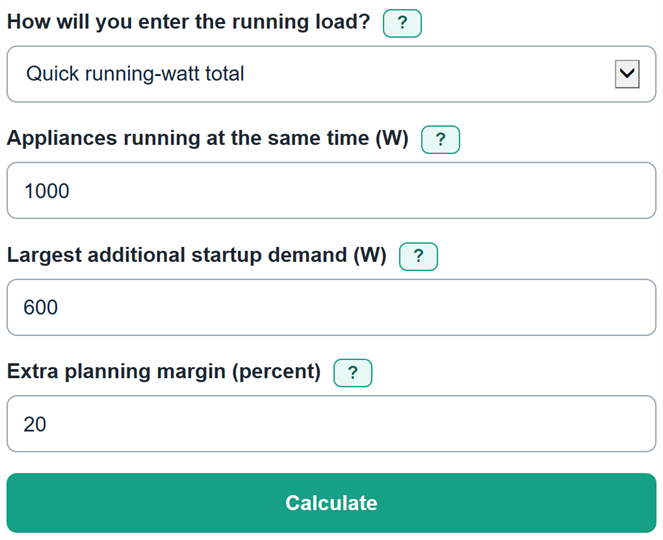
- Choose Quick running-watt total if you already know the combined load, or choose Appliance worksheet to add each appliance separately.
- Enter only appliances that may run at the same time, using running watts from the appliance label or manual.
- Enter the largest additional startup demand if you know it. This is only the extra watts above that appliance's normal running watts.
- Add a planning margin only if you want extra reserve or your equipment instructions require it, then select Calculate.
- Check that a candidate inverter's published continuous rating meets the continuous result and its published surge rating, for the stated surge duration, meets the surge result.
Definitions
Watt (W): A unit of power. Appliance labels often show running power in watts.
Simultaneous running load: The combined watts of appliances expected to run at the same time.
Continuous inverter rating: Power an inverter can supply during ongoing operation.
Additional startup demand: The temporary watts above an appliance's normal running power that it needs when starting.
Surge rating: Short-term power an inverter can supply for a startup event.
Planning margin: A user-chosen percentage added as reserve to the calculated load.
VA: Volt-amperes, a power rating used on some inverter listings. VA and watts are not automatically equal.
Common mistakes and quick fixes
Mistake: Adding every appliance in the home instead of the ones that may operate together.
Fix: Check How will you enter the running load? and then recalculate. Include only the appliances that could realistically be on at the same time.
Mistake: Entering an appliance's full startup peak as additional startup demand.
Fix: Check How will you enter the running load? and then recalculate. Subtract that appliance's running watts from its full startup watts, then enter only the difference.
Mistake: Using the continuous rating as proof that an inverter can start a motor.
Fix: Check How will you enter the running load? and then recalculate. Compare the separate minimum surge rating with the inverter's published surge rating and allowed surge duration.
Mistake: Guessing startup demand because it is not on the appliance label.
Fix: Check How will you enter the running load? and then recalculate. Check the manual or manufacturer. If startup demand is unknown, treat the surge result as incomplete.
Mistake: Treating a VA-only inverter listing as the same as a watt requirement.
Fix: Check How will you enter the running load? and then recalculate. Compare VA and watts only when the needed power-factor information is provided.
Mistake: Expecting a larger inverter to make the battery run longer.
Fix: Check How will you enter the running load? and then recalculate. Size battery energy and runtime separately. Inverter watts measure power capacity, not operating time.
Limitations & Key Assumptions / Boundary Conditions
- The result is a planning estimate from the appliance values entered and is not approval for an electrical installation.
- It assumes the listed appliances can run together and that only the largest expected added startup demand happens at that time.
- If startup demand is unknown, a running-load result does not confirm that an inverter can start a motorized appliance.
- Check the inverter's published continuous rating, surge rating, allowed surge duration, and operating instructions before buying.
- Battery capacity and condition, DC cables, fuses, grounding, ventilation, waveform compatibility, and local electrical rules can limit a real system even when the watt ratings match.
- Do not compare a watt result directly with a VA-only inverter listing unless relevant power-factor information is available.
Methodology
Calculation method
The calculator uses only the selected entry method. In quick mode, it uses the entered running-watt total. In worksheet mode, it multiplies each appliance quantity by its running watts and adds the row totals.
running load (W) = quick running watts, or sum of quantity * running watts for each appliance row
A planning margin adds a user-chosen reserve to the simultaneous running load. A blank margin is treated as 0 percent.
added continuous planning reserve (W) = running load * planning margin / 100
The continuous requirement rounds up to the next whole watt so the displayed requirement is never below the calculated value.
minimum continuous inverter rating (W) = ceiling(running load + added continuous planning reserve)
For startup sizing, the calculator adds only the largest additional startup demand above normal running power. This prevents the starting appliance's running watts from being counted twice.
estimated load during the largest startup (W) = running load + largest additional startup demand
minimum inverter surge rating (W) = ceiling(estimated startup load * (100 + planning margin) / 100)
Worked example
If the simultaneous running load is 1,000 W, the largest additional startup demand is 600 W, and the planning margin is 20 percent, the added continuous reserve is 200 W. The minimum continuous rating is 1,200 W. The startup load is 1,600 W, and the minimum surge rating is 1,920 W.