
Estimate a device's electricity cost from its power and use time, or price kWh measured by a bill, meter, or smart plug.
Advanced options
Table of contents
How to use our Electricity Cost Calculator
- Choose "Power and time" if you have a device label or manual, or choose "Known kWh" if a bill, smart plug, or energy meter gives the kWh.
- For Power and time, enter the device power, choose watts or kilowatts, enter typical hours used per day, and enter the number of days to estimate.
- Enter the electricity rate from your bill or rate plan, then choose whether that number is cents per kWh or $ per kWh.
- In Known kWh mode, add the days covered only if you also want daily, average-month, and yearly estimates.
- Check that the displayed kWh makes sense for the device and time entered before using the estimated cost as its energy-charge estimate.
Definitions
Device power (W or kW): Power is how fast a device uses electricity. A kilowatt (kW) equals 1,000 watts (W).
Kilowatt-hour (kWh): A unit of electrical energy. One kWh is the energy used by 1 kW running for 1 hour. Electric bills measure energy use in kWh. [1]
Electricity rate: The usage-based price per kWh. This calculator accepts cents per kWh or $ per kWh.
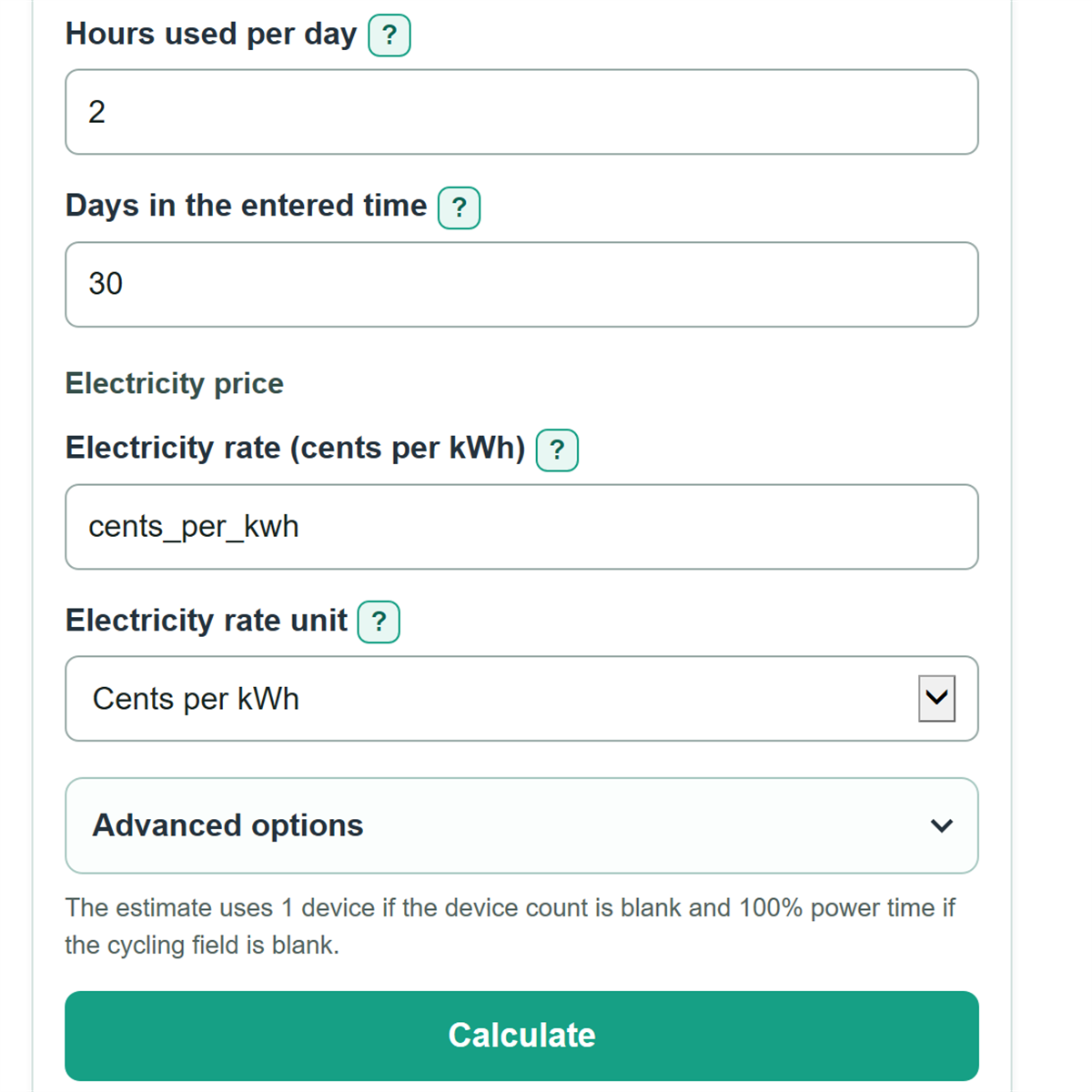
Hours used per day: The total time the device runs during a typical day, from 0 through 24 hours.
Time drawing the entered power (%): The share of scheduled use when the device draws the entered power. Use 100% for a steady load.
Common mistakes and quick fixes
Mistake: Entering watts in Electricity already measured (kWh).
Fix: Choose Power and time for watts or kilowatts. Enter kWh only when it was measured or listed on a bill.
Mistake: Using a $ per kWh rate while the rate unit is set to cents per kWh.
Fix: Check What information do you have? and then recalculate. Match the rate unit to the unit printed next to the rate on your bill or plan.
Mistake: Entering weekly hours in Hours used per day.
Fix: Enter a daily average from 0 through 24, then use Days in the entered time for the total number of days.
Mistake: Treating maximum label power as constant use for a refrigerator, air conditioner, or other cycling device.
Fix: Use measured kWh or average power when possible. Otherwise, adjust Time drawing the entered power (%) only if you have a reasonable estimate.
Mistake: Counting different appliances as identical devices.
Fix: Use Number of identical devices only when every device has the same power and schedule. Calculate unlike devices separately.
Mistake: Expecting the estimate to equal the full utility bill.
Fix: Check What information do you have? and then recalculate. Treat this as an energy-charge estimate. Fixed charges, taxes, delivery charges, and changing rates can affect the bill.
Limitations & Key Assumptions / Boundary Conditions
- The estimate is the usage-based energy charge: kWh multiplied by one entered rate.
- It does not include fixed customer charges, taxes, delivery charges, demand charges, credits, or minimum bills.
- Tiered, seasonal, and time-of-use rates can make an actual bill change differ from this flat-rate estimate.
- Power-and-time results assume the entered power, daily use, device count, and cycling percentage stay the same throughout the entered period.
- A device label may show maximum power instead of typical average power, so measured kWh or measured average power can give a better estimate for cycling or variable-load equipment.
- Yearly and average-month costs extend the daily estimate using 365 days per year and 365 divided by 12 days per average month.
Methodology
How the calculation works
The calculator first changes watts to kilowatts and cents to dollars when needed. One kilowatt equals 1,000 watts, and 100 cents equals $1.
power in kW = power in W / 1,000
rate in $ per kWh = rate in cents per kWh / 100
In Power and time mode, adjusted power is multiplied by hours used per day and days in the entered time. A blank number of identical devices is treated as 1, and a blank cycling percentage is treated as 100%.
electricity used in kWh = power in kW x device count x cycling percent / 100 x hours per day x days
In Known kWh mode, the entered kWh is used directly. Both modes multiply kWh by the electricity rate to calculate the first result.
estimated cost = electricity used in kWh x rate in $ per kWh
Time-based estimates
When days are available, daily cost is the entered-time cost divided by days. Average-month cost uses 365 divided by 12 days, and yearly cost uses 365 days.
average-month cost = daily cost x 365 / 12
yearly cost = daily cost x 365
Worked example
A 1,000 W device used 2 hours per day for 30 days uses 1 kW x 2 x 30 = 60 kWh. At 20 cents per kWh, the estimated cost is 60 x $0.20 = $12.00. The daily cost is $0.40, the average-month estimate is $12.17, and the yearly estimate is $146.00.