
Enter an appliance's label watts, or its volts and amps, to find its running wattage and optional daily energy use or cost.
Advanced options
Table of contents
How to use our Appliance Wattage Calculator
- Choose the label information you have: "I know the watts" or "I know the volts and amps."
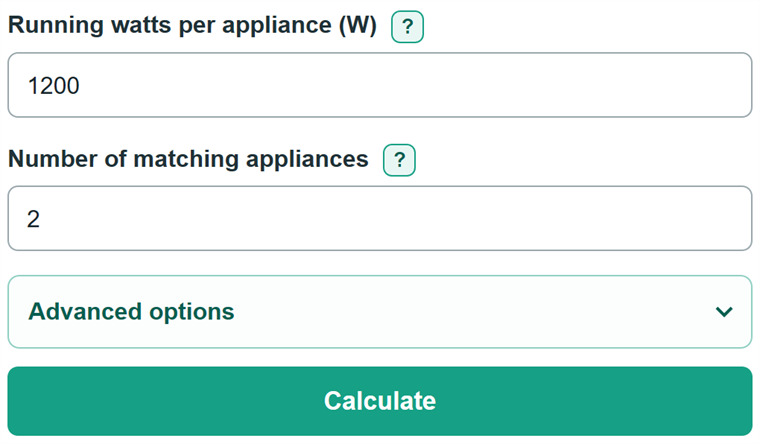
- Copy the active electrical values from the appliance nameplate, manual, or plug-in watt meter, then enter how many identical appliances may run at the same time.
- Click Calculate to see the running watts for one appliance and the combined running load in watts and kilowatts.
- For an energy estimate, open Advanced options and enter the hours the appliances actively run on a typical day. Add your electricity rate from the utility bill to estimate the daily energy charge.
- Sanity-check the answer: doubling the number of matching appliances should double the connected load, and entering 0 hours per day should show 0 kWh per day.
Definitions
Watt (W): A unit of power, or how fast an appliance uses electrical energy at a given moment.
Running watts: The normal power an appliance draws while operating, excluding a brief startup demand.
Voltage (V): Electrical pressure shown on an appliance label.
Current (A): Electrical flow, also called amperage, shown on an appliance label.
Kilowatt (kW): 1,000 watts.
Kilowatt-hour (kWh): A unit of energy used over time. Electricity use on a bill is commonly measured in kWh.
Electricity rate ($ per kWh): The energy price used to estimate the appliance's daily electricity charge.
Common mistakes and quick fixes
Mistake: Entering startup or surge watts as running watts.
Fix: Check What is shown on the appliance? and then recalculate. Enter the normal operating watts. Short startup demand is not included in the connected running load.
Mistake: Guessing the voltage from the outlet instead of reading the appliance label.
Fix: Check What is shown on the appliance? and then recalculate. Copy the voltage from the appliance, power adapter, or manual.
Mistake: Treating volts times amps as a measured watt reading for every AC appliance.
Fix: Check What is shown on the appliance? and then recalculate. Use label watts or a meter reading when available. The volts-and-amps path is a simplified estimate.
Mistake: Entering a fraction for the number of matching appliances.
Fix: Check What is shown on the appliance? and then recalculate. Enter a whole count of identical appliances that may run at the same time.
Mistake: Entering an electricity rate without daily use time and expecting a cost result.
Fix: Check What is shown on the appliance? and then recalculate. Enter hours used per day too, because cost needs both energy use and a rate.
Mistake: Entering cents as dollars in the electricity-rate field.
Fix: Check What is shown on the appliance? and then recalculate. Enter 18 cents per kWh as 0.18, not 18.
Limitations & Key Assumptions / Boundary Conditions
- The volts-times-amps path is a simplified estimate. For some AC appliances, it can differ from true measured watts because power factor is not included.
- Nameplate or rated watts can differ from actual draw as an appliance cycles, changes settings, or operates under different temperatures or loads.
- Connected running load includes only the identical appliances counted. It does not include startup surge, other appliances, circuit limits, or generator sizing.
- Daily energy assumes the appliances draw the calculated running load for every entered hour. Cycling and standby power are not modeled.
- Daily cost uses only the entered $ per kWh rate. It does not add fixed monthly account charges and can differ under time-of-use or tiered utility rates.
Methodology
Calculation method
In the watts path, the entered running watts are the power for one appliance. In the volts-and-amps path, the calculator multiplies the two label values to estimate the power for one appliance.
running watts per appliance = entered running watts
running watts per appliance = label voltage x label current
The calculator multiplies running watts per appliance by the number of matching appliances to find the connected running load. It divides watts by 1,000 to show kilowatts.
connected running load (W) = running watts per appliance x number of matching appliances
connected running load (kW) = connected running load (W) / 1000
If hours used per day is entered, the calculator converts the connected load into daily energy. If an electricity rate is also entered, it multiplies daily energy by that rate.
daily energy (kWh) = connected running load (W) x hours used per day / 1000
daily electricity cost ($) = daily energy (kWh) x electricity rate ($ per kWh)
Worked example
Two appliances rated at 1,200 W each have a connected running load of 2,400 W, or 2.4 kW. Used for 3.5 hours per day, they use 8.4 kWh per day. At $0.18 per kWh, the estimated daily electricity cost is $1.51.