
Estimate the true wall watts and monthly electricity cost for an indoor grow light setup.
Table of contents
How to use our Grow Light Wattage Calculator
- Enter Grow area width (feet) and Grow area length (feet) for the lit plant canopy, not the whole room.
- Choose Plant light goal, or pick Custom daily light goal and enter the target in mol/m2/day if you already know it.
- Enter Light hours per day (hours) and Electricity rate ($ per kWh); open Advanced options only if you know Fixture efficiency (umol/J), Light reaching plants (percent), Number of same grow areas, or Billing days per month (days).
- Click Calculate and read Recommended total true wall watts first, then check Estimated monthly light cost and Energy used per day.
- Sanity-check the result by comparing Target average PPFD with any fixture PPFD map or meter reading; if the fixture uses equivalent watts instead of true wall watts, do not use that number for sizing.
Definitions
True wall watts: The electrical power the light actually pulls from the outlet. It is not the same as marketing terms like equivalent watts.
DLI: Daily light integral, or the total useful plant light received in one day, shown as mol/m2/day.
PPFD: Photosynthetic photon flux density, or useful plant light hitting one square meter each second, shown as umol/m2/s. It is closer to plant light than watts are.
Fixture efficiency (umol/J): How much plant-usable light a fixture produces for each joule of electricity. A higher value means fewer watts are needed for the same light output.
Light reaching plants (percent): The estimated share of the fixture's light that lands on the plant canopy instead of spilling away.
kWh: Kilowatt-hour, the energy unit electric bills use. A 1000 W light running for 1 hour uses 1 kWh.
Common mistakes and quick fixes
Mistake: Using the whole room for Grow area width (feet) and Grow area length (feet).
Fix: Measure only the plant canopy area that the light must cover.
Mistake: Picking Plant light goal by plant size instead of light need.
Fix: Use Low light plants, Leafy greens and herbs, Fruiting plants, or High light flowering plants based on the crop's light demand.
Mistake: Entering a custom value in Custom daily light goal (mol/m2/day) while Plant light goal is not set to Custom daily light goal.
Fix: Select Custom daily light goal before using that custom number.
Mistake: Treating Fixture efficiency (umol/J) as the same thing as fixture watts.
Fix: Use the listed PPE or efficacy in umol/J; watts are the electrical draw.
Mistake: Setting Light reaching plants (percent) to 100 when the light spills outside the tray or shelf.
Fix: Use a lower percent when coverage is uneven or light misses the canopy.
Mistake: Comparing Recommended total true wall watts to marketing equivalent watts.
Fix: Compare it to true wall draw, measured fixture watts, or the fixture's real power rating.
Limitations & Key Assumptions / Boundary Conditions
- The result is an estimate. A PPFD meter reading or a fixture PPFD map at your hanging height is better for final setup.
- The calculator assumes the entered Fixture efficiency (umol/J) is accurate. Low-quality or missing fixture specs can make the watt estimate wrong.
- Light reaching plants (percent) is only an estimate. Reflective walls, fixture height, plant spacing, and beam angle can change real coverage.
- Plant light goals are general targets. Seedlings, mature plants, stressed plants, and different cultivars may need different DLI values.
- Estimated monthly light cost includes grow lights only. Fans, pumps, heaters, dehumidifiers, and air conditioning are not included.
- The calculation uses steady daily operation. Dimming, sunrise schedules, seasonal changes, and timer mistakes can change energy use.
- Very small or very large grow areas may need several fixtures for even coverage, even if the total watts look right.
Methodology
How the calculator sizes the light
The calculator starts with the grow area, the selected daily plant-light goal, the number of light hours, fixture efficiency, and the estimated percent of light that reaches the plants. It estimates plant light first, then converts that light need into true wall watts.
area_m2 = area_width_ft * area_length_ft * 0.09290304
target_ppfd = target_dli / (light_hours_per_day * 0.0036)
required_ppf_one = target_ppfd * area_m2 / (light_reaching_plants_percent / 100)
recommended_watts_each_area = required_ppf_one / fixture_efficiency
recommended_total_watts = recommended_watts_each_area * same_grow_areas
energy_per_day = recommended_total_watts / 1000 * light_hours_per_day
estimated_monthly_cost = energy_per_day * electricity_rate * billing_days
watts_per_square_foot = recommended_watts_each_area / (area_width_ft * area_length_ft)
The 0.0036 factor comes from 3600 seconds per hour divided by 1,000,000 micromoles per mole. The kWh cost step uses watts divided by 1000, then multiplies by hours and the electricity rate [3].
Mini example
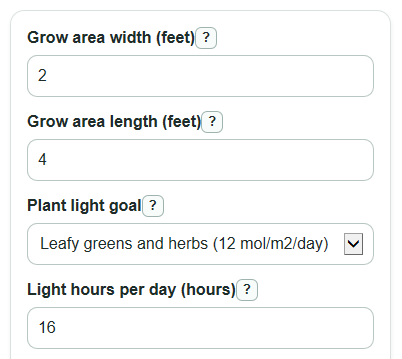
For a 2 ft by 4 ft canopy, the area is 8 ft2, or 0.74322432 m2. With a 12 mol/m2/day goal and 16 light hours per day, the target average PPFD is 12 / (16 * 0.0036) = 208.33 umol/m2/s. If 80 percent of the fixture light reaches the plants, the fixture must produce about 193.55 umol/s for that one area. With a 2.5 umol/J fixture, the estimate is 77.42 W. At 16 hours per day and $0.16 per kWh for 30 days, the light cost is about $5.95 per month.
Display choices
If Number display is Auto, the calculator uses plain numbers for values from 0.0001 up to less than 1000000 and scientific notation outside that range. Plain numbers and Scientific notation force the selected style.