
Convert hours to milliseconds, including decimal hours, with an exact result and an optional whole-millisecond value.
Advanced options
Table of contents
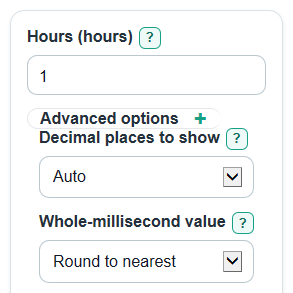
How to use our Hours to Milliseconds Converter
- Enter the time in the Hours field, such as 2, 1.5, or 0.0000001.
- Open Advanced options only if you want to change Decimal places to show or the Whole-millisecond value rounding rule.
- Select Calculate to see Milliseconds, plus Whole milliseconds if that option is turned on.
- Use Seconds as a quick check: hours should first turn into seconds, then into milliseconds.
- Sanity-check the size of the answer: 1 hour should equal 3,600,000 ms, so 0.5 hours should equal 1,800,000 ms and 2 hours should equal 7,200,000 ms.
Definitions
Hour: A time unit equal to 60 minutes, or 3,600 seconds.
Millisecond (ms): One thousandth of a second, so 1 second equals 1,000 milliseconds.
Decimal hours: Hours written with a decimal part, such as 1.5 hours for 1 hour and 30 minutes.
Whole milliseconds: A rounded integer number of milliseconds, useful when code, timers, or schedule tools do not accept decimals.
Rounding change: The signed difference between Whole milliseconds and the exact Milliseconds value. A negative value means rounding removed time.
Scientific notation: A compact number format like 3.6e6. This converter formats results with ordinary digits and comma separators instead.
Common mistakes and quick fixes
Mistake: Typing minutes into Hours , such as entering 30 for 30 minutes.
Fix: Convert minutes to hours first, so 30 minutes becomes 0.5 in Hours .
Mistake: Reading Milliseconds as seconds because the number is large.
Fix: Check Seconds ; 1 hour should show 3,600 seconds and 3,600,000 ms.
Mistake: Using Whole milliseconds when you need the exact decimal value.
Fix: Use Milliseconds for the exact converted value, and use Whole milliseconds only when a timer or code field needs a whole number.
Mistake: Setting Decimal places to show to 0 and thinking the exact value changed.
Fix: Keep Decimal places to show on Auto when you want readable precision without scientific notation.
Mistake: Choosing Whole-millisecond value as Round down when you meant the nearest millisecond.
Fix: Set Whole-millisecond value to Round to nearest for ordinary timer use, or choose Round up/down only when your system requires it.
Limitations & Key Assumptions / Boundary Conditions
- The converter treats 1 hour as exactly 3,600 seconds and 1 second as exactly 1,000 milliseconds.
- Negative Hours are allowed because negative time offsets can be useful in schedules, code, and time differences.
- Milliseconds is the exact converted value before any whole-millisecond rounding.
- Whole milliseconds is a separate rounded value. It should not replace the exact value unless your tool needs a whole number.
- Very tiny decimal-hour inputs can be less than 1 ms, so rounding may turn them into 0 ms or 1 ms depending on Whole-millisecond value.
- Very large values are limited by safe number display in the browser. If the input is too large to show reliably, enter a smaller number.
Methodology
Conversion used
The converter strips commas and spaces from Hours, then reads the value as a decimal number. It allows negative values and blocks blank or non-number entries.
milliseconds = hours x 3,600,000
seconds = hours x 3,600
The factor 3,600,000 comes from 3,600 seconds per hour times 1,000 milliseconds per second.
Whole-millisecond value
If Whole-millisecond value is turned on, the converter keeps the exact Milliseconds result and also makes a copy-ready whole-number version.
whole_milliseconds = round(milliseconds), floor(milliseconds), or ceil(milliseconds)
rounding_change = whole_milliseconds - milliseconds
A positive Rounding change means the whole-millisecond value added time. A negative change means it removed time.
Mini-example
For 1.5 hours, the milliseconds calculation is:
1.5 x 3,600,000 = 5,400,000 ms
The seconds check is:
1.5 x 3,600 = 5,400 s
For 0.0000001 hours, the exact result is 0.36 ms. Round to nearest gives 0 whole milliseconds, so the rounding change is -0.36 ms. Round up gives 1 whole millisecond, so the rounding change is 0.64 ms.