
Convert seconds to milliseconds, or milliseconds to seconds, with rounding control and an exact copy-ready result.
Advanced options
Table of contents
How to use our Seconds to Milliseconds Converter
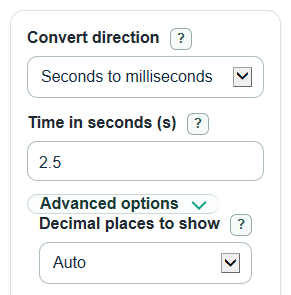
- Pick the Convert direction so the calculator knows which unit you are starting with.
- Enter the visible time value: Time in seconds (s) or Time in milliseconds (ms).
- Open Advanced options only if you need a fixed Decimal places to show or a specific How to round setting.
- Press Calculate, then use Converted time for the labeled answer or Copy-ready number when you need to paste only the number.
- Sanity-check the Math used: seconds to milliseconds should multiply by 1000, and milliseconds to seconds should divide by 1000.
Definitions
Second (s): A standard unit of time. In this converter, seconds are the starting unit for Time in seconds (s).
Millisecond (ms): One thousandth of a second. There are 1000 milliseconds in 1 second.
Converted time: The main answer after changing the time into the target unit chosen by Convert direction.
Exact converted value: The unrounded value from the conversion rule before Decimal places to show changes the display.
Copy-ready number: The converted number without unit text, so it can be pasted into code, a spreadsheet, homework, or notes.
Decimal places to show: The number of digits shown after the decimal point when you do not use Auto.
How to round: The rule used when Decimal places to show is set to a number, such as nearest, round down, or round up.
Common mistakes and quick fixes
Mistake: Leaving Convert direction on Seconds to milliseconds when your starting value is in milliseconds.
Fix: Change Convert direction to Milliseconds to seconds before entering Time in milliseconds (ms).
Mistake: Typing a negative value in Time in seconds (s) or Time in milliseconds (ms).
Fix: Use 0 or a positive duration, because this converter is for lengths of time, not signed time offsets.
Mistake: Comparing Converted time to Exact converted value without noticing Decimal places to show.
Fix: Set Decimal places to show to Auto if you want the displayed answer to stay as close to the exact conversion as practical.
Mistake: Using How to round while Decimal places to show is Auto and expecting it to change the result.
Fix: Choose 0, 1, 2, 3, 6, or 9 in Decimal places to show before using How to round.
Mistake: Copying Converted time with the unit when a form or spreadsheet needs only a plain number.
Fix: Use Copy-ready number for the number alone, then add the unit separately if needed.
Mistake: Multiplying by 1000 when Convert direction is Milliseconds to seconds.
Fix: Check Math used; milliseconds to seconds divides the Time in milliseconds (ms) value by 1000.
Limitations & Key Assumptions / Boundary Conditions
- The converter treats the entered value as a nonnegative time duration. It rejects negative values instead of treating them as time before or after an event.
- Only the visible time input is used. Time in seconds (s) is used for Seconds to milliseconds, and Time in milliseconds (ms) is used for Milliseconds to seconds.
- Decimal places to show changes the displayed Converted time and Copy-ready number, but Exact converted value keeps the unrounded conversion.
- How to round is ignored when Decimal places to show is Auto.
- Very large or very tiny decimal values can be limited by normal browser number precision after the text is parsed.
- This is a unit converter, not a stopwatch or date-time tool. It does not account for calendars, time zones, leap seconds, or event timestamps.
Methodology
Conversion rules
The calculator uses the fixed relationship between seconds and milliseconds: 1 second equals 1000 milliseconds, so 1 millisecond equals 0.001 seconds.
milliseconds = seconds * 1000
seconds = milliseconds / 1000
Convert direction decides which formula is used. If Convert direction is Seconds to milliseconds, the calculator reads Time in seconds (s). If Convert direction is Milliseconds to seconds, it reads Time in milliseconds (ms).
Rounding method
Exact converted value is calculated first. If Decimal places to show is Auto, the calculator displays the exact converted value in a readable decimal form when practical. If Decimal places to show is a number, the calculator applies How to round to the exact value.
shown_value = round_rule(exact_value, decimal_places)
For the nonnegative durations accepted by this converter, Round down moves toward 0, Round up moves away from 0, and Nearest uses the closest value at the selected number of decimal places. Converted time and Copy-ready number use the rounded display value. Exact converted value stays unrounded so you can see whether rounding changed the answer.
Worked example
If Time in seconds (s) is 0.1234567 and Convert direction is Seconds to milliseconds, the exact conversion is 0.1234567 * 1000 = 123.4567 ms.
123.4567 rounded to 2 decimal places = 123.46
In that example, Converted time is 123.46 ms when Decimal places to show is 2 and How to round is Nearest. Exact converted value is 123.4567 ms, and the Rounding note explains that the displayed value was rounded.