
Enter milliseconds to get the exact decimal seconds and a copy-ready hours, minutes, seconds, and milliseconds display.
This is the exact decimal conversion. Milliseconds are divided by 1,000.
This whole-millisecond value is used only for the elapsed-time display.
Table of contents
How to use our Milliseconds to Seconds Converter
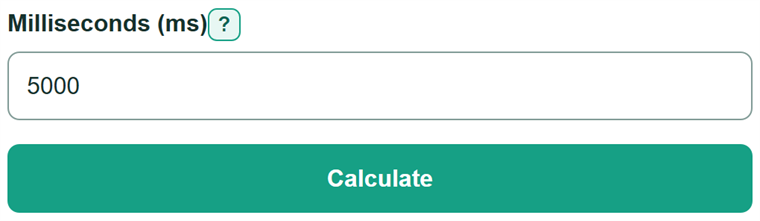
- Enter the duration in Milliseconds (ms). You can enter a decimal, commas such as 1,500, or an optional ms suffix.
- Click Calculate to see the exact decimal value in Seconds from milliseconds.
- Use Copy-ready elapsed time when you need the duration written as hours, minutes, seconds, and milliseconds in hh:mm:ss.fff form.
- If you entered part of a millisecond, compare Milliseconds used in elapsed display with your source. The elapsed-time display rounds to the nearest whole millisecond, while the seconds result keeps the exact entered value.
Definitions
Millisecond (ms): One thousandth of a second.
Second (s): A time unit equal to 1,000 milliseconds.
Decimal seconds: A duration written in seconds with a decimal point. For example, 1.5 s is one and one-half seconds.
hh:mm:ss.fff: An elapsed-time format for hours, minutes, seconds, and milliseconds. The fff part has three digits, so.073 means 73 milliseconds.
Nearest whole millisecond: The closest whole-millisecond value. For the elapsed-time display, a value ending in.5 ms rounds up.
Common mistakes and quick fixes
Mistake: Entering seconds in the Milliseconds (ms) field, such as 1.5 for a 1.5-second duration.
Fix: Enter 1,500 ms to convert 1.5 seconds.
Mistake: Using malformed commas such as 1,01.
Fix: Check Milliseconds (ms) and then recalculate. Use commas only as thousands separators, such as 1,500, or enter 1500 without commas.
Mistake: Reading 1.5005 seconds as 1 second and 5,005 milliseconds.
Fix: Check Milliseconds (ms) and then recalculate. Read it as a decimal: 1.5005 seconds equals 1,500.5 milliseconds.
Mistake: Treating the final three digits in the elapsed-time display as an unlabeled number.
Fix: Check Milliseconds (ms) and then recalculate. In 00:00:01.073, the.073 means 73 milliseconds.
Mistake: Expecting the elapsed-time display to keep part of a millisecond.
Fix: Use Seconds from milliseconds for the exact value. The elapsed-time display rounds to a whole millisecond.
Limitations & Key Assumptions / Boundary Conditions
- This converter accepts nonnegative elapsed durations only. Negative values are outside its input range.
- Seconds from milliseconds keeps the entered decimal value, but Copy-ready elapsed time rounds fractional milliseconds to the nearest whole millisecond.
- The elapsed-time display is a duration, not a clock time or date. It does not use time zones, daylight saving time, or calendar rules.
- Enter one plain decimal value in milliseconds. Scientific notation, ranges, formulas, other unit names, and malformed comma grouping are not accepted.
- Very large durations can have more than two hour digits. Minutes, seconds, and milliseconds remain padded to two, two, and three digits.
Methodology
Conversion calculation
One second contains exactly 1,000 milliseconds, so the converter divides the entered duration by 1,000. The decimal-seconds answer preserves the entered decimal precision without showing floating-point tails.
seconds = milliseconds / 1000
For example, 1,500.5 ms becomes 1.5005 s.
Elapsed-time display
The copy-ready display first rounds a nonnegative input to the nearest whole millisecond. A value with exactly half a millisecond rounds up. The converter then separates that whole value into hours, remaining minutes, remaining seconds, and remaining milliseconds.
rounded_milliseconds = floor(milliseconds + 0.5)
1 hour = 3,600,000 ms; 1 minute = 60,000 ms; 1 second = 1,000 ms
For example, 1,500.5 ms uses 1,501 ms for the formatted display, producing 00:00:01.501. Likewise, 59,999.6 ms rounds to 60,000 ms, so the display rolls over to 00:01:00.000. Zero is valid and converts to 0 s and 00:00:00.000.