
Enter a number of centuries to find the equivalent years, or switch directions to convert years into centuries.
Table of contents
How to use our Century to Years Calculator
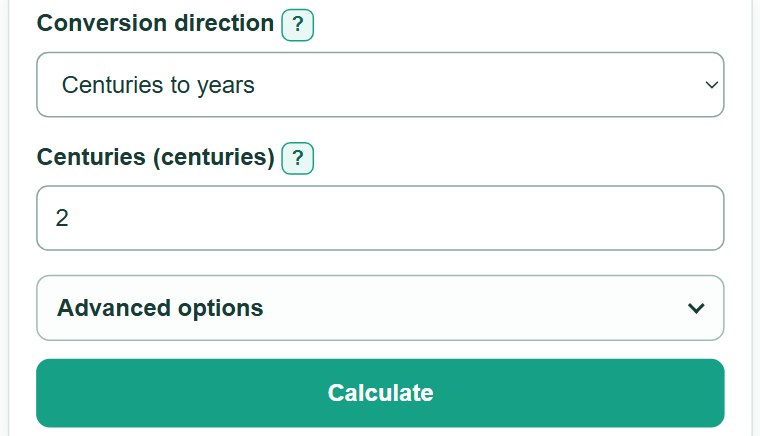
- Choose "Centuries to years" or "Years to centuries" under "Conversion direction."
- Enter one time amount in the active field. You can use a decimal such as 1.5.
- Open "Advanced options" only if you want to change "Result decimal places."
- Select "Calculate," then check that the answer unit matches your choice: years from centuries, or centuries from years.
Definitions
Century: A period of 100 years. [1]
Year: The time unit used as either the starting amount or converted amount.
Duration: An amount of time, such as 2 centuries or 250 years, rather than a specific calendar date.
Decimal places: The number of digits shown after the decimal point. This setting changes display rounding only.
Common mistakes and quick fixes
Mistake: Entering a calendar year, such as 1900, instead of a time amount.
Fix: Enter a duration such as 2 centuries or 250 years. This calculator does not identify a numbered calendar century.
Mistake: Assuming 1.5 centuries is not allowed.
Fix: Enter 1.5. A fractional century is valid and equals 150 years.
Mistake: Using a comma as a decimal mark, such as 1,5.
Fix: Use a decimal point: 1.5. Use commas only to group thousands, as in 1,000.
Mistake: Entering a negative time amount.
Fix: Enter 0 or a positive number. This calculator converts nonnegative durations only.
Mistake: Thinking a rounded display changes the conversion.
Fix: Change "Result decimal places" if needed. The calculator keeps the unrounded value before formatting the display.
Limitations & Key Assumptions / Boundary Conditions
- This calculator converts time amounts only; it does not identify which numbered century contains a calendar year.
- Enter one finite, nonnegative number. Negative values, lists, formulas, and malformed comma grouping are not accepted.
- You may add a matching unit suffix, such as "c," "centuries," "yr," or "years." A suffix for the other unit is not accepted.
- The selected decimal places can round a fractional display, while the conversion remains based on 1 century = 100 years.
Methodology
Conversion rule
A century is 100 years. To convert centuries to years, multiply by 100. To convert years to centuries, divide by 100. [1]
years = centuries × 100
centuries = years / 100
Worked example
For 1.5 centuries, calculate 1.5 × 100 = 150 years. For 250 years, calculate 250 / 100 = 2.5 centuries.
Calculation choices
The calculator keeps the unrounded conversion value and applies "Result decimal places" only when showing the answer. Zero is valid: 0 centuries equals 0 years, and 0 years equals 0 centuries. This method is for nonnegative time amounts, not calendar-century numbering.