
Convert decades to years or years to decades fast, including decimal values and a plain-English explanation of the result.
Advanced options
Table of contents
How to use our Decades to Years Calculator
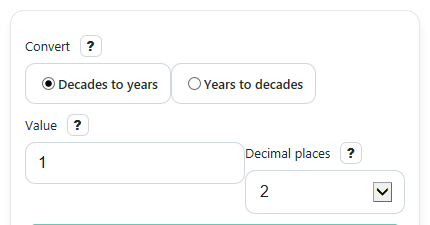
- Choose a direction under Convert: Decades to years or Years to decades.
- Enter your number in Value. You can use whole numbers, decimals, 0, or even a negative value if you mean a signed time offset.
- Pick how many digits to show with Decimal places.
- Click Calculate to see Converted value, What this means, and Rule used.
- Sanity-check the answer: if you convert decades to years, the number should become 10 times larger; if you convert years to decades, the number should become 10 times smaller.
Definitions
Decade: A time span of 10 years.
Year: A 12-month time unit used as the base unit in this converter.
Convert: The direction of the calculation, either from decades to years or from years to decades.
Value: The number you type in before conversion. It can be a whole number or a decimal.
Decimal places: How many digits appear after the decimal point in Converted value.
Converted value: The main numerical answer in the target unit.
Rule used: The fixed conversion relationship applied to your input, either multiply by 10 or divide by 10.
Common mistakes and quick fixes
Mistake: Picking the wrong option under Convert , such as using Years to decades when you meant the reverse.
Fix: Check the direction first, then recalculate so Converted value ends in the unit you want.
Mistake: Leaving Value blank or typing text instead of a real number.
Fix: Enter a numeric Value like 3, 2.5, or 0 before clicking Calculate .
Mistake: Reading a rounded display as if it were the exact answer.
Fix: If needed, increase Decimal places to see a more detailed Converted value .
Mistake: Confusing a plain 10-year span with a named decade like the 1990s when reading What this means .
Fix: Treat this tool as a length-of-time converter: one decade here means any span of 10 years, not a specific calendar nickname.
Mistake: Thinking a negative Value is always wrong.
Fix: Negative input is allowed in the math, but for ordinary elapsed time most users should enter a non-negative Value .
Limitations & Key Assumptions / Boundary Conditions
- This calculator uses the fixed relationship 1 decade = 10 years, so it is for unit conversion only.
- It treats a decade as a generic 10-year span, not as a named calendar decade such as the 1990s.
- Rounding depends on Decimal places, so the displayed Converted value may be shorter than the exact decimal.
- Negative inputs are mathematically valid as signed offsets, but many real-life elapsed-time questions use only non-negative values.
- Very large numbers can be converted, but readability depends on screen space and chosen precision.
Methodology
Conversion rule
This calculator uses one fixed fact: 1 decade equals 10 years.
years = decades * 10
decades = years / 10
How the result is produced
If Convert is set to Decades to years, the entered Value is multiplied by 10.
If Convert is set to Years to decades, the entered Value is divided by 10.
The calculator then rounds the displayed answer to the selected Decimal places. The plain-English line restates the same answer in words so it is easier to read.
Mini example
If you enter 2.5 with Convert set to Decades to years, the result is:
years = 2.5 * 10 = 25
If you enter 15 with Convert set to Years to decades, the result is:
decades = 15 / 10 = 1.5
Assumptions and limits
This method assumes decade always means exactly 10 years. It does not interpret named calendar decades, and it does not add any calendar context such as start dates or end dates.