
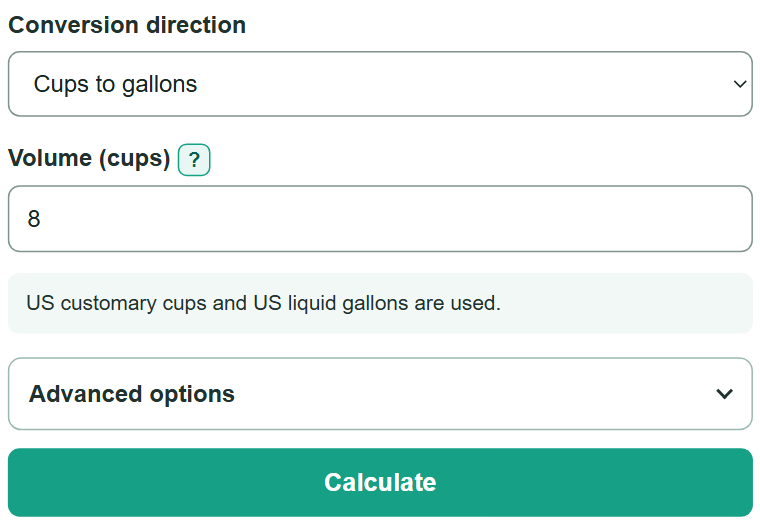
Enter cups to convert them to US liquid gallons, or switch directions to find how many cups are in a gallon amount.
Advanced options
Table of contents
How to use our Cups to Gallons Converter
- Choose "Cups to gallons" or "Gallons to cups" based on the unit you have.
- Enter one zero-or-positive volume in the field that appears. You can type a matching suffix, such as "8 cups" or "0.5 gal."
- Select "Calculate" to see the matching volume first, followed by milliliters and US liquid quarts.
- Open "Advanced options" only when your source specifically identifies a metric cup or a US food-label cup, or when you need a different number of decimal places.
- Check a familiar US customary value: 4 cups equals 1/4 gallon, 8 cups equals 1/2 gallon, and 16 cups equals 1 gallon.
Definitions
US liquid gallon: A US volume unit equal to 4 US liquid quarts and 16 US customary cups. [1]
US customary cup: The usual US recipe measure. Sixteen US customary cups equal 1 US liquid gallon. [1]
Metric cup: A cup measure equal to 250 milliliters (mL).
US food-label cup: A 240 mL household measure used for US food-label metric equivalents. [2]
Milliliter (mL): A metric unit for volume. The calculator shows mL so you can check the physical volume behind the conversion.
US liquid quart: A US volume unit equal to one-fourth of a US liquid gallon. [1]
Common mistakes and quick fixes
Mistake: Treating 4 cups as 1 gallon.
Fix: In US customary volume, 4 cups equal 1 quart. It takes 16 cups to make 1 US liquid gallon.
Mistake: Using a metric cup when the source means a US customary cup.
Fix: Keep "US customary cup" selected unless the recipe, package, or measuring tool names a different cup definition.
Mistake: Entering an imperial gallon or a US dry gallon.
Fix: This converter uses US liquid gallons. Convert another gallon type to US liquid gallons before entering it.
Mistake: Typing "8 gal" in the cups field.
Fix: Select "Gallons to cups" and enter the amount in "Volume (US liquid gallons)."
Mistake: Confusing fluid ounces with ounces by weight.
Fix: Cups and gallons measure volume. Weight ounces need the ingredient's density before they can be related to volume.
Limitations & Key Assumptions / Boundary Conditions
- Every gallon result is a US liquid gallon, not an imperial gallon or a US dry gallon.
- The selected cup definition changes the conversion. Choose the 250 mL metric or 240 mL food-label setting only when the source states that definition.
- This calculator converts volume, not weight. Cups cannot be converted to ounces by weight without the density of the material.
- Changing decimal places changes displayed rounding only; the conversion uses the unrounded value.
- A very small nonzero volume can round to zero at low precision. Increase "Result decimal places" to view more detail.
Methodology
Conversion method
The calculator converts the active input to milliliters, then expresses that same volume as US liquid gallons, selected cups, and US liquid quarts. A US customary cup is one-sixteenth of a US liquid gallon, or 236.5882365 mL when a US liquid gallon is 3785.411784 mL. [1]
US liquid gallons = cups x selected cup volume in mL / 3785.411784
selected cups = US liquid gallons x 3785.411784 / selected cup volume in mL
milliliters = cups x selected cup volume in mL
US liquid quarts = milliliters / 946.352946
Worked example
With "US customary cup" selected, 8 cups x 236.5882365 mL per cup = 1892.705892 mL. Dividing by 3785.411784 mL per US liquid gallon gives 0.5 US liquid gallon. That volume is also 2 US liquid quarts.
Calculation boundaries
The cup selector uses 236.5882365 mL for a US customary cup, 250 mL for a metric cup, and 240 mL for a US food-label cup. The 240 mL food-label measure follows FDA household-measure guidance. [2] Zero is a valid volume and converts to zero. Negative volumes, multiple numbers, and mismatched unit suffixes are rejected.