
Convert cups to milliliters or milliliters to cups, and choose the cup size that matches your recipe, label, or measuring tool.
Advanced options
Table of contents
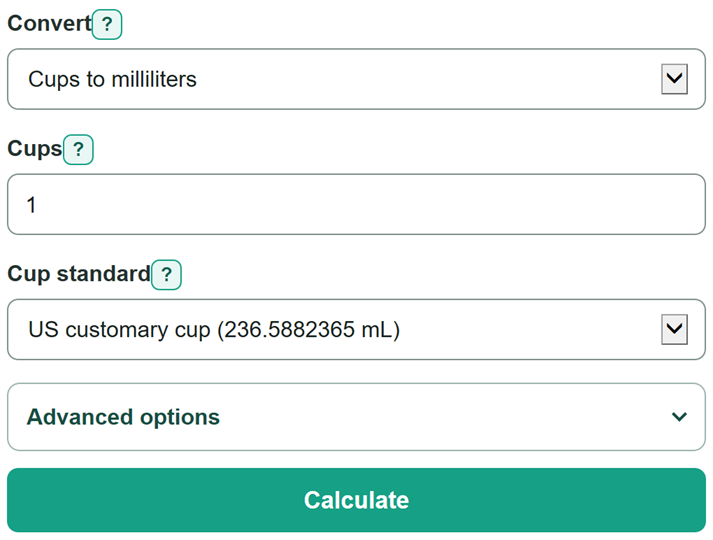
How to use our Cups to mL Converter
- Choose the conversion direction shown on your recipe or container: cups to milliliters or milliliters to cups.
- Enter the source amount. For cups, you can use a whole number, decimal, fraction such as 2/3, or mixed fraction such as 1 1/2.
- Choose the cup standard that matches the source. US customary is used by most US recipes; metric and imperial recipes may use a different cup size.
- Select Calculate. Use the first result as your converted volume, then check the selected cup size shown underneath.
- If your jug or measuring cup has wide markings, open Advanced options and choose fewer result decimal places so you do not measure more precisely than your tool allows.
Definitions
Cup standard: The definition of one cup used by a recipe, label, or measuring tool. Cup sizes are not the same in every context.
US customary cup: The cup used in most US recipes. This calculator uses 236.5882365 mL per cup.
US legal cup: A 240 mL cup used in some US package-label contexts.
Metric cup: A 250 mL cup used in many recipes written with metric cooking measures.
Imperial cup: A 284.130625 mL cup used in some older imperial-measure sources.
Milliliter (mL): A unit of volume. It is not a fixed weight in grams because different ingredients have different densities. [1]
Common mistakes and quick fixes
Mistake: Leaving US customary selected for a metric or imperial recipe.
Fix: Check Convert and then recalculate. Check the recipe origin or notes and choose the matching cup standard before calculating.
Mistake: Entering more than one cup amount, such as "1 1/2 3".
Fix: Check Convert and then recalculate. Enter one amount only, such as 1 1/2, 1.5, or 3/2.
Mistake: Using a fraction with zero after the slash, such as 1/0.
Fix: Check Convert and then recalculate. Use a denominator greater than zero, such as 1/2 or 2/3.
Mistake: Treating milliliters as grams.
Fix: Check Convert and then recalculate. Use this calculator for volume only. The weight in grams depends on the ingredient and how it is measured.
Mistake: Measuring a long decimal result with a jug marked in large steps.
Fix: Check Convert and then recalculate. Set result decimal places to match the smallest marking you can reliably measure.
Limitations & Key Assumptions / Boundary Conditions
- This calculator converts volume only. It does not convert cups or mL into grams, ounces by weight, or another ingredient weight.
- The answer depends on the selected cup standard. Check the recipe, label, or measuring tool instead of assuming every cup is 240 mL or 250 mL.
- Result decimal places change only the displayed rounding. The calculator uses the full cup factor before rounding.
- A kitchen measuring tool may not be accurate enough to use every displayed decimal place, especially for small volumes.
- Only nonnegative amounts are accepted. Empty entries, incomplete fractions, and fractions with a zero denominator cannot be converted.
Methodology
Conversion method
The calculator selects the milliliters-per-cup factor for the chosen cup standard. It multiplies cups by that factor for cups-to-mL conversion, or divides milliliters by it for the reverse conversion. The US customary factor remains 236.5882365 mL per cup during the calculation. NIST also gives 240 mL per cup as a practical rounded cooking equivalent. [2]
mL = cups × selected mL per cup
cups = mL ÷ selected mL per cup
Worked example
For 1 1/2 US customary cups, the fraction becomes 1.5 and the selected factor is 236.5882365 mL per cup.
mL = 1.5 × 236.5882365 = 354.88235475
With result decimal places set to 2, the displayed answer is 354.88 mL. Rounding happens after the conversion, not before it.