
Convert milliliters to cups, tablespoons, and teaspoons with a practical measuring split for recipes.
Advanced options
Table of contents
How to use our mL to Cups and Tablespoons Converter
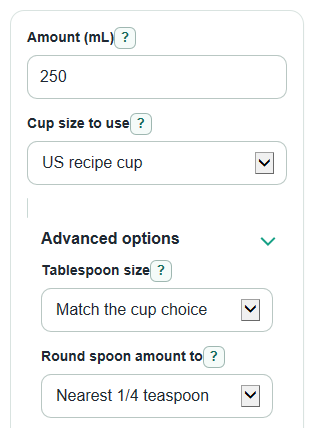
- Enter the recipe volume in Amount (mL); commas and spaces are okay, but do not enter grams.
- Choose Cup size to use: US recipe cup for most US recipes, US label cup for nutrition-label style amounts, or Metric cup for metric recipes.
- Open Advanced options only if you need to change Tablespoon size or how the spoon part is rounded in Round spoon amount to.
- Select Calculate, then read the easy measure from cups to tablespoons to teaspoons.
- Sanity-check the result by looking at Rounding change; a small value near 0 mL means the rounded spoon measure stayed close to the original mL amount.
Definitions
Amount (mL): The liquid volume from the recipe, measured in milliliters.
Cup size to use: The cup standard used for the conversion. In this converter, a US recipe cup is 236.5882365 mL, a US label cup is 240 mL, and a metric cup is 250 mL.
Tablespoon size: The tablespoon standard used for spoon results. The converter can use a US recipe tablespoon of 14.78676478125 mL or a metric or label tablespoon of 15 mL.
Teaspoon: One third of the selected tablespoon size in this converter.
Easy measure: A kitchen-friendly split into whole cups, tablespoons, and teaspoons, designed to match measuring cups and spoons.
Rounding change: The rounded easy measure minus the original Amount (mL). Positive means a little more volume; negative means a little less.
Common mistakes and quick fixes
Mistake: Typing a weight into Amount (mL) , such as 250 g.
Fix: Use Amount (mL) only for liquid volume from the recipe, not grams or ounces by weight.
Mistake: Leaving Amount (mL) blank or adding words like mL in the box.
Fix: Enter numbers only in Amount (mL) , such as 250 or 1,000.
Mistake: Using the wrong Cup size to use for the recipe source.
Fix: Use US recipe cup for most US cookbooks, US label cup for nutrition-label style measures, or Metric cup for 250 mL cup recipes.
Mistake: Ignoring Tablespoon size when your spoon set is marked 15 mL.
Fix: Set Tablespoon size to Metric or label tablespoon if you want 15 mL tablespoons.
Mistake: Reading Exact amount in cups as the same thing as the easy measuring split.
Fix: Use Easy measure: cups , Easy measure: tablespoons , and Easy measure: teaspoons together when measuring with kitchen tools.
Mistake: Treating a negative Rounding change as an error.
Fix: Negative means the rounded easy measure is slightly smaller than the entered mL amount; choose a finer Round spoon amount to setting if you need it closer.
Limitations & Key Assumptions / Boundary Conditions
- This is a volume converter. It does not convert grams to mL because weight-to-volume conversion depends on the ingredient.
- Cup and spoon sizes are not universal. Results change when you switch Cup size to use or Tablespoon size.
- The easy measuring split rounds only the leftover spoon amount, based on Round spoon amount to. The exact cup, tablespoon, and teaspoon totals are calculated before display rounding.
- Very small rounding differences can appear because decimal numbers cannot always store cup and spoon constants perfectly.
- For baking, a small mL difference can matter more for strong ingredients like salt, yeast, extracts, or leaveners than for water or broth.
- Real measuring cups and spoons can vary, and the way you fill them can change the actual volume.
Methodology
Unit choices
The converter first chooses the cup size from Cup size to use. It uses 236.5882365 mL for a US recipe cup, 240 mL for a US label cup, and 250 mL for a metric cup. It then chooses the tablespoon size from Tablespoon size. If the setting is Match the cup choice, US recipe cup uses 14.78676478125 mL per tablespoon, while US label cup and metric cup use 15 mL per tablespoon. A tablespoon is commonly used as a cooking measure of about 15 milliliters [2].
decimal_cups = amount_ml / cup_ml
total_tablespoons = amount_ml / tbsp_ml
tsp_ml = tbsp_ml / 3
total_teaspoons = amount_ml / tsp_ml
Easy measuring split
The easy split starts with as many whole cups as fit in the entered amount. The leftover mL is converted to teaspoons, then rounded only if Round spoon amount to is set to 1/4 teaspoon, 1/2 teaspoon, or 1 teaspoon. After rounding, every 3 teaspoons becomes 1 tablespoon.
whole_cups = floor(amount_ml / cup_ml)
remaining_ml = amount_ml - whole_cups * cup_ml
remaining_tsp_exact = remaining_ml / tsp_ml
rounded_remaining_tsp = round(remaining_tsp_exact / round_step_tsp) * round_step_tsp
tablespoons_part = floor(rounded_remaining_tsp / 3)
teaspoons_part = rounded_remaining_tsp - tablespoons_part * 3
If rounding pushes the leftover spoon amount to a full cup or more, the converter adds 1 to the whole-cup count and subtracts one cup worth of teaspoons from the leftover spoon amount.
Rounding change
The rounding change shows how close the easy measure is to the original amount. It is signed, so a negative value means the easy measure is slightly under the entered amount.
rounded_total_ml = whole_cups * cup_ml + (tablespoons_part * 3 + teaspoons_part) * tsp_ml
rounding_error_ml = rounded_total_ml - amount_ml
Mini-example
For 250 mL using a US recipe cup, matched US recipe tablespoons, and nearest 1/4 teaspoon rounding, the converter finds 1 whole cup. The leftover is about 13.4118 mL, which is about 2.7203 teaspoons. Rounded to the nearest 1/4 teaspoon, that becomes 2.75 teaspoons. The easy measure is 1 cup, 0 tablespoons, and 2.75 teaspoons, with a rounding change of about +0.143 mL.