
Convert cups to milliliters and liters using the cup size your recipe expects.
Table of contents
How to use our Cups to mL and Liters Converter
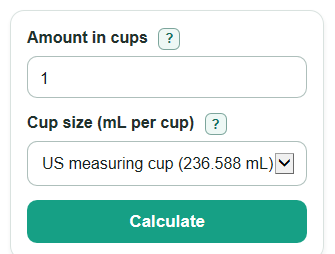
- Enter the Amount in cups as a whole number, decimal, fraction, or mixed number, such as 1, 1.5, 3/4, or 2 1/4.
- Choose the Cup size that matches your recipe: US measuring cup, US rounded cup, or metric cup.
- Select Calculate to see Milliliters, Liters, Nearest measuring amount, and Cup size used.
- Sanity-check the answer by confirming that Cup size used matches the recipe source, especially for non-US recipes.
Definitions
Amount in cups: The recipe volume you want to convert. It can be a decimal, a simple fraction, or a mixed number.
Fraction: A number written as one number over another, such as 3/4. In this converter, the bottom number must be greater than 0.
Cup size: The number of milliliters counted as 1 cup. This matters because US and metric recipes can use different cup sizes.
Milliliters (mL): A small metric volume unit often printed on measuring jugs and liquid measuring cups.
Liters (L): A larger metric volume unit. There are 1000 mL in 1 L.
Nearest measuring amount: The milliliter answer rounded to a practical amount for kitchen measuring.
Common mistakes and quick fixes
Mistake: Leaving Amount in cups blank.
Fix: Enter a value such as 1, 1.5, 3/4, or 2 1/4.
Mistake: Typing a bad fraction in Amount in cups , such as 1/0 or 1//2.
Fix: Use one slash only, and make the bottom number greater than 0.
Mistake: Choosing the wrong Cup size for the recipe.
Fix: Use US measuring cup for many US recipes, US rounded cup when the recipe says 240 mL, and metric cup when the recipe says 250 mL.
Mistake: Copying Nearest measuring amount when the recipe needs an exact lab-style value.
Fix: Use Milliliters for the more exact converted amount.
Mistake: Reading Liters as milliliters for small amounts.
Fix: For everyday recipe steps, use Milliliters unless the amount is large enough that liters are easier to read.
Limitations & Key Assumptions / Boundary Conditions
- This converter changes volume only. It does not convert cups of flour, sugar, butter, or other ingredients into grams or ounces by weight.
- The answer depends on the selected Cup size. A US measuring cup, a rounded 240 mL cup, and a 250 mL metric cup give different results.
- Nearest measuring amount is rounded for practical measuring. Use Milliliters when you need the more exact calculated value.
- Very tiny amounts may be more precise than common kitchen tools can measure, even when the math is correct.
- Negative cup amounts are not allowed because recipe volume cannot be negative.
Methodology
How the converter reads the cup amount
The converter accepts whole numbers, decimals, simple fractions, and mixed numbers. For a mixed number, it adds the whole number to the fraction part.
cups = whole + numerator / denominator
For example, 2 1/4 cups is read as 2 + 1 / 4, which equals 2.25 cups. A fraction with a bottom number of 0 is rejected because division by 0 is not valid.
Conversion math
The selected Cup size supplies the milliliters per cup: 236.5882365 for a US measuring cup, 240 for a US rounded cup, or 250 for a metric cup.
milliliters = cups * cup_size_ml
liters = milliliters / 1000
The liters step uses the calculated milliliters before display rounding, so small rounding changes do not build up.
Practical measuring amount
The exact milliliter result is also turned into a kitchen-friendly measuring amount.
rounded_measuring_ml = if milliliters < 10 then round(milliliters * 10) / 10 else round(milliliters)
This keeps one decimal place for very small amounts under 10 mL and rounds larger amounts to the nearest whole mL.
Mini example
If Amount in cups is 1 1/3 and Cup size is US rounded cup, the cup amount is 1 + 1 / 3 = 1.333333 cups.
milliliters = 1.333333 * 240 = 320 mL
liters = 320 / 1000 = 0.32 L
rounded_measuring_ml = 320 mL