
Enter tablespoons from your recipe, choose its regional spoon standard, and calculate the matching amount in milliliters.
Advanced options
This conversion assumes a level measuring spoon. Do not use kitchen spoons to measure medicine. Follow the medicine label and use an appropriately marked dosing device.
Table of contents
How to use our Tablespoons to mL Converter
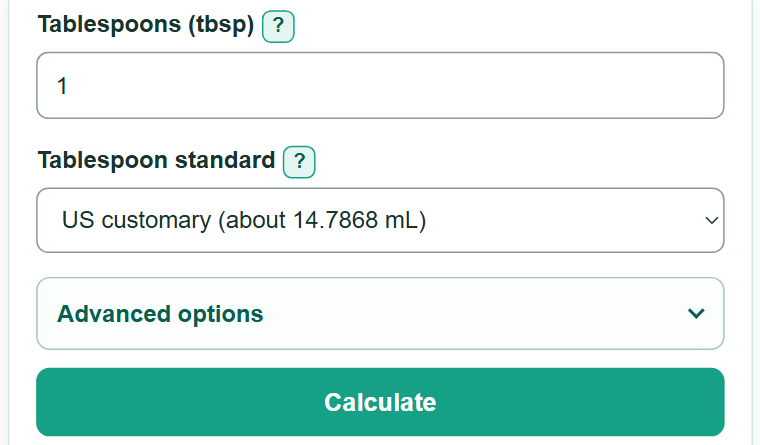
- Enter one tablespoon amount from the recipe, such as 2.5. You may also type a matching suffix, such as "2.5 tbsp".
- Choose the tablespoon standard from the recipe country, cookbook notes, or measuring-spoon label.
- Click "Calculate" to see the converted volume in milliliters and the factor used.
- Check the "Conversion used" result before measuring. Australian tablespoons are 20 mL, so they give a different answer from US customary or 15 mL metric tablespoons.
Definitions
Tablespoon (tbsp): A cooking volume measure. Its volume depends on the regional standard used by the recipe.
Milliliter (mL): A metric unit of volume equal to one thousandth of a liter.
US customary tablespoon: A tablespoon equal to about 14.7868 mL.
Metric recipe spoon: A recipe tablespoon measure equal to 15 mL. [1]
Australian tablespoon: A tablespoon measure equal to 20 mL. [2]
Level spoon: A measuring spoon filled to its rim and leveled off, with no rounded heap above the edge.
Common mistakes and quick fixes
Mistake: Assuming every tablespoon equals 15 mL.
Fix: Choose the recipe's standard. An Australian tablespoon is 20 mL, while a US customary tablespoon is about 14.7868 mL.
Mistake: Entering a range such as "1-2" instead of one amount.
Fix: Enter the exact amount the recipe calls for, or convert each amount separately.
Mistake: Using a comma as a decimal mark, such as "1,5".
Fix: Use a decimal point for decimals: enter "1.5". Use commas only for thousands groups, such as "1,000".
Mistake: Measuring a rounded or heaped spoonful after converting a level tablespoon.
Fix: Fill the measuring spoon to the rim and level it off. A heap does not have one fixed volume.
Mistake: Using a cooking spoon conversion to measure medicine.
Fix: Follow the medicine label and use a dosing device marked for the prescribed amount.
Limitations & Key Assumptions / Boundary Conditions
- This converts volume, not weight. Equal volumes of flour, sugar, oil, and other ingredients can have different weights.
- The selected tablespoon standard must match the recipe or measuring spoon. A different standard gives a different milliliter amount.
- The calculation assumes a level measuring spoon. Rounded or heaped spoonfuls do not have a fixed volume.
- Changing displayed decimal places changes screen rounding only. The calculation uses the full selected conversion factor.
- This tool is for recipe amounts, not medication dosing. Follow the medicine label and use a marked dosing device.
Methodology
Calculation
The converter selects the milliliters in one tablespoon from the chosen standard, then multiplies that factor by the entered tablespoon amount. It uses about 14.7868 mL for a US customary tablespoon, 15 mL for a metric recipe spoon, and 20 mL for an Australian tablespoon. [1] [2]
milliliters = tablespoons x milliliters per tablespoon
Worked example
For 2 metric recipe tablespoons, the factor is 15 mL per tablespoon.
milliliters = 2 x 15 mL = 30 mL
Rounding
The converter multiplies first and rounds only the displayed result. Extra decimal places can help with a worksheet, but kitchen tools may not measure very small differences.
Assumptions and limits
The result assumes a level measuring spoon and the selected regional standard. It does not convert volume to ingredient weight, and it is not medication-dosing guidance.