
Convert milliliters to tablespoons using either US or metric spoon sizes, with decimal and kitchen-friendly fraction results.
Table of contents
How to use our mL to Tablespoons Converter
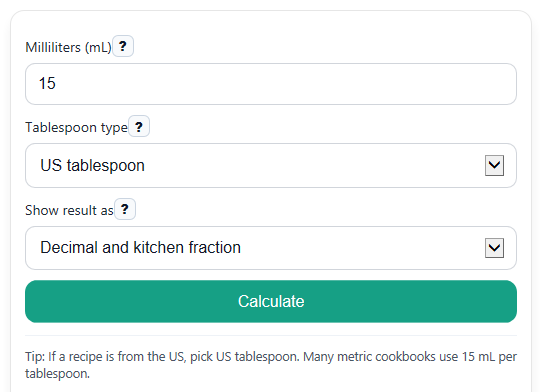
- Enter the amount in Milliliters (mL).
- Pick the correct Tablespoon type for your recipe or instructions: US tablespoon or Metric tablespoon.
- Choose Show result as if you want a decimal, a kitchen-style fraction, or both.
- Click Calculate to see Tablespoons, the Kitchen-friendly amount when selected, and the note for Difference if you used the other tablespoon type.
- Sanity-check the answer: 15 mL should be exactly 1 metric tablespoon, while 15 mL is slightly more than 1 US tablespoon.
Definitions
Milliliter (mL): A metric unit of liquid volume. 1 mL is 0.001 liter.
Tablespoon (tbsp): A larger spoon-based volume unit used in cooking and measuring liquids.
US tablespoon: A US customary tablespoon equal to 14.78676478125 mL.
Metric tablespoon: A kitchen tablespoon set to 15 mL [1].
Kitchen-friendly amount: A rounded fraction such as 1/2 tbsp or 2 tbsp that is easier to use in recipes.
Difference if you used the other tablespoon type: The signed change between the selected result and the result from the other tablespoon standard. A positive value means your selected-standard answer is larger.
Common mistakes and quick fixes
Mistake: Entering cups or teaspoons into Milliliters (mL) instead of actual mL.
Fix: Convert your amount to milliliters first, then enter that number in Milliliters (mL) .
Mistake: Leaving Tablespoon type on US when the recipe uses metric spoons.
Fix: Check the source of the recipe and switch Tablespoon type to Metric tablespoon if needed.
Mistake: Using Kitchen-friendly amount for medicine-style measuring where exact amounts matter more.
Fix: Set Show result as to Decimal only and use the Tablespoons value.
Mistake: Thinking the note in Difference if you used the other tablespoon type is an error.
Fix: Read it as a comparison that shows how much the answer changes if the recipe uses the other spoon standard.
Mistake: Typing a blank, negative, or non-numeric value into Milliliters (mL) .
Fix: Enter a real number that is 0 or greater, such as 7.5, 15, or 30.
Limitations & Key Assumptions / Boundary Conditions
- This converter assumes the input is a liquid volume entered in Milliliters (mL) and requires mL to be 0 or greater.
- The result depends on the chosen Tablespoon type. US tablespoon and metric tablespoon are close, but not identical.
- Kitchen-friendly amount is rounded for convenience, so it may not exactly match the decimal Tablespoons value.
- Very small amounts may round to 0 in fraction form even when the decimal result is not 0.
- This tool converts volume only. It does not convert weight, density, or ingredient-specific packing differences.
- If a recipe does not say which spoon standard it uses, real-world measuring may differ slightly from the displayed result.
Methodology
Conversion method
This calculator converts the entered Milliliters (mL) into tablespoons using the spoon standard you choose. The math changes only with Tablespoon type.
tbsp_us = mL / 14.78676478125
tbsp_metric = mL / 15
If you pick US tablespoon, the calculator divides by 14.78676478125. If you pick Metric tablespoon, it divides by 15 [1].
Difference note
The comparison note shows how much the answer changes if the other tablespoon standard were used instead.
difference = selected_result - other_result
A positive difference means the selected-standard result is larger. A negative difference means it is smaller.
Kitchen fraction rounding
When fraction output is requested, the calculator tries to show a simple cooking-style fraction such as 1/4, 1/3, 1/2, 2/3, or 3/4 tablespoon when the decimal value is close enough. If no simple fraction is a good match, it falls back to decimal text so the result is not misleading.
Mini example
Example: convert 30 mL using US tablespoon.
tbsp_us = 30 / 14.78676478125 = 2.0288413622
So the decimal result is about 2.0288 tbsp, and the kitchen-style result may be shown as about 2 tbsp if fraction rounding is selected.
Assumptions used
This tool assumes standard tablespoon sizes, not the exact size of a spoon in your drawer. Recipe results can differ slightly if a source uses a different measuring standard or if you round to a simple fraction for convenience.