
Convert gallons to liters fast, choose US liquid or Imperial gallons clearly, and compare both results so you do not mix them up.
Table of contents
How to use our Gallons to Liters Converter
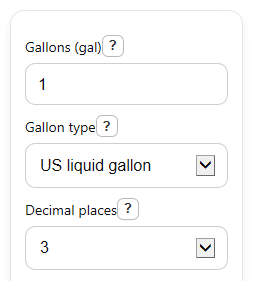
- Enter the amount in Gallons (gal). You can use whole numbers or decimals.
- Choose the correct Gallon type. Use US liquid gallon for most US fuel, water, and container amounts, and Imperial gallon for some UK-related amounts.
- Pick Decimal places if you want a shorter estimate or a more detailed display.
- Click Calculate to see Liters, the Same amount in the other gallon system, the Conversion factor used, and the Formula used.
- Sanity-check the result by comparing the two liter answers. If the selected Liters value looks too high or too low for your situation, recheck Gallon type first.
Definitions
Gallons (gal): The volume amount you enter before conversion.
Gallon type: The gallon definition used for the math. The two choices here are US liquid gallon and Imperial gallon.
US liquid gallon: The common gallon used in the United States for liquids such as gasoline and water.
Imperial gallon: A larger gallon used in some UK-related measurements.
Liters (L): A metric unit of volume. One liter equals one cubic decimeter.
Conversion factor used: The number of liters in one gallon for the selected gallon type.
Formula used: The plain-language rule for the conversion, which is liters equals gallons times the selected factor.
Decimal places: How many digits appear after the decimal point in the displayed answer.
Common mistakes and quick fixes
Mistake: Leaving Gallons (gal) blank.
Fix: Enter a number in Gallons (gal) , such as 1, 2.5, or 10.
Mistake: Typing words or symbols into Gallons (gal) , like ten gallons.
Fix: Use numbers only in Gallons (gal) . Decimals are fine.
Mistake: Choosing the wrong Gallon type and getting a larger or smaller Liters answer than expected.
Fix: Check whether your source uses US liquid gallon or Imperial gallon , then compare it with Same amount in the other gallon system .
Mistake: Entering a negative value in Gallons (gal) .
Fix: Use 0 or a positive number. This converter is for volume amounts, so negative gallons are not allowed.
Mistake: Thinking Decimal places changes the actual conversion.
Fix: Decimal places only changes how the answer is shown. The internal math still uses the full conversion factor in Conversion factor used .
Mistake: Reading only Formula used and missing the unit difference.
Fix: Check both Formula used and Conversion factor used so you know which gallon definition was applied.
Limitations & Key Assumptions / Boundary Conditions
- This converter only converts from gallons to liters, not from liters back to gallons.
- You must choose the correct Gallon type. US liquid and Imperial gallons are different sizes, so the answers are different.
- The tool is for liquid-volume unit conversion only. It does not adjust for temperature, pressure, density, or what substance is in the container.
- Negative values are blocked because they are not meaningful for a physical volume in this converter.
- Decimal places changes display rounding only. It does not change the internal conversion factor.
- Very large inputs are supported, but rounded display may hide tiny differences beyond the selected number of decimal places.
Methodology
How the converter works
The calculator multiplies your entered Gallons value by the liters-per-gallon factor for the selected Gallon type.
Liters = Gallons x 3.785411784
Use that formula when Gallon type is US liquid gallon.
Liters = Gallons x 4.54609
Use that formula when Gallon type is Imperial gallon.
Same amount in the other gallon system = Gallons x other factor
This comparison uses the same entered gallon amount, but swaps in the other gallon definition so you can catch mix-ups quickly.
Worked mini-example
If you enter 10 for Gallons (gal) and choose US liquid gallon, the main calculation is:
Liters = 10 x 3.785411784 = 37.85411784 L
If Decimal places is set to 2, the displayed Liters result becomes 37.85 L.
The side-by-side check uses the Imperial factor on the same 10 gallons:
Comparison = 10 x 4.54609 = 45.4609 L
That large difference is exactly why choosing the right Gallon type matters.
Display and rounding
The converter keeps the full internal factor for the math, then rounds only the displayed result to the selected Decimal places. The Conversion factor used shows the factor behind the answer.
Assumptions used
This method assumes your starting value is already in either US liquid gallons or Imperial gallons and that you only need a unit conversion. It does not account for measurement errors, tank shape, fill level, or real-world conditions that can affect how a volume was measured.