
Enter a Celsius temperature to find its Fahrenheit equivalent, or convert the size of a Celsius temperature rise or drop.
Advanced options
Table of contents
How to use our Celsius to Fahrenheit Converter
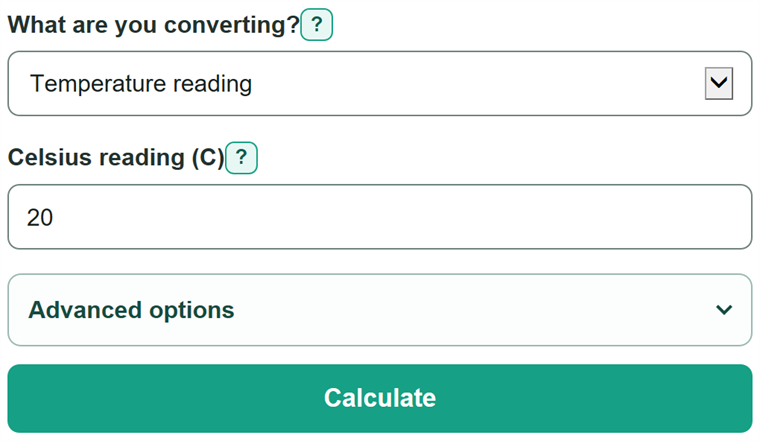
- Choose "Temperature reading" for an actual temperature from a thermometer, forecast, setting, or school problem.
- Choose "Temperature change" only for the size of a rise, drop, or interval.
- Enter one signed Celsius number, such as 20, -5.5, or 1e-7, then click "Calculate."
- Check the worked calculation: a 10 C degree change should be 18 F degrees, while a 10 C reading should be 50 F.
Definitions
Celsius reading (C): An actual temperature at one moment, such as a weather reading or appliance setting.
Fahrenheit temperature (F): The same actual temperature expressed on the Fahrenheit scale.
Temperature change: The amount and direction of a rise or drop between temperatures. Positive means a rise, and negative means a drop.
Offset: The 32 F amount added when converting a temperature reading because the Celsius and Fahrenheit scales have different zero points.
Absolute zero: -273.15 C, the lowest possible physical temperature reading.
Common mistakes and quick fixes
Mistake: Using a temperature reading when the number is a rise, drop, or interval.
Fix: Select "Temperature change." It multiplies by 9/5 and does not add 32.
Mistake: Adding 32 to every Celsius value.
Fix: Add 32 only for an actual temperature reading. A 10 C degree change is 18 F degrees, not 50 F degrees.
Mistake: Dropping the negative sign.
Fix: Keep it. A -10 C reading is 14 F, while a -10 C degree change is a -18 F degree drop.
Mistake: Entering a formula, range, or two numbers in one field.
Fix: Enter one Celsius number, such as -10 or 21.5. Do any separate arithmetic before entering it.
Mistake: Treating 0 C and a 0 C degree change as the same result.
Fix: A reading of 0 C equals 32 F. A temperature change of 0 C degrees equals 0 F degrees.
Limitations & Key Assumptions / Boundary Conditions
- This calculator converts numeric values only. It does not predict weather, appliance performance, or heating and cooling time.
- A physical Celsius reading must be -273.15 C or higher. Temperature changes may be positive, zero, or negative.
- Use "Temperature reading" for an actual temperature and "Temperature change" for a difference between temperatures. Selecting the wrong task gives a different answer because only readings use the 32 F offset.
- Rounding can hide a very small nonzero change. Choose more decimal places or scientific notation when required for classwork or lab work.
Methodology
Temperature readings
For an actual temperature reading, multiply the Celsius value by 9/5, then add 32 F. The scale factor converts the size of each degree, and the added 32 accounts for the scales' different zero points.
Fahrenheit reading = (Celsius reading × 9/5) + 32
Example: for 20 C, multiply 20 by 9/5 to get 36, then add 32. The Fahrenheit reading is 68 F.
(20 × 9/5) + 32 = 68 F
Temperature changes
A temperature change is the distance between two readings, so the zero-point offset does not apply. Multiply the signed Celsius change by 9/5 only.
Fahrenheit change = Celsius change × 9/5
Example: a rise of 10 C degrees becomes a rise of 18 F degrees.
10 × 9/5 = 18 F degrees
Calculation boundary
The calculator uses the exact scale ratio 9/5 and the exact reading offset of 32 F. It accepts signed values, but rejects Celsius readings below absolute zero, -273.15 C. A negative temperature change remains valid because it describes a drop.