
Enter a temperature in degrees Rankine to find its matching temperature in degrees Fahrenheit, including values below 0 F.
Advanced options
A negative Fahrenheit answer can be valid. The Rankine input itself must be 0 R or greater.
Table of contents
How to use our Rankine to Fahrenheit Converter
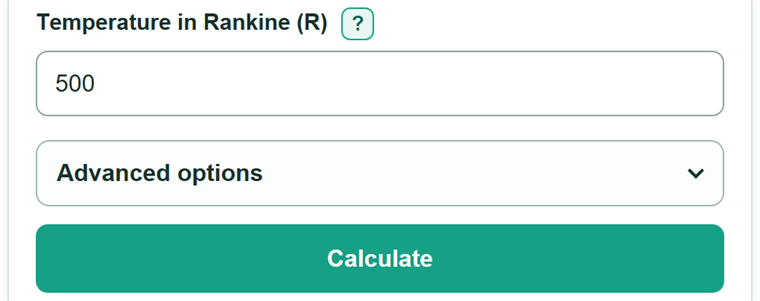
- Enter the value marked R from your problem, table, simulation, or specification in Temperature in Rankine (R).
- Use 0 R or more. You can enter a plain number, such as 491.67, or add an R suffix, such as 491.67 R.
- Open Advanced options if you need a different number of decimal places in the displayed Fahrenheit answer.
- Click Calculate to convert the temperature.
- Check the sign: a Fahrenheit answer below 0 F can be correct, but an input below 0 R is not physically valid.
Definitions
Rankine (R): An absolute temperature scale with zero at absolute zero.
Fahrenheit (F): A temperature scale commonly used in the United States.
Absolute zero: The lowest thermodynamic temperature, equal to 0 R and -459.67 F.
Offset: A fixed amount used when two temperature scales have different zero points. This conversion subtracts 459.67. [1]
Decimal places: Digits displayed to the right of a decimal point. Changing this setting changes rounding on screen, not the conversion.
Common mistakes and quick fixes
Mistake: Multiplying the Rankine value by 9/5.
Fix: Rankine and Fahrenheit degrees are the same size. Subtract 459.67 from the Rankine value.
Mistake: Entering a Fahrenheit reading in the Rankine field.
Fix: Enter the absolute-temperature value marked R in the source material.
Mistake: Using a negative Rankine temperature.
Fix: Use 0 R or a positive value. A value below 0 R is below absolute zero.
Mistake: Treating a negative Fahrenheit answer as an error.
Fix: A Fahrenheit temperature may be negative when the Rankine input is 0 R or greater.
Mistake: Typing commas in a pattern such as 1,00.
Fix: Use commas only as thousands separators, such as 1,000, or enter 1000 without commas.
Mistake: Rounding the Rankine value before converting.
Fix: Enter the source value with its available digits, then set the displayed decimal places for the Fahrenheit answer.
Limitations & Key Assumptions / Boundary Conditions
- This converter is for temperature readings, not temperature changes. A change of 1 R equals a change of 1 F, so a temperature difference does not use the 459.67 offset.
- The Rankine input must be 0 R or greater because Rankine is an absolute scale.
- Displayed rounding can hide small differences. Increase the decimal-place setting when a worksheet or technical record needs more detail.
- The calculation converts the entered number only. It does not account for sensor accuracy, measurement uncertainty, or rounding in the source value.
Methodology
Conversion calculation
Rankine and Fahrenheit degree intervals are the same size, but their zero points differ. The calculator subtracts 459.67 from the Rankine reading. [1]
Fahrenheit temperature = Rankine temperature - 459.67
Worked example
For 500 R, subtract 459.67 from 500. The Fahrenheit temperature is 40.33 F.
500 R - 459.67 = 40.33 F
Boundary conditions
At the lower boundary, 0 R converts to -459.67 F. A negative Fahrenheit result is valid. Only a Rankine input below 0 R is rejected because it is below absolute zero.