
Convert common CGS units to SI or SI units to CGS with quantity-matched unit choices that help prevent unit mix-ups.
Table of contents
How to use our CGS System of Units Converter
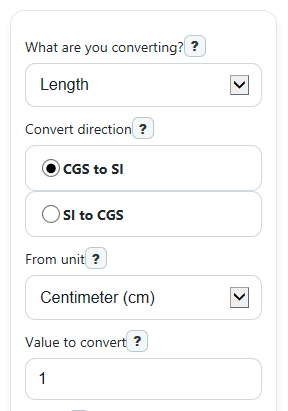
- Choose What are you converting? first, because that limits the unit lists to a matching quantity like force, energy, or density.
- Pick the Convert direction, then choose the From unit and To unit shown for that quantity.
- Enter your number in Value to convert. You can use decimals or scientific notation such as 1e-5.
- Set Rounded result (significant figures) to control how the answer is displayed, then calculate.
- Sanity-check the result by reading Conversion factor used and Unit equivalence. If the factor is less than 1, the converted number should usually get smaller when converting to a larger unit.
Definitions
CGS: A unit system based on centimeter, gram, and second.
SI: The modern metric system built around units like meter, kilogram, and second [2].
From unit: The unit your starting number is already written in.
To unit: The unit you want the final answer written in.
Significant figures: Meaningful digits shown in the result. This changes display rounding, not the exact conversion used.
Conversion factor: The number multiplied by your input to change it from one unit to another.
Dyne (dyn): A CGS unit of force. One dyne equals 1e-5 newton [1].
Erg: A CGS unit of energy. One erg equals 1e-7 joule [1].
Barye (Ba): A CGS unit of pressure. It equals 0.1 pascal.
Poise (P): A CGS unit of dynamic viscosity. It equals 0.1 pascal-second.
Stokes (St): A CGS unit of kinematic viscosity. It equals 1e-4 square meter per second.
Gauss (G): A CGS-related unit of magnetic flux density. One gauss equals 1e-4 tesla [1].
Common mistakes and quick fixes
Mistake: Picking the wrong item in What are you converting? , such as choosing pressure when you meant force.
Fix: Recheck the quantity first, then choose From unit and To unit again from the rebuilt lists.
Mistake: Typing words or symbols into Value to convert instead of a number.
Fix: Enter only a numeric value, decimal, or scientific notation like 2.5E3 in Value to convert .
Mistake: Reversing the unit order by setting From unit to the result unit and To unit to the starting unit.
Fix: Match From unit to the unit your number is already in, then set To unit to the unit you want.
Mistake: Thinking Rounded result (significant figures) changes the real conversion math.
Fix: Use Rounded result (significant figures) only to change display precision. The calculator still uses the full conversion factor underneath.
Mistake: Ignoring Notes about this unit family for special units like gauss.
Fix: Read Notes about this unit family before using the answer, especially for magnetic quantities and named CGS units.
Mistake: Expecting the same number after conversion when From unit and To unit are different-sized units.
Fix: Compare your answer with Conversion factor used and Unit equivalence to see whether the number should grow or shrink.
Limitations & Key Assumptions / Boundary Conditions
- This converter only covers the quantity-specific unit pairs built into the page. It does not handle every CGS unit name or every electromagnetic CGS family.
- Mechanical CGS conversions here use exact power-of-ten relationships based on centimeter, gram, and second units.
- Electromagnetic CGS units can be ambiguous across different CGS families, so this page includes only clearly matched mappings such as gauss to tesla.
- The result uses full internal precision and rounds only for display based on Rounded result (significant figures).
- If you choose the same unit for From unit and To unit, the converter returns the original value with a factor of 1.
- The calculator accepts negative numbers when the math allows them, but whether a negative physical value makes sense depends on your specific science context.
Methodology
How the conversion is done
The calculator uses the selected quantity, direction, source unit, and target unit to look up one exact conversion factor for that supported unit pair.
converted_value = input_value * factor(from_unit -> to_unit)
For the reverse direction, it uses the reciprocal of the CGS-to-SI factor for the same matched pair.
factor(SI -> CGS) = 1 / factor(CGS -> SI)
Why many mechanical CGS conversions are powers of ten
In mechanical CGS units, centimeter equals 10^-2 meter and gram equals 10^-3 kilogram, while second stays the same [1]. That is why many derived conversions reduce to simple powers of ten.
1 cm = 10^-2 m
1 g = 10^-3 kg
1 s = 1 s
Example:
force in CGS uses dyne, where 1 dyn = 1 g*cm/s^2. Replacing g and cm with SI base units gives 1 dyn = 10^-5 N [1].
1 dyn = 1 g*cm/s^2 = 10^-5 kg*m/s^2 = 10^-5 N
Mini-example
If you convert 500000 dyn to N, the factor is 1e-5 N per dyn. Multiply the input by the factor.
converted_value = 500000 * 1e-5 = 5
So the result is 5 N.
Special unit-family note
Some CGS electromagnetic units are not safely interchangeable without extra context. This converter avoids broad electromagnetic cross-system matching and only includes specific supported pairs, such as gauss to tesla.
1 G = 1e-4 T
Assumptions used
The calculator assumes the selected units belong to the same physical quantity, uses only supported unit pairs, rejects non-numeric inputs, and rounds only after the conversion is finished. Real-world scientific work can differ if a source uses a different CGS electromagnetic convention or a unit outside this tool's supported list.