
Convert cents, including partial cents, into dollars. Whole-cent inputs also show whole dollars, leftover cents, and an optional coin mix.
Table of contents
How to use our Cents to Dollars Calculator
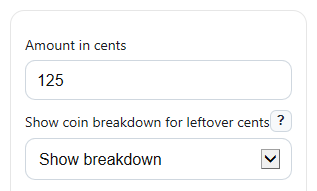
- Enter Amount in cents, such as 125 for $1.25 or 0.705 for $0.00705.
- Choose Show coin breakdown for leftover cents if you want one simple way to make the remaining cents with quarters, dimes, nickels, and pennies.
- Click Calculate to see Dollar amount. Whole-cent inputs also show Whole dollars and Leftover cents.
- Sanity-check the result: every 100 cents should equal 1 dollar. For a partial-cent input, keep the extra decimal digits shown in Dollar amount.
Definitions
Amount in cents: The total number of cents you enter, such as 125.
Dollar amount: The same value divided by 100. Whole-cent values use 2 decimal places; partial cents retain the needed additional digits.
Whole dollars: The number of complete dollars contained in the cents amount.
Leftover cents: The cents remaining after full dollars are removed. In $1.25, the leftover cents are 25.
Leftover-cent coin mix: One practical way to make the leftover cents using quarters, dimes, nickels, and pennies.
Common mistakes and quick fixes
Mistake: Reading a partial-cent result such as $0.00705 as a whole cent.
Fix: Keep the extra decimal digits when the input contains a fraction of a cent.
Mistake: Leaving Amount in cents blank.
Fix: Enter a cents value before you calculate, even if it is 0.
Mistake: Reading Whole dollars as the full answer.
Fix: Use Dollar amount for the full conversion. Whole dollars only counts complete dollars before the leftover cents.
Mistake: Thinking Leftover cents should be negative when the total is below zero.
Fix: Read the sign from Dollar amount . Leftover cents is shown as a non-negative remainder.
Mistake: Expecting Leftover-cent coin mix to list every possible coin combination.
Fix: Treat Leftover-cent coin mix as one simple check, not the only valid way to make that amount.
Limitations & Key Assumptions / Boundary Conditions
- This calculator accepts whole or partial cents with up to 8 decimal places and up to 15 significant digits so the conversion stays exact. Coin and leftover-cent outputs are shown only for whole-cent inputs.
- The conversion assumes standard U.S. money where 100 cents make 1 dollar.
- Leftover-cent coin mix is only for the leftover cents after full dollars are removed, not for the entire amount.
- The coin mix uses one greedy method with quarters, then dimes, then nickels, then pennies. It is a quick check, not every possible combination.
- Negative entries are allowed. The sign is shown in Dollar amount, while Leftover cents stays a non-negative remainder.
Methodology
How the calculator works
The main conversion is cents divided by 100 because one dollar equals 100 cents [4]. Whole-cent answers use 2 decimal places. Partial-cent answers retain the additional decimal digits needed to avoid falsely rounding the conversion to a whole cent.
dollars = cents / 100
whole_dollars = floor(abs(cents) / 100)
leftover_cents = abs(cents) mod 100
Coin mix for leftover cents
If you choose to show the coin check, the calculator builds one simple leftover-cent coin mix using common U.S. coins: quarters, dimes, nickels, and pennies [2]. It uses the largest coin first, then works down to smaller coins.
quarters = floor(leftover_cents / 25)
rem1 = leftover_cents mod 25
dimes = floor(rem1 / 10)
rem2 = rem1 mod 10
nickels = floor(rem2 / 5)
pennies = rem2 mod 5
Mini example
Suppose Amount in cents is 125. Then 125 / 100 = 1.25, so Dollar amount is $1.25. The complete-dollar part is floor(125 / 100) = 1, so Whole dollars is 1. The remainder is 125 mod 100 = 25, so Leftover cents is 25. A simple coin mix for 25 leftover cents is 1 quarter.
If the input is -250, the main answer is -$2.50. The calculator still shows Whole dollars as 2 and Leftover cents as 50 because those two outputs describe the magnitude of the amount, while the sign stays with the full dollar result.
Assumptions used
This method supports whole and partial U.S. cents. Coin breakdowns apply only to whole cents; it does not handle foreign currency systems, taxes, or every possible coin combination.