
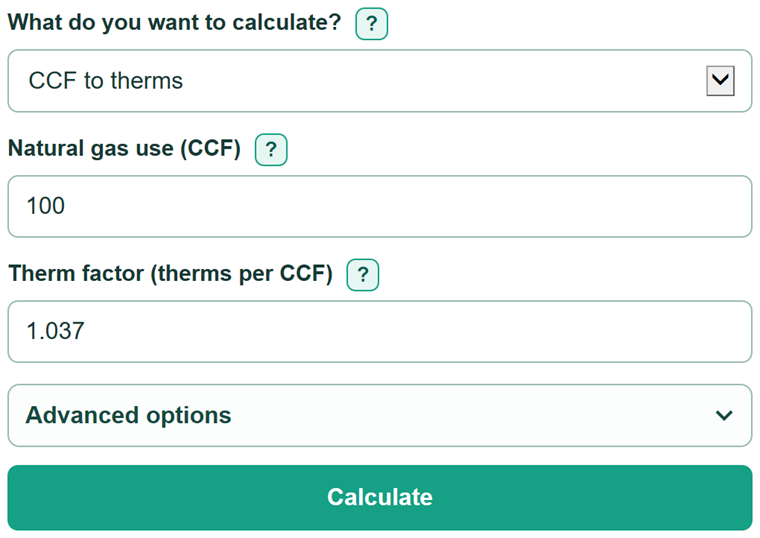
Enter gas use in CCF and your bill's therm factor to convert it to therms or check billed therms.
Advanced options
Table of contents
How to use our CCF to Therms Calculator
- Choose CCF to therms, Therms to CCF, or Bill check from meter CCF.
- Copy the gas-use amount from the usage section of your bill: use CCF for volume or therms for energy.
- Enter the therm factor printed on the bill when available. The planning estimate is only a starting point and may not match your utility.
- In Bill check mode, enter a pressure factor only when the bill lists one. Keep 1.000 if no pressure adjustment appears.
- Compare the calculated therms with the bill's usage therms, not the amount due. If they differ, check the factors and the bill's rounding.
Definitions
CCF: One hundred cubic feet of natural gas. It is a volume measurement.
Therm: A unit of energy equal to 100,000 Btu. Natural-gas utilities often bill gas use in therms.
Therm factor: The number of therms per CCF used to convert gas volume into energy. A utility's factor can change by location or billing period.
Pressure factor: A separate multiplier that some utilities apply to meter CCF before converting it to therms. A value of 1.000 makes no change.
Btu: British thermal unit, a unit used to describe heat energy and natural-gas heat content.
Common mistakes and quick fixes
Mistake: Treating CCF and therms as the same unit.
Fix: CCF measures gas volume, while therms measure energy. Enter the value in the unit printed on the bill.
Mistake: Using a planning therm factor to check a specific bill.
Fix: Copy the bill's therm factor, Btu factor, multiplier, or factor if one is shown.
Mistake: Adding the pressure factor to the therm factor.
Fix: Keep the factors separate. Bill check multiplies meter CCF by the pressure factor and then by the therm factor.
Mistake: Entering zero for a therm factor or pressure factor.
Fix: Enter a number greater than zero. A pressure factor of 1.000 means no pressure adjustment.
Mistake: Comparing converted therms with the dollar amount due.
Fix: Compare with usage therms. Per-therm rates, fixed charges, taxes, credits, and tiers are separate from the conversion.
Limitations & Key Assumptions / Boundary Conditions
- This calculator converts gas volume and energy only. It does not calculate gas charges, fixed fees, taxes, credits, or tiered rates.
- Use the therm factor printed on the bill for a bill comparison. A planning estimate can differ from the utility's factor.
- Bill check mode assumes meter CCF, pressure factor, and therm factor are multiplied as shown by the calculator.
- A utility may use more digits internally or round at a different step, so a small difference from billed therms can remain.
- CCF and therm values must be zero or greater. Therm factors and pressure factors must be greater than zero.
Methodology
Conversion math
The direct calculation multiplies gas volume by the therm factor. Because the factor is measured in therms per CCF, the result is in therms.
therms = CCF x therm factor
To convert in the other direction, divide therms by a positive therm factor.
CCF = therms / therm factor
Bill check math
Some utility statements adjust meter volume with a separate pressure factor before converting volume to energy. Bill check mode applies that multiplier first and keeps it separate from the therm factor.
adjusted meter CCF = meter CCF x pressure factor
billed therms = meter CCF x pressure factor x therm factor
Worked example
For 100 CCF and a therm factor of 1.037, the calculation is 100 x 1.037 = 103.7 therms. For a bill check using 100 CCF, a pressure factor of 1.020, and a therm factor of 1.050, the calculation is 100 x 1.020 x 1.050 = 107.1 therms.
Changing result decimal places changes only the number of digits shown on screen. The calculator uses the unrounded calculation value.