
Enter a pressure in torr to find its value in standard atmospheres and check whether it is below, equal to, or above 1 atm.
Table of contents
How to use our Torr to atm Conversion Calculator
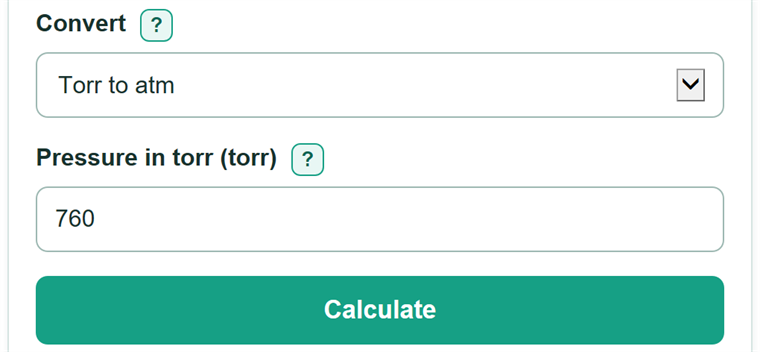
- Choose the unit printed with your starting pressure in the Convert list.
- Enter one pressure value in the field that appears. You can use decimals, scientific notation, or a matching unit suffix such as 760 torr.
- Click Calculate to see the converted pressure and how far it is above or below 1 atm.
- Check the Homework check: a value below 760 torr must convert to less than 1 atm, while a value above 760 torr must convert to more than 1 atm.
Definitions
Torr: A unit of pressure. This calculator's main direction starts with a pressure in torr.
Standard atmosphere (atm): A pressure unit used in chemistry and physics. One atm equals 760 torr. [1]
Unit-canceling factor: A fraction with units arranged so the starting unit cancels. For torr to atm, multiplying by 1 atm / 760 torr cancels torr and leaves atm.
Scientific notation: A compact way to write very large or very small numbers. For example, 2.5e-3 means 0.0025.
Signed difference: A comparison that may be positive, zero, or negative. The calculator compares the entered pressure with 1 atm.
Common mistakes and quick fixes
Mistake: Multiplying a torr value by 760.
Fix: Check Convert and then recalculate. Divide torr by 760 to get atm. Multiply by 760 only when converting atm to torr.
Mistake: Entering an atm value in the torr field.
Fix: Choose "Atm to torr," then enter the value in Pressure in atm.
Mistake: Typing a range or calculation, such as 700-800 or 760/2.
Fix: Check Convert and then recalculate. Enter one number only. Calculate each end of a range separately.
Mistake: Using a comma as a decimal mark, such as 1,01.
Fix: Check Convert and then recalculate. Use a decimal point, such as 1.01. Use commas only for thousands, such as 1,520.
Mistake: Treating a negative above-or-below value as an error.
Fix: Check Convert and then recalculate. A negative value means the entered pressure is below 760 torr, which is below 1 atm.
Mistake: Entering a value labeled mmHg as though it were torr.
Fix: Check Convert and then recalculate. Keep the unit from the source value. This calculator converts torr and does not treat mmHg as the same unit.
Limitations & Key Assumptions / Boundary Conditions
- This calculator changes units only. It does not adjust for altitude, temperature, humidity, gauge reference, or instrument calibration.
- Enter the unit printed with the source value. A value labeled mmHg is not silently treated as torr.
- Zero and negative finite values can be converted mathematically. The calculator cannot determine whether a negative pressure is physically meaningful for the reference used.
- The displayed conversion may have more digits than the source measurement supports. Round a reported answer to match your assignment or measurement precision.
- Enter one finite number, with an optional matching unit suffix. Ranges, formulas, malformed comma grouping, and conflicting unit suffixes are rejected.
Methodology
Conversion method
The calculator uses the fixed relationship 1 atm = 760 torr. [1]
Pressure in atm = Pressure in torr / 760
Pressure in torr = Pressure in atm x 760
For a torr-to-atm conversion, the factor 1 atm / 760 torr is arranged so torr cancels and atm remains.
Comparison with one atmosphere
The above-or-below value is a signed difference from one standard atmosphere. A negative difference is below 1 atm, zero is exactly 1 atm, and a positive difference is above 1 atm.
Torr above or below 1 atm = Pressure in torr - 760
Atm above or below 1 atm = Pressure in atm - 1
Worked example
For 380.5 torr, divide by 760: 380.5 / 760 = approximately 0.5006579 atm. The pressure is 379.5 torr below 760 torr, so the converted value should be below 1 atm.
Calculation boundaries
The conversion factor changes units only. It does not account for whether a reading is absolute or gauge pressure, or for conditions such as altitude, temperature, and calibration. Torr and mmHg should remain distinct when the source specifically labels the pressure as mmHg.