
Convert pounds to newtons fast, with a clear choice between pound-force and pound-mass so you get the right force value.
How to use our Lbs to Newtons Converter Calculator
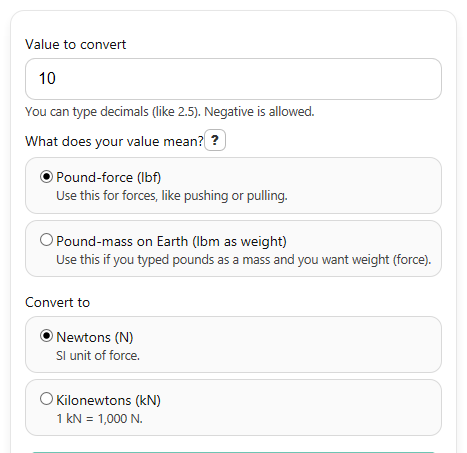
- Enter your number in Value to convert.
- Choose What does your value mean?: pick Pound-force (lbf) if your value is already a force, or Pound-mass on Earth (lbm as weight) if you are treating pounds as mass-based weight.
- Choose Convert to as Newtons (N) or Kilonewtons (kN). If you picked pound-mass, enter Gravity for mass-to-weight conversion (m/s^2).
- Click Calculate, then check Formula used and What your input meant to make sure the calculator handled your pounds as force or mass the way you intended.
- Use Converted force as the main answer, and use Force in newtons when you need the SI force value for physics or engineering formulas.
Definitions
Pound-force (lbf): A unit of force. This is the right choice when your input already means a push, pull, or weight force.
Pound-mass (lbm): A unit of mass. In this calculator, lbm can be turned into weight force by multiplying by gravity.
Newton (N): The SI unit of force. It is the base force output shown in Force in newtons.
Kilonewton (kN): A larger force unit equal to 1,000 newtons.
Gravity (m/s^2): The local gravitational acceleration used to turn pound-mass into weight force.
Converted force: The main answer in the unit you picked under Convert to.
Formula used: The exact conversion rule the calculator applied so you can verify whether it treated your input as lbf or lbm.
Common mistakes and quick fixes
Mistake: Entering a mass in Value to convert but leaving What does your value mean? on Pound-force (lbf) .
Fix: Switch What does your value mean? to Pound-mass on Earth (lbm as weight) if your pounds are mass being turned into weight.
Mistake: Leaving Gravity for mass-to-weight conversion (m/s^2) blank when using pound-mass mode.
Fix: Enter a gravity value greater than 0, such as 9.80665 for standard Earth gravity.
Mistake: Reading Converted force in kN as if it were in N.
Fix: Check Convert to before using the answer. 1 kN equals 1,000 N.
Mistake: Assuming Force in newtons and Converted force should always match exactly.
Fix: They match when Convert to is Newtons (N) . If you choose Kilonewtons (kN) , only Force in newtons stays in N.
Mistake: Thinking a negative number in Value to convert is automatically wrong.
Fix: Negative force can be valid for direction. Use the sign in Converted force and Force in newtons to show direction.
Mistake: Ignoring Note or What your input meant after calculating.
Fix: Read those fields before copying the answer, especially if you used Pound-mass on Earth (lbm as weight) .
Limitations & Key Assumptions / Boundary Conditions
- The calculator converts pounds to force, not to mass in SI units such as kilograms.
- If you choose Pound-mass on Earth (lbm as weight), the result depends on the Gravity for mass-to-weight conversion (m/s^2) value you enter.
- lbf and lbm give the same numeric newton result only when pound-mass is converted using standard gravity, 9.80665 m/s^2.
- This tool is for unit conversion, so it does not model friction, motion, changing gravity with altitude, or other real-world forces.
- Very small or very large answers are formatted in ordinary decimal style for readability, so displayed rounding may hide tiny differences from the full internal value.
- Negative values are allowed to represent direction, but the calculator does not assign a physical direction for you.
Methodology
How the conversion works
The calculator first decides whether your input is already a force or is a mass being turned into weight. Then it converts to newtons, and if needed, it converts newtons to kilonewtons.
N = lbf x 4.4482216152605
N = lbm x 0.45359237 x g
kN = N / 1000
What each formula means
If you choose Pound-force (lbf), the calculator multiplies by 4.4482216152605 to get newtons [2].
If you choose Pound-mass on Earth (lbm as weight), the calculator first converts pound-mass to kilograms using 0.45359237, then multiplies by gravity to get force in newtons.
If you choose Kilonewtons (kN), the calculator divides the newton result by 1,000 for the main displayed answer.
Worked mini-example
Example 1: enter 10 for Value to convert, choose Pound-force (lbf), and choose Newtons (N).
N = 10 x 4.4482216152605 = 44.482216152605
Converted force is 44.482216 N after display rounding, and Force in newtons shows the same value.
Example 2: enter 10 for Value to convert, choose Pound-mass on Earth (lbm as weight), and use gravity 9.80665.
N = 10 x 0.45359237 x 9.80665 = 44.482216152605
That matches the lbf result because standard gravity makes 1 lbm of weight equal to 1 lbf numerically.
Assumptions used
The calculator uses 0.45359237 kg per lbm, standard gravity 9.80665 m/s^2, and 1 lbf = 4.4482216152605 N. Results are then rounded for display.
If you use a different gravity, pound-mass mode gives a different force result, while pound-force mode does not change.