
Find the volume of a rectangular box, room, or tank in cubic meters, liters, and cubic feet from its length, width, and height.
How to use our Cubic Meter Calculator
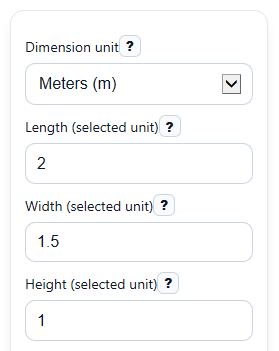
- Pick the same Dimension unit used for all three measurements.
- Enter Length, Width, and Height, then enter Number of identical items as 1 for one space or a larger whole number for matching items.
- If you want more or fewer decimals, change Result precision.
- Click Calculate and read Total volume first, then check Total volume in liters and Total volume in cubic feet if you need other units.
- Sanity-check the result by reading Formula used and making sure the size feels reasonable for your chosen Dimension unit; a tiny or huge answer often means the wrong unit was selected.
Definitions
Cubic meter (m3): A unit of volume equal to the space inside a box that is 1 meter long, 1 meter wide, and 1 meter high [2].
Length: The longest side you measure for the rectangular space or item.
Width: The side across from length.
Height: The up-and-down measurement.
Number of identical items: How many matching boxes, rooms, or tanks you want to total together.
Volume per item: The volume of one item before quantity is applied.
Total volume: The combined volume in m3 after multiplying one-item volume by quantity.
Liter (L): A smaller volume unit often used for liquids; 1 m3 equals 1000 L.
Cubic foot (ft3): A volume unit based on feet, useful when plans or notes use U.S. customary units [1].
Result precision: The number of decimal places shown in the answers.
Common mistakes and quick fixes
Mistake: Entering measurements in centimeters while Dimension unit is set to meters.
Fix: Make sure Dimension unit matches all three entries in Length , Width , and Height .
Mistake: Leaving Length , Width , or Height blank, zero, or negative.
Fix: Enter a positive number in each of those fields before calculating Total volume .
Mistake: Typing a fraction of an item in Number of identical items when you really mean separate whole boxes.
Fix: Use a whole number like 1, 2, or 10 in Number of identical items .
Mistake: Expecting Volume per item to change when only Number of identical items changes.
Fix: Read Volume per item as one-item size, and read Total volume as the combined size after quantity is applied.
Mistake: Using this tool for round or irregular shapes and trusting the Formula used anyway.
Fix: Use this calculator only for rectangular spaces where Length x Width x Height makes sense.
Mistake: Reading only Total volume in liters or Total volume in cubic feet and missing the main metric result.
Fix: Start with Total volume in m3, then use the converted outputs only as equivalents.
Limitations & Key Assumptions / Boundary Conditions
- This calculator is only for rectangular shapes such as boxes, rooms, tanks, and straight-edged spaces.
- All three measurements must use the same Dimension unit; it does not support mixed units in one calculation.
- Number of identical items is treated as a positive count of matching items, so the total assumes each item has the same dimensions.
- Converted outputs in liters and cubic feet are equivalents of the same total volume, not separate calculations for different shapes.
- Displayed values are rounded to the selected Result precision, so shown results may differ slightly from full internal precision.
- Very small or very large valid inputs can produce results that are mathematically correct but easy to misread if the wrong unit was chosen.
Methodology
How the calculator works
The calculator first converts Length, Width, and Height into meters. Then it multiplies them to get one-item volume in cubic meters. Last, it multiplies by Number of identical items to get the combined total.
volume = length_m * width_m * height_m
total_m3 = volume * quantity
liters = total_m3 * 1000
ft3 = total_m3 * 35.3147
Unit conversion used before volume
meters = centimeters * 0.01
meters = millimeters * 0.001
meters = feet * 0.3048
meters = inches * 0.0254
meters = yards * 0.9144
The cubic-foot equivalent uses a standard metric-to-U.S. customary conversion factor [1].
Worked example
If Dimension unit is meters and the measurements are 2 by 1.5 by 1 with Number of identical items set to 1, the one-item volume is 3 m3.
volume = 2 * 1.5 * 1 = 3 m3
total_m3 = 3 * 1 = 3 m3
liters = 3 * 1000 = 3000 L
ft3 = 3 * 35.3147 = 105.9441 ft3
How to interpret the outputs
Total volume is the main answer in m3. Volume per item helps when quantity is more than 1. The liters output is handy for liquid capacity, and the cubic-feet output helps when notes or plans use feet-based volume.
Assumptions behind the math
This method assumes the object or space is a rectangular prism. It also assumes all entered measurements use the chosen Dimension unit. If your result looks far too small or too large, the most likely cause is a unit mismatch rather than a formula error.