
Enter molarity or solute data, temperature, and particle factor to calculate a dilute-solution osmotic pressure estimate.
Advanced options
Table of contents
How to use our Osmotic Pressure Calculator
- Choose the information you have: direct molarity, or solute mass with molar mass and final solution volume.
- Enter the concentration data for that route. For the mass route, use the final volume of the prepared solution, not just the starting water volume.
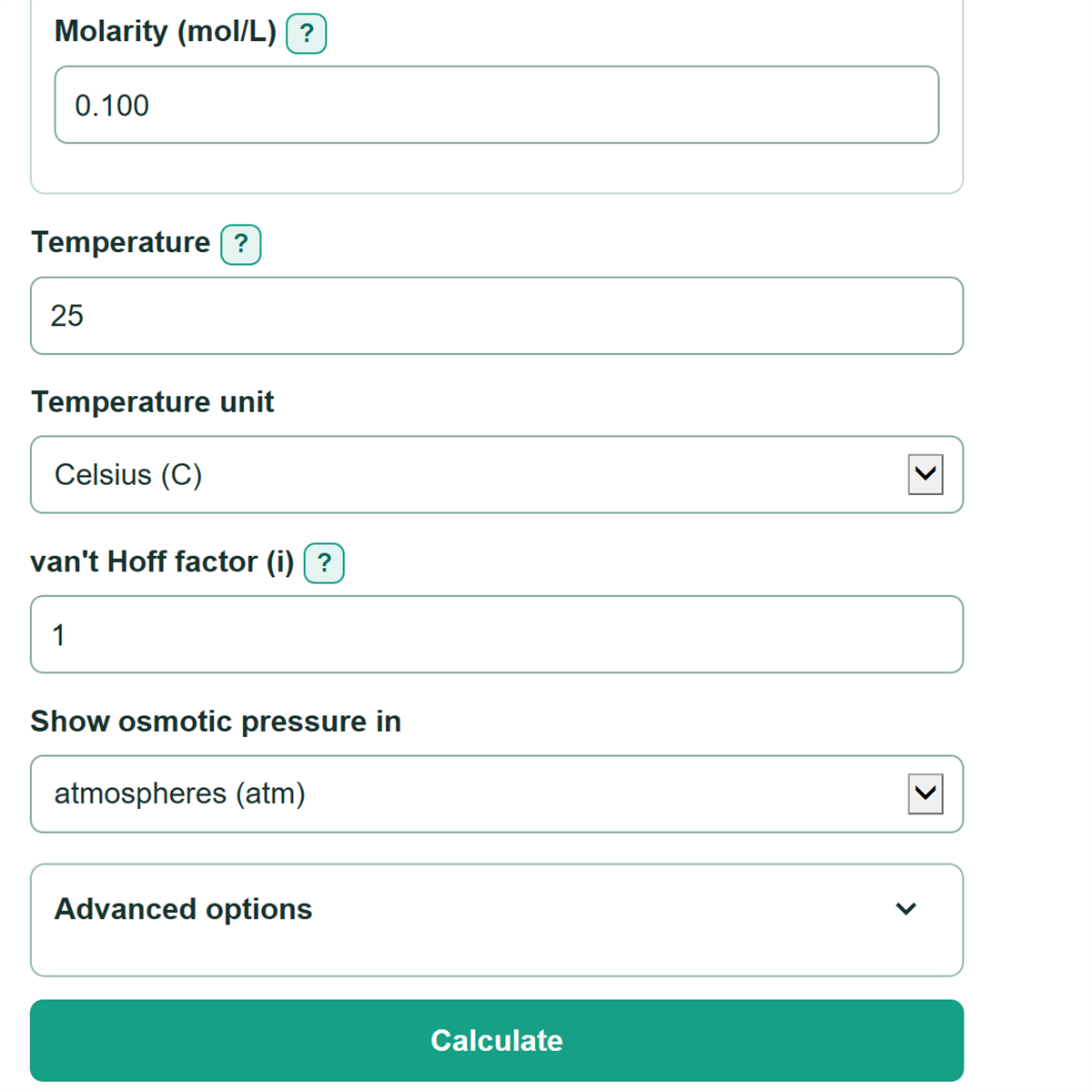
- Enter temperature and choose its unit, then enter the van't Hoff factor used by your problem or lab data.
- Choose the pressure unit and select Calculate. The calculator converts Celsius to Kelvin because the equation requires absolute temperature.
- Check the supporting values before reporting the answer: 25 C should show as 298.15 K, and the displayed molarity should match your concentration setup.
Definitions
Osmotic pressure: Pressure associated with a difference in dissolved-particle concentration across a membrane. For dilute solutions, it can be estimated with the van't Hoff equation. [3]
Molarity (mol/L): Moles of dissolved solute per liter of final solution.
van't Hoff factor (i): The effective number of dissolved particles per solute formula unit under the stated conditions.
Osmotic coefficient (φ): A correction for nonideal particle behavior. A value of 1 uses the ideal dilute-solution assumption.
Kelvin (K): An absolute temperature scale. The equation requires a temperature above 0 K.
Effective particle concentration (osmol/L): Molarity multiplied by the van't Hoff factor and osmotic coefficient.
Common mistakes and quick fixes
Mistake: Entering grams, percent concentration, or mOsm/L in the Molarity field.
Fix: Enter moles of solute per liter of final solution, or choose the mass, molar mass, and final volume route.
Mistake: Using the starting water volume instead of the final solution volume.
Fix: Use the total volume after dissolving the solute unless the problem states that the volumes are the same.
Mistake: Treating 25 C as 25 K.
Fix: Choose Celsius (C) when the given temperature is in Celsius. The calculator converts it to Kelvin.
Mistake: Using the number of ions in a formula as an exact van't Hoff factor for every solution.
Fix: Use the factor given in the problem or measured for the stated conditions. Real electrolyte solutions can differ from the simple ion count.
Mistake: Entering zero for final solution volume, molar mass, Kelvin temperature, van't Hoff factor, or osmotic coefficient.
Fix: Each of these must be greater than zero. Direct molarity may be zero, which gives an osmotic pressure of zero.
Limitations & Key Assumptions / Boundary Conditions
- This calculator estimates osmotic pressure for dilute solutions. It is not a clinical tonicity, medication, or dosing calculator.
- It assumes the entered van't Hoff factor and osmotic coefficient apply to the specific solute, concentration, and temperature.
- Real electrolyte solutions can depart from ideal behavior, especially when concentration changes the effective particle behavior.
- The mass route assumes that the solute mass, molar mass, and final solution volume all describe the same prepared solution.
- Actual membrane systems can also depend on membrane selectivity, mixtures, and concentration changes over time.
Methodology
Calculation method
The calculator first finds molarity from the selected route. It multiplies molarity by the van't Hoff factor and osmotic coefficient, then applies the dilute-solution van't Hoff relation. [3]
M (molarity in mol/L) = mass (g) / molar mass (g/mol) / final solution volume (L)
T (temperature in K) = T (temperature in C) + 273.15
effective particle concentration = φ (osmotic coefficient) x i (van't Hoff factor) x M
π (osmotic pressure in atm) = φ x i x M x R x T
R is the molar gas constant, 0.082057366080960 L atm mol^-1 K^-1. [1] The calculator computes pressure in atmospheres first, then converts it to the selected unit using the standard atmosphere relationship. [2]
Worked example
For 0.100 mol/L glucose at 25 C, with i = 1 and φ = 1, the temperature is 298.15 K and the effective particle concentration is 0.100 osmol/L.
π = 1 x 1 x 0.100 x 0.082057366080960 x 298.15 = 2.446540369675424 atm
Rounded to two decimal places, the estimated osmotic pressure is 2.45 atm.