
Use this Langmuir isotherm calculator to solve for one missing value and quickly read surface coverage and adsorption favorability.
How to use our Langmuir Isotherm Calculator
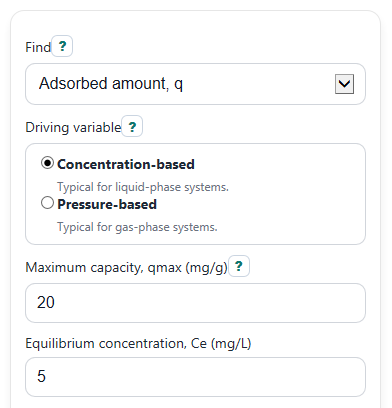
- Pick the value under Find that you want to calculate, then choose the Driving variable as concentration-based or pressure-based so the unit labels for Equilibrium concentration or pressure, Ce, Langmuir constant, b, and Initial concentration or pressure, C0 match your system.
- Enter the known values for Adsorbed amount, q, Maximum capacity, qmax, Equilibrium concentration or pressure, Ce, and Langmuir constant, b as needed for your solve mode. If you want the favorability check, leave Show favorability check with RL on and enter Initial concentration or pressure, C0.
- Click Calculate to get the Calculated value, Surface coverage, theta, Surface coverage (%), and Used capacity (q/qmax). If enough information is available, the calculator also shows Separation factor, RL.
- Sanity-check the result: Surface coverage, theta and Used capacity (q/qmax) should match in the standard Langmuir model, and if your result suggests q is larger than qmax or a negative concentration, recheck your inputs and units.
Definitions
Adsorbed amount, q: The equilibrium amount of solute held on the adsorbent per unit mass of adsorbent, shown here in mg/g.
Maximum capacity, qmax: The model's monolayer limit, or the largest q predicted when adsorption sites are essentially full.
Equilibrium concentration or pressure, Ce: The fluid-phase value left at equilibrium. In liquid systems this is usually concentration, and in gas systems it is pressure.
Langmuir constant, b: A measure of adsorption affinity. Its units must match the chosen driving variable so that b times Ce is unitless.
Surface coverage, theta: The fraction of adsorption sites occupied, from 0 for almost empty to 1 for nearly full surface coverage [1][2].
Used capacity (q/qmax): The fraction of the maximum capacity currently used. In the standard Langmuir model, this equals theta.
Separation factor, RL: A dimensionless favorability check computed from b and C0. Smaller positive values usually indicate more favorable adsorption.
Initial concentration or pressure, C0: The starting fluid-phase concentration or pressure used for the RL check, not the equilibrium value after adsorption.
Common mistakes and quick fixes
Mistake: Mixing liquid and gas units, such as using pressure data while Driving variable is set to concentration-based.
Fix: Set Driving variable first, then make sure Equilibrium concentration or pressure, Ce , Langmuir constant, b , and Initial concentration or pressure, C0 all use that same variable family.
Mistake: Entering a value for Adsorbed amount, q that is equal to or greater than Maximum capacity, qmax when solving for Equilibrium concentration or pressure, Ce or Langmuir constant, b .
Fix: For a finite positive solution, keep Adsorbed amount, q less than Maximum capacity, qmax .
Mistake: Typing negative numbers into Adsorbed amount, q , Maximum capacity, qmax , Equilibrium concentration or pressure, Ce , Langmuir constant, b , or Initial concentration or pressure, C0 .
Fix: Use only zero or positive physical values, because the standard Langmuir form does not use negative loading, capacity, concentration, pressure, or affinity constants.
Mistake: Expecting Separation factor, RL to appear when Show favorability check with RL is on but Initial concentration or pressure, C0 is blank or invalid.
Fix: Enter a valid Initial concentration or pressure, C0 in the same unit family used with Langmuir constant, b , or leave the RL check off if you only need the main answer.
Mistake: Treating Surface coverage (%) as different from Surface coverage, theta .
Fix: Read Surface coverage, theta as a fraction from 0 to 1, and read Surface coverage (%) as that same value multiplied by 100.
Mistake: Ignoring a very large result when Adsorbed amount, q is extremely close to Maximum capacity, qmax .
Fix: Check the Warning and remember that solved Equilibrium concentration or pressure, Ce or Langmuir constant, b can become very large near saturation, so small input errors matter a lot.
Limitations & Key Assumptions / Boundary Conditions
- This calculator uses the standard single-solute Langmuir model, so it is not intended for multicomponent adsorption, strong surface heterogeneity, or systems with interactions between adsorbed molecules.
- The math assumes monolayer adsorption, which means adsorption stops at a single full layer rather than building multiple layers on the surface.
- Units must be internally consistent: if Driving variable is pressure-based, then Equilibrium concentration or pressure, Ce, Langmuir constant, b, and Initial concentration or pressure, C0 must all use pressure-compatible units.
- When solving for Equilibrium concentration or pressure, Ce or Langmuir constant, b, the model requires Adsorbed amount, q to be less than Maximum capacity, qmax; otherwise no finite positive solution exists.
- Results can become numerically unstable when q is very close to qmax because the denominator qmax minus q becomes very small.
- Separation factor, RL is a quick indicator, not a full adsorption-quality score. Real systems can still differ because of temperature, pH, ionic strength, competing species, and experimental method.
- The calculator reports model-based equilibrium relationships only. It does not estimate how fast equilibrium is reached.
Methodology
Core equations
The calculator uses the standard Langmuir isotherm form for one adsorbate on one class of sites.
q = (qmax * b * Ce) / (1 + b * Ce)
theta = (b * Ce) / (1 + b * Ce)
q = qmax * theta
These equations connect equilibrium loading, maximum capacity, equilibrium concentration or pressure, and fractional site coverage. The surface-coverage form theta = bCe / (1 + bCe) is the usual Langmuir form for a matching driving variable [1][2].
How each solve mode works
If you choose Adsorbed amount, q, the calculator uses the main Langmuir equation directly.
q = (qmax * b * Ce) / (1 + b * Ce)
If you choose Maximum capacity, qmax, it rearranges the same equation.
qmax = q * (1 + b * Ce) / (b * Ce)
If you choose Equilibrium concentration or pressure, Ce, it solves for Ce.
Ce = q / (b * (qmax - q))
If you choose Langmuir constant, b, it solves for b.
b = q / (Ce * (qmax - q))
If you choose Surface coverage, theta, it uses the capacity ratio.
theta = q / qmax
After the main value is found, the calculator also reports Surface coverage, theta, Surface coverage (%), and Used capacity (q/qmax). In the standard Langmuir model, q/qmax and theta should match.
Favorability check with RL
If the RL option is enabled and C0 is valid, the calculator computes the dimensionless separation factor.
RL = 1 / (1 + b * C0)
A common reading is: RL greater than 1 unfavorable, RL equal to 1 linear, 0 less than RL less than 1 favorable, and RL equal to 0 irreversible.
Worked mini-example
Suppose qmax = 20 mg/g, b = 0.2 L/mg, and Ce = 5 mg/L. First compute b times Ce = 1. Then q = 20 times 1 divided by 2 = 10 mg/g. Next, theta = 1 divided by 2 = 0.5, so the surface coverage is 50%. The used-capacity ratio is q/qmax = 10/20 = 0.5, which matches theta. If C0 = 10 mg/L, then RL = 1 / (1 + 0.2 times 10) = 1/3 about 0.333, which suggests favorable adsorption.
Validation logic
The calculator rejects negative physical inputs for q, qmax, Ce, b, and C0. It also blocks impossible solve cases, such as q greater than or equal to qmax when solving for Ce or b, because that would require an infinite or nonphysical positive result. When RL is requested but C0 is missing or invalid, the main calculation still runs and RL is simply omitted.
Assumptions behind the math
The model assumes a single-site Langmuir form, monolayer adsorption, and unit consistency between the chosen driving variable and b. If you switch from concentration-based to pressure-based input, the calculator keeps the same algebra but the meaning and units of Ce, C0, and b must change with that choice [3].
Sources
- 3.3: Langmuir Isotherm from a Kinetics Consideration - Chemistry LibreTexts - Libretexts
- 3.2: Langmuir Isotherm - derivation from equilibrium considerations - Chemistry LibreTexts - Libretexts
- Userguide - NIST
- Direct calculation of the equilibrium composition for multi-component Langmuir isotherms in batch adsorption | Adsorption | Springer Nature Link - Springer