
Estimate annual electricity and utility-bill savings from lowering compressed-air system pressure while staying above your verified minimum required pressure.
Energy-charge savings plus any active demand-charge estimate.
Estimated compressor power reduction multiplied by annual operating time.
Fixed customer, meter, and service charges are excluded.
This depends on the compressor reduction overlapping the billed facility peak.
This is a simplified screening estimate, not a compressor performance guarantee.
Actual response can differ with compressor controls, leakage, unregulated demand, and system loading.
Pressure reduction, leak repair, unregulated-demand work, and compressor-control projects can affect the same energy baseline.
Table of contents
How to use our Compressed Air Pressure Reduction Energy Savings Calculator
- Choose the pressure unit shown on your controller or gauge, then enter Current system pressure, Proposed system pressure, and Minimum required pressure.
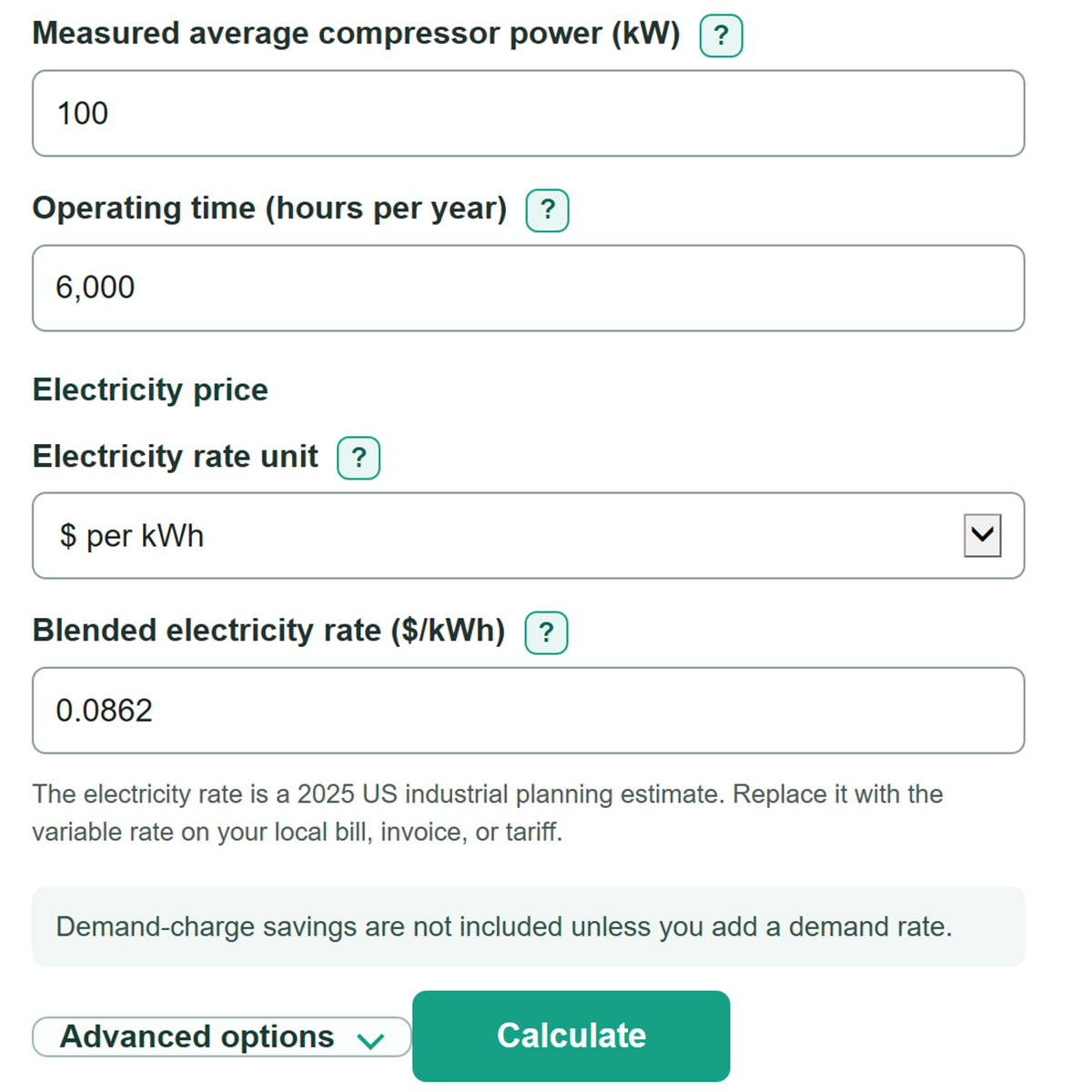
- Enter Measured average compressor power from a meter or controller trend, plus Operating time from run-hour records or the operating schedule.
- Choose Electricity rate unit and enter Blended electricity rate from the variable energy-charge portion of the utility bill.
- Open Advanced options only if a demand charge applies. Enter Demand charge ($ per kW-month), Months with demand savings, and Reduction during billed peak (percent).
- Click Calculate, then sanity-check that the estimated power reduction is reasonable for the pressure change and that demand savings are included only when compressor reduction overlaps the facility billing peak.
Definitions
psig: Pounds per square inch gauge. This is pressure measured relative to surrounding air and is common on US compressor gauges.
bar gauge: Gauge pressure measured in bar. One bar equals 14.503773773 psi.
psia: Pounds per square inch absolute. It includes atmospheric pressure and is used for the pressure ratio in this estimate.
Measured average compressor power: Average electrical input in kW while the compressor system operates. It is different from motor nameplate horsepower.
Blended electricity rate: The variable electricity cost per kWh used to price saved energy. Fixed account, meter, and service charges are excluded.
Demand charge: A utility charge based on billed peak kW, often stated as $ per kW-month. It can fall only if the compressor reduction occurs during the facility's billed peak.
Reduction during billed peak: The share of estimated compressor kW reduction that overlaps the billing peak, from 0% to 100%.
Common mistakes and quick fixes
Mistake: Entering a psia reading as Current system pressure.
Fix: Enter the gauge reading shown by the controller or header gauge and choose the matching Pressure unit.
Mistake: Setting Proposed system pressure below Minimum required pressure.
Fix: Verify pressure at the most pressure-sensitive end use, then enter a proposed setting at or above that requirement.
Mistake: Entering motor nameplate horsepower in Measured average compressor power.
Fix: Enter measured operating electrical kW from a meter, controller trend, or energy-management record.
Mistake: Typing 8.6 while Electricity rate unit is set to $ per kWh.
Fix: Choose cents per kWh for 8.6, or enter 0.086 for $ per kWh.
Mistake: Counting a Demand charge ($ per kW-month) as savings without checking peak timing.
Fix: Use Reduction during billed peak (percent) to reflect how much compressor reduction actually overlaps the billed facility peak.
Mistake: Adding this estimate to separate leak-repair or compressor-control savings without checking the baseline.
Fix: Check Pressure unit and then recalculate. Use one shared baseline or an engineering review so overlapping savings are not counted twice.
Limitations & Key Assumptions / Boundary Conditions
- This is a simplified screening estimate. It assumes compressor electrical power changes in direct proportion to the change in absolute pressure.
- Actual savings can differ because of compressor controls, loading, multiple compressors, leakage, unregulated air use, storage, and pressure losses in piping or treatment equipment.
- The proposed setting must remain at or above the verified Minimum required pressure at the most pressure-sensitive end use during normal production.
- Annual savings depend on measured average compressor power and actual Operating time. Controller run hours can include unloaded or idle time.
- Energy-charge savings use the entered Blended electricity rate and exclude fixed utility charges. Time-of-use bills may need a weighted variable rate.
- Demand-charge savings are conditional on the entered Reduction during billed peak. A lower compressor kW at other times may not reduce billed demand.
- Pressure reduction, leak repair, and control changes can affect the same energy baseline. Do not add separate estimates without checking for overlap.
Methodology
Calculation method
The calculator converts gauge pressure to psi when needed, then adds Reference atmospheric pressure (psia) to both pressure settings. This converts gauge pressure to absolute pressure for a simplified pressure-ratio estimate. The structure uses baseline and adjusted gauge pressure, power, operating hours, and energy cost inputs used in compressed-air pressure-reduction assessments. [1]
gauge pressure in psi = entered pressure x 14.503773773 (only for bar gauge)
absolute pressure = gauge pressure in psi + atmospheric pressure in psia
pressure reduction fraction = 1 - proposed absolute pressure / current absolute pressure
estimated compressor power reduction = measured average compressor power x pressure reduction fraction
annual electricity savings = estimated compressor power reduction x operating time
annual energy-charge savings = annual electricity savings x electricity rate per kWh
If Electricity rate unit is cents per kWh, the entered rate is divided by 100 before cost savings are calculated. The starting $0.0862 per kWh rate is a 2025 US industrial planning estimate; replace it with the facility's variable electricity rate. [2]
annual demand-charge savings = estimated compressor power reduction x demand charge x demand months x billed-peak overlap / 100
estimated total annual savings = annual energy-charge savings + annual demand-charge savings
Worked example
With 110 psig current pressure, 100 psig proposed pressure, 14.7 psia atmospheric pressure, and 100 kW measured average power, the reduction fraction is about 8.019%. At 6,000 hours per year, that is about 48,115 kWh per year. At $0.0862 per kWh, energy-charge savings are about $4,148 per year before any demand-charge estimate.
Calculation choices
The calculator blocks a proposed pressure that is not lower than current pressure or is below Minimum required pressure. A blank demand rate keeps demand-charge savings at $0; once a demand rate is entered, demand months and billed-peak overlap are required. Zero Operating time produces zero annual kWh and dollar savings.