
Use this calculator to find actual yield, theoretical yield, or percent yield and match grams with moles when needed.
Advanced options
How to use our Actual Yield Calculator
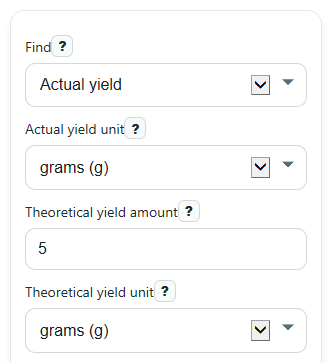
- Choose what you want to find in Find: Actual yield, Theoretical yield, or Percent yield (%).
- Enter the known values in Actual yield amount, Theoretical yield amount, and or Percent yield (%), then pick the correct unit for each yield.
- If one yield is in grams and the other is in moles, enter Product molar mass (g/mol) using the product's molar mass.
- Pick your preferred Rounding (significant figures) or turn on Show the rearranged formula if you want to see the setup.
- Click Calculate, then sanity-check that the Calculated value has the unit you expected and that Actual yield in matched unit and Theoretical yield in matched unit make sense if a conversion was used.
Definitions
Actual yield: The amount of product you really collected in the lab.
Theoretical yield: The largest amount of product the reaction could make based on stoichiometry.
Percent yield (%): How close the actual yield is to the theoretical yield, found by comparing actual to theoretical and multiplying by 100 [1].
Matched unit: The common basis used before comparing yields, such as both in grams or both in moles [2].
Molar mass (g/mol): The mass of 1 mole of a substance, used to convert between grams and moles.
Significant figures: A rounding choice that controls how many meaningful digits are shown in the answer.
Common mistakes and quick fixes
Mistake: Entering Actual yield amount in grams and Theoretical yield amount in moles without adding Product molar mass (g/mol) .
Fix: If the units do not match, enter the product molar mass so the calculator can compare the yields on the same basis.
Mistake: Using the reactant's value in Product molar mass (g/mol) .
Fix: Enter the molar mass of the product whose yield you are measuring, not a reactant or a different compound.
Mistake: Typing 0 into Percent yield (%) when solving for Theoretical yield .
Fix: Use a percent yield greater than 0, because this mode divides by percent yield.
Mistake: Entering 0 for Theoretical yield amount when solving for Percent yield (%) .
Fix: Use a theoretical yield greater than 0, because percent yield compares actual yield to theoretical yield.
Mistake: Thinking a high Percent yield (%) is always impossible if it goes over 100.
Fix: The calculator allows it and shows a Quick note ; recheck for wet product, impurities, or measurement error instead of assuming the math is wrong.
Mistake: Reading Calculated value without checking the unit selected in Actual yield unit or Theoretical yield unit .
Fix: Confirm whether your answer is in g, mol, or % before writing it down.
Limitations & Key Assumptions / Boundary Conditions
- The calculator assumes Actual yield amount and Theoretical yield amount refer to the same product.
- If the yield units already match, Product molar mass (g/mol) is not used and does not change the answer.
- If one yield is in grams and the other is in moles, the result depends on the molar mass entered. A wrong molar mass gives a wrong answer.
- Negative values are not allowed for yield amounts or molar mass because they do not make physical sense in this context.
- When solving for Percent yield (%), Theoretical yield amount must be greater than 0 to avoid division by zero.
- When solving for Theoretical yield, Percent yield (%) must be greater than 0 because the formula divides by the percent as a decimal.
- Percent yield above 100% is allowed, but it usually means the sample may contain extra mass from moisture, impurities, or measurement problems rather than a truly perfect reaction.
Methodology
Core idea
This calculator uses the standard percent-yield relationship: actual yield compared with theoretical yield, times 100 [1]. Actual and theoretical can be compared in grams or in moles, but they must be in the same unit first [2].
Formulas used
percent yield (%) = (actual yield / theoretical yield) x 100
actual yield = (percent yield / 100) x theoretical yield
theoretical yield = actual yield / (percent yield / 100)
mass in g = moles x molar mass
moles = mass in g / molar mass
How unit matching works
If Actual yield unit and Theoretical yield unit already match, the calculator uses the numbers directly. If one is in grams and the other is in moles, it converts one amount using Product molar mass (g/mol) so both values are on the same basis before solving.
Worked mini-example
Suppose you want to find percent yield. If the Actual yield amount is 3.5 g and the Theoretical yield amount is 5.0 g, then percent yield is 70%.
percent yield = (3.5 / 5.0) x 100 = 70
If the actual yield is 18 g, the theoretical unit is mol, the percent yield is 50%, and the Product molar mass (g/mol) is 18 g/mol, first convert 18 g to 1 mol. Then solve for theoretical yield in moles.
1 mol = 18 g / 18 g/mol
theoretical yield = 1 / 0.50 = 2 mol
Interpretation notes
A lower percent yield means you collected less product than the theoretical maximum. A percent yield over 100% is unusual but still possible in lab data, often because the sample was not fully dry, had impurities, or was measured inaccurately, so the calculator shows a note instead of blocking the answer.
Assumptions used
The method assumes the entered values describe the same product, the molar mass belongs to that product, and the given percent yield is a percent value like 70 rather than a decimal like 0.70.