
Use this activation energy calculator to solve Arrhenius problems from either k, A, and temperature or from two temperatures and two rate constants.
Advanced options
How to use our Activation Energy Calculator
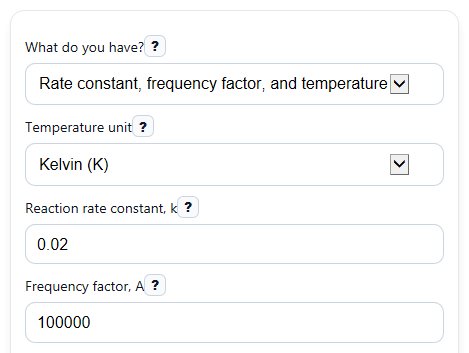
- Choose your method in "What do you have?" and pick the matching "Temperature unit" and "Result unit".
- If you chose the first method, enter "Reaction rate constant, k", "Frequency factor, A", and "Temperature" using consistent units for k and A.
- If you chose the two-point method, enter "Temperature 1", "Rate constant at temperature 1, k1", "Temperature 2", and "Rate constant at temperature 2, k2" using the same units for k1 and k2.
- Click "Calculate" to see "Activation energy", the fixed "Activation energy (kJ/mol)", the "Formula used", and a short meaning note.
- Sanity-check the result: if the value seems strange, make sure temperatures were entered in the right unit, the two temperatures are not equal, and all rate constants are positive.
Definitions
Activation energy: The energy barrier a reaction must get over in the Arrhenius model. A larger value usually means the rate changes more with temperature.
Reaction rate constant, k: A number that describes reaction speed under a specific condition. In this calculator, k must be positive.
Frequency factor, A: Also called the pre-exponential factor. It is the Arrhenius constant paired with k in the equation, and it must use units consistent with k [2].
Temperature unit: The choice of Kelvin or Celsius for your entered temperatures. The calculator converts Celsius to kelvin before using the formulas.
Result unit: The unit used to display "Activation energy": kJ/mol, J/mol, or eV per molecule.
Two-point method: A way to find activation energy from two temperatures and two rate constants instead of using A directly [1].
Common mistakes and quick fixes
Mistake: Entering Celsius values while "Temperature unit" is set to Kelvin.
Fix: Change "Temperature unit" to Celsius or re-enter "Temperature", "Temperature 1", and "Temperature 2" in K.
Mistake: Using different units for "Reaction rate constant, k" and "Frequency factor, A".
Fix: Make sure "Reaction rate constant, k" and "Frequency factor, A" use matching units so the ratio k/A is unitless.
Mistake: Entering 0 or a negative value for "Reaction rate constant, k", "Frequency factor, A", "Rate constant at temperature 1, k1", or "Rate constant at temperature 2, k2".
Fix: Use positive numbers only, because the Arrhenius formulas use natural logs.
Mistake: Setting "Temperature 1" and "Temperature 2" to the same value in the two-point method.
Fix: Change one temperature so the calculator can compare how the rate changes between two different temperatures.
Mistake: Thinking a negative "Activation energy" must always be an error.
Fix: Check the "Check your inputs" note first. If your inputs are valid, keep the signed result and read "What this means" for careful interpretation.
Mistake: Comparing only the chosen "Activation energy" unit and ignoring "Activation energy (kJ/mol)".
Fix: Use "Activation energy (kJ/mol)" as a quick reference when you want to compare with class examples or textbook values.
Limitations & Key Assumptions / Boundary Conditions
- The calculator assumes the Arrhenius model fits your data over the temperature range you entered.
- All temperatures are converted to kelvin before calculation, so values at or below 0 K after conversion are invalid.
- In the direct method, "Reaction rate constant, k" and "Frequency factor, A" must use consistent units, but the calculator cannot detect a unit mismatch from numbers alone.
- In the two-point method, "Rate constant at temperature 1, k1" and "Rate constant at temperature 2, k2" must use the same units.
- "Temperature 1" and "Temperature 2" must be different, or the denominator in the two-point equation becomes zero.
- Negative activation energy is allowed by the math, but it may reflect an apparent or more complex kinetic situation rather than a simple single-step barrier.
- Results are calculation-based estimates and can differ from lab values when reaction mechanisms change, measurements are noisy, or the data do not follow one straight Arrhenius trend.
Methodology
How the calculator works
This calculator uses the Arrhenius relationship between reaction rate constant, temperature, and activation energy [2]. It offers two solve modes so you can use the data you actually have.
Formula for k, A, and temperature
k = A * exp(-Ea / (R * T))
Ea = -R * T * ln(k / A)
Here, R is the universal gas constant, 8.314462618 J mol^-1 K^-1. Temperature T must be in kelvin. If you enter Celsius, the calculator first converts it with:
T(K) = T(C) + 273.15
Formula for two temperatures and two rate constants
ln(k1 / k2) = -(Ea / R) * (1 / T1 - 1 / T2)
Ea = -R * ln(k1 / k2) / ((1 / T1) - (1 / T2))
This form is useful when you know two measured rate constants at two different temperatures and want activation energy directly [1][3].
Unit conversion for the result
The calculator first finds activation energy in J/mol, then converts it for display if needed.
Ea(kJ/mol) = Ea(J/mol) / 1000
Ea(eV per molecule) = Ea(J/mol) / 96485.33212
Mini-example
Suppose you use the first mode with k = 0.02, A = 100000, and T = 298.15 K. The calculator finds ln(k/A) = ln(0.02/100000), then computes Ea = -8.314462618 x 298.15 x ln(0.02/100000) = about 38237.78 J/mol, which is 38.23778 kJ/mol (38.24 kJ/mol rounded).
How to read the result
A higher positive activation energy means the rate constant is more sensitive to temperature changes. A lower value means the rate changes less strongly with temperature [4]. If the result is negative, the calculator keeps that sign because some apparent kinetic cases can produce it.
Assumptions used
The method assumes positive rate constants, positive absolute temperature, and one consistent unit system for each pair of related inputs. It also assumes your data are suitable for an Arrhenius-style fit over the temperatures entered.