
Calculate saponification value from titration data, convert KOH and NaOH values, or estimate average triglyceride molecular weight in one place.
Advanced options
Reporting
Extra result (optional)
Display
How to use our Saponification Value Calculator
- Choose What do you want to find? and enter only the fields needed for that mode.
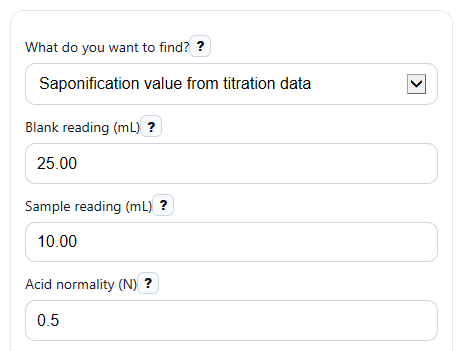
- For titration mode, enter Blank reading (mL), Sample reading (mL), Acid normality (N), and Sample mass (g) exactly as recorded in your lab method.
- For conversion or molecular-weight mode, enter Saponification value (mg KOH/g), and add Acid value (mg KOH/g) in Advanced options only if you want Ester value too.
- Click Calculate, then sanity-check the result: in titration mode, Titration difference used should be blank minus sample, and a negative value means the readings are likely reversed.
- Read Notes or warning before using the number for reporting or soapmaking, especially if your sample is not mostly triglycerides.
Definitions
Saponification value (mg KOH/g): The milligrams of potassium hydroxide needed to saponify 1 gram of fat or oil. It is commonly reported on a KOH basis [1][2].
Blank reading (mL): The acid volume used for the blank test, with no sample present.
Sample reading (mL): The acid volume used for the tested sample after the reaction and back titration.
Acid normality (N): Concentration in equivalents per liter. In this calculator, it scales the titration result directly.
Titration difference used (mL): Blank reading minus Sample reading. This is the volume difference used in the SV formula.
Equivalent sodium hydroxide value (mg NaOH/g): The NaOH-based amount that matches the same sample, useful when comparing with soapmaking tables on a sodium hydroxide basis [1].
Estimated average molecular weight (g/mol): An estimated average mass of the triglyceride molecules in the sample. Higher SV usually means lower average molecular weight [1][2].
Ester value (mg KOH/g): Saponification value minus Acid value. It estimates the part tied to esterified fatty acids.
Triglyceride: A fat molecule made from glycerol and three fatty acids [3].
Common mistakes and quick fixes
Mistake: Entering a Sample reading (mL) that is larger than Blank reading (mL) in the standard titration setup.
Fix: Recheck the labels and glassware record. Titration difference used should usually be positive or zero for a normal SV run.
Mistake: Leaving Sample mass (g) at 0 or typing the wrong decimal place.
Fix: Enter the actual weighed mass in grams. A tiny mass error can change Saponification value a lot.
Mistake: Using the wrong Acid normality (N), such as 0.05 instead of 0.5.
Fix: Copy the exact normality from your lab method or bottle label and keep the decimal place exactly right.
Mistake: Typing a NaOH-based soapmaking value into Saponification value (mg KOH/g).
Fix: This input expects a KOH basis. If your source is NaOH-based, convert it first or confirm the basis before using conversion or molecular-weight mode.
Mistake: Entering a negative Acid value (mg KOH/g) or one much larger than the sample's Saponification value.
Fix: Acid value should be non-negative. If Ester value comes out negative, recheck both inputs and the reported basis.
Mistake: Treating Estimated average molecular weight as exact for any oil blend or impure sample.
Fix: Use it as an estimate mainly for mostly triglyceride samples with low free fatty acids and low unsaponifiable matter, and read Notes or warning.
Limitations & Key Assumptions / Boundary Conditions
- The titration formula assumes the standard setup where Blank reading (mL) is greater than or equal to Sample reading (mL). If not, the usual SV result should be reviewed instead of trusted.
- Saponification value from titration is reported here on a KOH basis in mg KOH/g.
- The KOH to NaOH mode is only a basis conversion. It does not correct for impurities, moisture, or different test methods.
- Estimated average molecular weight is most useful for samples that are mostly triglycerides. It becomes less reliable when free fatty acids, mono- or diglycerides, or unsaponifiable matter are high.
- If Acid value (mg KOH/g) is larger than Saponification value (mg KOH/g), Ester value will be negative. The calculator still shows it because that usually signals an input or sample issue that needs review.
- Different lab methods, reflux times, endpoint choices, and reagent standardization can change real-world results even when the math is correct.
Methodology
Formulas used
SV_KOH = ((B - S) * N * 56.1) / m
SV_NaOH = SV_KOH * (40.00 / 56.11)
MW_avg = (3 * 56.1 * 1000) / SV_KOH + 38.049
EV = SV_KOH - AV
What each symbol means
B is Blank reading (mL), S is Sample reading (mL), N is Acid normality (N), m is Sample mass (g), and AV is Acid value (mg KOH/g).
How the calculator works
In titration mode, the calculator first finds Titration difference used by subtracting Sample reading from Blank reading. It then multiplies that difference by the acid normality and the KOH factor 56.1, and divides by Sample mass to get Saponification value in mg KOH/g.
In conversion mode, the calculator changes a KOH-based value into an equivalent NaOH-based value using the molar-mass ratio of NaOH to KOH. This keeps the chemistry basis consistent while changing the reporting base.
In molecular-weight mode, the calculator uses the entered Saponification value (mg KOH/g) to estimate the average triglyceride molecular weight. This estimate follows the triglyceride-based relationship and is best for samples that are mostly triglycerides [2].
If Acid value (mg KOH/g) is entered, Ester value is also shown by subtracting acid value from the KOH-based saponification value.
Mini example
Suppose Blank reading is 25.00 mL, Sample reading is 10.00 mL, Acid normality is 0.5 N, and Sample mass is 2.00 g.
B - S = 25.00 - 10.00 = 15.00 mL
SV_KOH = (15.00 * 0.5 * 56.1) / 2.00 = 210.375 mg KOH/g
SV_NaOH = 210.375 * (40.00 / 56.11) = about 150.00 mg NaOH/g
If you instead enter 190 mg KOH/g in molecular-weight mode, the estimate is about 923.84 g/mol.
Assumptions behind the math
The titration equation assumes the method is reported on a KOH basis and that the blank and sample readings come from the same standardized procedure. The molecular-weight estimate assumes a mostly triglyceride sample and becomes less reliable when the sample contains substantial free fatty acids or non-triglyceride material [3][3].