
Estimate a landscape tree's appraised value from trunk diameter, ratings, and base price with clear steps you can check.
Advanced options
Method choices
Input safety
Number display
How to use our Tree Value Calculator
- Enter Trunk diameter at 4.5 ft (inches), which is DBH measured about 4.5 feet above the ground.
- Enter Species rating (%), Condition rating (%), and Location rating (%) using the rating method you are following.
- Choose Base price input method: either enter Base price ($ per sq in) directly or use Replacement tree installed cost ($) and Replacement tree trunk diameter (inches) to derive it.
- If needed, open Advanced options and choose whether to Include replacement tree area in base-value step and whether to Keep ratings within 0% to 100%, then click Calculate.
- Sanity-check the result by looking at Trunk area, Base price used, Base value before ratings, and Combined rating factor before trusting Estimated tree value.
Definitions
DBH: Diameter at breast height. In this calculator, that means the trunk diameter measured about 4.5 feet above the ground.
Trunk area: The cross-sectional area of the trunk in square inches, found from the DBH with a circle formula. Larger area usually raises value.
Base price ($ per sq in): Dollar amount assigned to 1 square inch of trunk area before ratings are applied.
Replacement tree installed cost ($): The installed cost of the largest reasonably available nursery replacement tree used in the helper method.
Replacement tree area: The trunk area of the nursery replacement tree. It is used to derive Base price used in helper mode and to explain the base-value step.
Species rating (%): A percent score for how suitable and desirable the species is for the site and region under the method you are using.
Condition rating (%): A percent score for the tree's health and structure.
Location rating (%): A percent score for how well the tree contributes to the site based on placement and use.
Combined rating factor: The decimal made by multiplying the three ratings after each percent is divided by 100. Example: 80% x 75% x 70% becomes 0.42.
Base value before ratings: The dollar amount from size and pricing before species, condition, and location adjustments are applied.
Common mistakes and quick fixes
Mistake: Measuring the trunk somewhere other than Trunk diameter at 4.5 ft (inches).
Fix: Measure DBH at about 4.5 feet above the ground on the uphill side, then enter that value in Trunk diameter at 4.5 ft (inches).
Mistake: Typing decimals into Species rating (%), Condition rating (%), or Location rating (%) as if 80% should be 0.80.
Fix: Enter whole-percent style values such as 80, 75, and 70 so Combined rating factor is built correctly.
Mistake: Filling in Base price ($ per sq in) while Base price input method is set to the helper and expecting both pricing paths to be used.
Fix: Match the field to the selected Base price input method. In direct mode, use Base price ($ per sq in). In helper mode, use Replacement tree installed cost ($) and Replacement tree trunk diameter (inches).
Mistake: Entering nursery size in radius or circumference instead of Replacement tree trunk diameter (inches).
Fix: Enter the replacement tree's diameter in inches so Replacement tree area and Base price used are calculated from the right area.
Mistake: Being surprised when Base value before ratings stays at the replacement cost floor for a small tree.
Fix: If Include replacement tree area in base-value step is set to Yes and the appraised tree is smaller than the replacement tree area, the calculator uses the replacement cost floor by design.
Mistake: Treating Estimated tree value like a legal claim amount without checking Method note.
Fix: Read Method note and use this as a quick estimate only. For claims, disputes, or unusual trees, get a qualified appraiser.
Limitations & Key Assumptions / Boundary Conditions
- This calculator gives a quick trunk-formula estimate for landscape appraisal, not timber value, shade-value, or ecosystem-service value.
- DBH must be measured correctly at about 4.5 feet above ground. A bad trunk measurement can distort every later step.
- The result depends heavily on the ratings and the Base price used. Different local guides or appraisers may score the same tree differently.
- If Base price input method is set to the helper, the estimate depends on the replacement tree cost and replacement tree diameter you choose.
- When Include replacement tree area in base-value step is set to Yes, the base value uses the replacement cost floor if the appraised tree area is smaller than the replacement tree area.
- If Keep ratings within 0% to 100% is set to Yes, values outside that range should be corrected instead of forced into the math.
- Very large DBH trees may be handled differently under regional guides or newer protocols, so this simple estimate may differ from a professional appraisal.
- Official claims, insurance disputes, and legal matters may require a qualified appraiser and a region-specific method rather than this general estimate [2].
Methodology
How the calculator works
This calculator follows a trunk-formula style estimate that starts with trunk size, converts ratings from percent to decimals, and then applies those ratings to a base value. Public explanations of this approach commonly use trunk area, replacement cost or basic price, and rating factors [1].
Formulas used
A = pi * (DBH / 2)^2
Here, A is trunk area in square inches and DBH is Trunk diameter at 4.5 ft (inches).
P = C_rep / A_rep
This helper formula is used only when Base price input method is the nursery helper. P is Base price used, C_rep is Replacement tree installed cost ($), and A_rep is Replacement tree area.
BV = C_rep + P * max(A - A_rep, 0)
This is the base-value step when Include replacement tree area in base-value step is set to Yes. The max(A - A_rep, 0) part means extra area cannot go below zero, so the base value does not drop below the replacement cost floor.
BV_simple = P * A
This simplified version is used when Include replacement tree area in base-value step is set to No.
F = (S / 100) * (C / 100) * (L / 100)
F is Combined rating factor. S, C, and L are Species rating (%), Condition rating (%), and Location rating (%).
V = BV * F
V is Estimated tree value.
Worked mini-example
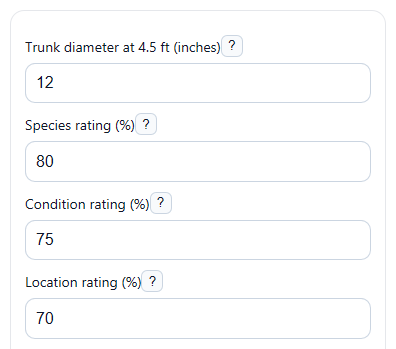
Suppose Trunk diameter at 4.5 ft (inches) is 12, Species rating (%) is 80, Condition rating (%) is 75, and Location rating (%) is 70.
A = pi * (12 / 2)^2 = 113.10 sq in
If you use helper mode with Replacement tree installed cost ($) of 900 and Replacement tree trunk diameter (inches) of 3, then:
A_rep = pi * (3 / 2)^2 = 7.07 sq in
P = 900 / 7.07 = 127.32 $/sq in
With the replacement-area step turned on:
BV = 900 + 127.32 * (113.10 - 7.07) = 14,400
F = 0.80 * 0.75 * 0.70 = 0.42
V = 14,400 * 0.42 = 6,048
That means the final estimate is $6,048 for this set of assumptions.
How to read the outputs
Estimated tree value is the final dollar estimate. Base value before ratings helps you check whether the size and pricing step looks reasonable before depreciation-like rating effects are applied. Base price used is especially important because a high or low number there can shift the final value a lot.
Assumptions behind this quick estimate
This page uses one general trunk-formula framework so users can see the math clearly. Real appraisals may use regional replacement data, newer depreciation factors, or different handling for large trees and special cases [2]. That is why the calculator shows a method note and should be treated as a first-pass estimate rather than a final legal appraisal.