
Estimate how many leaves are on a tree using canopy size, a small leaf sample, and LAI with a simple low-to-high range.
Advanced options
How to use our Tree Leaves Calculator
- Pick Canopy shape, then enter Crown width (feet). If the tree is longer one way than the other, choose oval and also enter Second crown width (feet).
- Measure your sample circle and enter Sample circle diameter (inches) and Leaves needed to cover sample circle for one full layer with very small gaps.
- Choose LAI source. Use Tree preset for a quick estimate, or choose custom and enter Custom LAI if you already know it.
- Optional: open Advanced options to set LAI spread for low/high estimate (%), Leaves per yard bag, or your preferred rounding.
- Click Calculate, then sanity-check the results: if Leaf density from your sample or the Estimated range looks unrealistic, remeasure the sample circle or count a new sample with more typical leaves.
Definitions
Canopy shape: The ground footprint of the tree crown. Use round for a roughly circular crown and oval for a longer, stretched crown.
Crown width (feet): The distance across the canopy at its widest point, measured on the ground below the tree.
Second crown width (feet): The canopy width measured at a right angle to the first width for an oval crown.
Sample circle diameter (inches): The width of the small round area you cover with leaves to build a one-layer sample.
Leaves needed to cover sample circle: The number of leaves needed to make one full layer over that sample circle.
LAI: Leaf area index, or how many leaf layers overlap the ground below the tree on average. Higher LAI means more overlapping leaves [1].
Leaf density from your sample: How many leaves are needed per square foot for one leaf layer, based on your sample circle.
Leaves for one full layer: The estimated number of leaves needed to cover the canopy ground area once, before LAI adds overlap.
Common mistakes and quick fixes
Mistake: Entering trunk width instead of Crown width (feet) .
Fix: Measure the canopy spread across the ground at the drip line or shadow, not the trunk.
Mistake: Choosing oval Canopy shape but leaving Second crown width (feet) blank.
Fix: Add the second width at a right angle to the first width so the oval area can be calculated.
Mistake: Using inches for Crown width (feet) or feet for Sample circle diameter (inches) .
Fix: Keep canopy measurements in feet and the sample circle in inches exactly as labeled.
Mistake: Counting leaves loosely for Leaves needed to cover sample circle with big gaps or lots of overlap.
Fix: Count the leaves needed for one full layer with little to no gaps so Leaf density from your sample is more realistic.
Mistake: Picking the wrong LAI source or forgetting to enter Custom LAI in custom mode.
Fix: Use a Tree preset for a quick rough value, or enter your own measured LAI when you select custom.
Mistake: Treating Estimated leaves on the tree like an exact count.
Fix: Read Estimated range and Estimate note too, especially when your sample is tiny or your LAI is unusual.
Limitations & Key Assumptions / Boundary Conditions
- This tool gives a rough estimate, not an exact leaf count. Real trees have gaps, clumps, and mixed leaf sizes.
- The method assumes your sample leaves represent the typical leaves on that tree. If you choose unusually small or large leaves, the estimate can shift a lot.
- LAI is the biggest uncertainty. Preset values are only typical starting points, and actual LAI can vary by species, season, age, pruning, and growing conditions.
- Round and oval canopy shapes are simplified footprints. Irregular crowns, missing sections, or very uneven branching can make the ground area estimate less accurate.
- A very small Sample circle diameter (inches) or very low Leaves needed to cover sample circle can make results jumpy because one odd leaf changes the density a lot.
- Estimated yard bags needed is only a planning estimate. Bag totals depend on how tightly leaves pack, whether they are dry or wet, and your actual bag size and filling method.
Methodology
How the estimate is built
This calculator starts with a one-layer leaf sample, scales that sample to the whole canopy footprint on the ground, and then multiplies by LAI to account for overlapping leaf layers.
d_ft = d_in / 12
A_sample = pi x (d_ft / 2)^2
density = N_sample / A_sample
If the canopy is round, the ground area is treated like a circle. If it is oval, the ground area is treated like an ellipse.
A_canopy_round = pi x (d_crown / 2)^2
A_canopy_oval = pi x (w1 / 2) x (w2 / 2)
The one-layer leaf count is the sample density times the canopy ground area.
N_one_layer = density x A_canopy
Then the calculator multiplies by LAI. LAI means leaf area index, a measure of leaf area relative to ground area, and values above 1 represent overlapping leaf layers [1][2].
N_total = LAI x N_one_layer
If you use the low-high range, the calculator applies the spread percentage above and below the chosen LAI.
LAI_low = LAI x (1 - spread / 100)
LAI_high = LAI x (1 + spread / 100)
N_low = LAI_low x N_one_layer
N_high = LAI_high x N_one_layer
If you enter bag capacity, cleanup bags are estimated from the mid leaf count.
bags = N_total / leaves_per_bag
Mini example
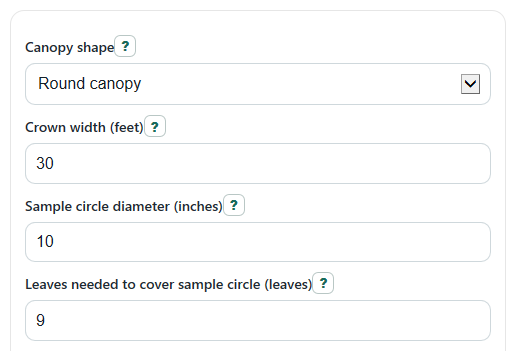
Suppose the tree has a round canopy with Crown width (feet) of 30, a Sample circle diameter (inches) of 10, and Leaves needed to cover sample circle of 9. First convert 10 inches to 0.8333 feet, so the sample area is about 0.5454 square feet. That gives a sample density of about 16.50 leaves per square foot.
The 30-foot round canopy has a ground area of about 706.86 square feet. One full leaf layer would need about 11,653.52 leaves. With a maple preset LAI of 4.8, the total estimate is about 55,936.92 leaves. If the spread is 15%, the range is about 47,546 to 64,328 leaves.
Assumptions behind the math
The method assumes your sample leaves are typical in size and packing, the canopy footprint can be simplified as round or oval, and the chosen LAI is a reasonable average for that tree. Results can differ from reality when the crown is irregular, leaf size varies a lot, or the tree has unusually sparse or dense foliage.