
Estimate how much potting soil you need for a pot, planter, grow bag, or raised bed, then see how many bags to buy.
Advanced options
How to use our Potting Soil Calculator
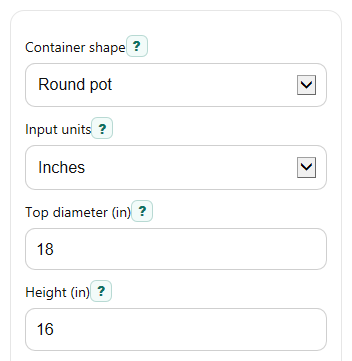
- Choose Container shape and Input units, then enter the inside measurements that match that shape.
- Pick a Bag size; if you choose Custom bag size, enter that bag volume in cubic feet.
- Open Advanced options if needed and enter Space below rim and Extra soil to buy to match how you really plan to fill the container.
- Click Calculate to see Potting soil needed, Bags to buy, and the same volume in quarts and liters.
- Sanity-check Filled height used and Selected bag volume; if the filled height looks too small or the bag volume does not match the label you plan to buy, fix those inputs and recalculate.
Definitions
Container shape: The simple shape the calculator uses to estimate volume, such as round pot, tapered round pot, rectangle, or square.
Input units: The measurement unit used for all size inputs: inches, feet, or centimeters.
Top diameter: The inside width across the top opening of a round pot.
Bottom diameter: The inside width across the bottom of a tapered round pot.
Height: The inside depth from the bottom to the planned soil surface before any rim gap is subtracted.
Space below rim: The empty space left at the top for watering. This amount is subtracted from height.
Filled height used: The actual soil depth used in the math after subtracting the rim gap.
Bag size: The volume of one soil bag, such as 1.5 cubic feet or 50 quarts.
Potting soil needed: The estimated soil volume for the container, shown in cubic feet and also converted to quarts and liters.
Bags to buy: The number of whole bags needed after rounding up.
Common mistakes and quick fixes
Mistake: Measuring the outside of the container instead of the inside for Top diameter , Length , Width , or Height .
Fix: Use the inside measurements where the soil actually sits, then calculate again.
Mistake: Entering Space below rim that is equal to or bigger than Height .
Fix: Reduce Space below rim or increase Height so the Filled height used stays above 0.
Mistake: Using Top diameter for a tapered pot but leaving Bottom diameter wrong or blank.
Fix: For Container shape set to tapered round pot, measure and enter both Top diameter and Bottom diameter .
Mistake: Picking the wrong Bag size because the store label is in quarts, not cubic feet.
Fix: Match Bag size to the label you will buy, and compare it with Selected bag volume and Potting soil needed in quarts.
Mistake: Choosing Custom bag size but leaving Custom bag size at 0 or blank.
Fix: Enter the bag volume in cubic feet before calculating.
Mistake: Forgetting that Extra soil to buy changes Bags to buy .
Fix: Set Extra soil to buy to 0 if you want the raw volume only, or keep a small cushion if you want a safer shopping estimate.
Limitations & Key Assumptions / Boundary Conditions
- This is an estimate based on simple shapes. Very curved, bulged, or irregular containers can differ from the result.
- Measurements should be inside dimensions, not outside dimensions. Thick walls can change the real soil volume.
- Space below rim is treated as a straight subtraction from Height. If the pot shape changes a lot near the top, the real volume may differ.
- Tapered round pots are modeled as a frustum. If the container has ridges, inward curves, or a false bottom, actual capacity can change.
- Bags to buy always rounds up to whole bags because partial bags cannot be purchased.
- Bag labels sold by trade gallons or brand-specific sizing may not exactly match measured inside container volume.
- The extra-buy setting adds a percentage cushion for settling, leveling, and small spills, but it does not predict every real-world loss.
Methodology
How the calculator works
The calculator first finds the soil depth actually being filled, then uses a shape formula to estimate volume. After that, it can add a small buying cushion and divide by your selected bag size to get whole bags to buy.
Step 1: Find filled height
H_fill = H - gap
Height is the inside container height, and Space below rim is the empty space left at the top. If filled height is 0 or less, the calculator shows an error because there is no room left for soil.
Step 2: Convert measurements to feet for volume math
x_ft = x_in / 12
x_ft = x_cm / 30.48
Using one length unit keeps the volume result in cubic feet.
Step 3: Calculate raw container volume
For a rectangular planter or raised bed:
V = L * W * H_fill
For a square planter:
V = S * S * H_fill
For a straight-sided round pot:
V = pi * (D / 2)^2 * H_fill
For a tapered round pot:
V = (pi * H_fill / 12) * (D_top^2 + D_top * D_bottom + D_bottom^2)
The tapered round formula is the frustum formula written with diameters instead of radii.
Step 4: Add the optional extra-buy cushion
V_buy = V * (1 + extra_percent / 100)
This increases the buying volume when you want a little extra for settling, leveling, or minor spills.
Step 5: Convert to bag count
bags = ceil(V_buy / bag_cuft)
The calculator always rounds up because stores sell whole bags, not fractions of a bag.
Unit conversions used for display
quarts = cubic_feet * 29.922078
liters = cubic_feet * 28.316846592
These extra displays help when soil bags are labeled in quarts or liters instead of cubic feet.
Mini example
Suppose you have a round pot with Top diameter 18 inches, Height 16 inches, Space below rim 2 inches, Bag size 1.5 cubic feet, and Extra soil to buy 10%.
H_fill = 16 - 2 = 14 inches
D = 18 / 12 = 1.5 ft; H_fill = 14 / 12 = 1.1667 ft
V = pi * (1.5 / 2)^2 * 1.1667 = about 2.4544 cu ft
V_buy = 2.4544 * 1.10 = about 2.6998 cu ft
bags = ceil(2.6998 / 1.5) = 2
So the calculator would show about 2.70 cubic feet of potting soil needed and 2 bags to buy.
Assumptions used
The estimate assumes simple geometric shapes, inside measurements, and a uniform fill depth. Real containers with curved sides, drainage layers, false bottoms, or trade-size labels can vary from the estimate. Raised-bed fill guidance is often planned from bed dimensions, but the exact soil amount still depends on the true inside size and target fill height [1].