
Estimate a practical daily raw food amount for your dog, split it into meals, and compare a percent-based plan with a calorie-based check.
Advanced options
Breakdown and shopping
Tuning and display
How to use our Raw Dog Food Calculator
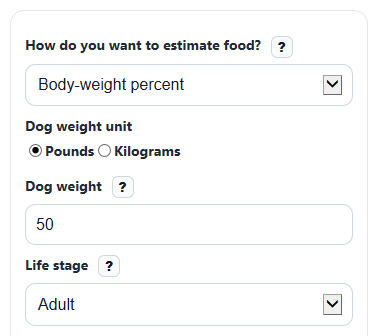
- Choose "How do you want to estimate food?" Use "Body-weight percent" for a simple starting amount, or "Calories plus food calories" if your food label lists calories.
- Enter "Dog weight," pick the right "Dog weight unit," then choose "Life stage," "Body goal," "Activity level," and "Meals per day." If your dog needs to slim down, use a healthy target weight in "Dog weight" instead of a higher current weight.
- If you know your package calories, enter "Food calories." In Advanced options, you can also choose "Raw meal breakdown," set "Shopping list rounding," or add a "Feeding percent override".
- Click Calculate and read "Daily raw food" first, then "Food per meal" and "Weekly total." If both "Daily raw food" and "Daily food from calories" appear and they are far apart, recheck the food label unit and monitor your dog's body condition before making big changes.
Definitions
Body-weight percent: A starting rule that feeds a percent of your dog's body weight each day, such as 2% to 3% for many adult maintenance cases.
Food calories: The energy density of the raw food, entered as kcal per lb or kcal per kg to match your selected weight unit.
Starting feeding percent: The rule-of-thumb percent the calculator picks from "Life stage," "Body goal," and "Activity level," unless you enter a manual override.
Daily raw food: The estimated total amount to feed in one day.
Food per meal: The daily amount split by "Meals per day."
Weekly total: Seven days of food, useful for meal prep and shopping.
PMR 80/10/10: A common split of 80% muscle meat, 10% edible bone, and 10% organ.
BARF 70/10/10/10: A simple split of 70% muscle meat, 10% edible bone, 10% organ, and 10% plant or extra part.
RER: Resting energy requirement, a calorie estimate based on body weight.
MER: Maintenance energy requirement, which adjusts RER for life stage, goal, and activity to estimate daily calories.
Common mistakes and quick fixes
Mistake: Entering current overweight weight in "Dog weight" when "Body goal" is set to "Lose weight."
Fix: Put your dog's healthy target weight in "Dog weight" so "Daily raw food" starts from a leaner goal.
Mistake: Mixing up pounds and kilograms after choosing "Dog weight unit."
Fix: Make sure the number in "Dog weight" matches the selected unit, then check that "Daily raw food" looks reasonable for your dog.
Mistake: Typing package calories in the wrong unit for "Food calories."
Fix: Match "Food calories" to the selected weight unit so "Daily food from calories" uses kcal per lb when weight is in pounds or kcal per kg when weight is in kilograms.
Mistake: Using "Feeding percent override" as a guess without comparing it to the built-in "Starting feeding percent."
Fix: Leave "Feeding percent override" blank unless you have a reason to change it, or compare your override to "Starting feeding percent" before using it.
Mistake: Setting "Meals per day" to 0 or forgetting that "Food per meal" is just the daily total divided evenly.
Fix: Enter 1 or more in "Meals per day," then use "Food per meal" as an equal split unless you plan uneven meals on purpose.
Mistake: Treating "Muscle meat part," "Edible bone part," and "Organ part" as proof the full diet is balanced.
Fix: Use "Raw meal breakdown" only as a portioning helper. The split shows parts of the total, not a complete nutrition review.
Limitations & Key Assumptions / Boundary Conditions
- These results are starting estimates, not a full diet formulation or a veterinary prescription.
- Puppy results need extra caution because growth feeding changes with age and body condition more than a simple adult-style rule.
- The calorie method depends on accurate "Food calories" from the package and the correct unit match of kcal per lb or kcal per kg.
- "Body goal" set to "Lose weight" works best when "Dog weight" is a healthy target weight, not an overweight current weight.
- "Raw meal breakdown" only splits the total amount into parts. It does not confirm the diet is complete, balanced, or appropriate for every dog.
- Medical conditions, pregnancy, lactation, and very hard-working dogs can need feeding plans that differ a lot from these estimates.
- "Shopping list rounding" changes only "Weekly total" for buying convenience. It does not change "Daily raw food" or "Food per meal."
Methodology
How the calculator estimates food
The calculator offers two paths. The percent path uses a body-weight feeding percent. The calorie path estimates daily calories first, then converts those calories into a food amount using the package calorie density.
Formulas
kg = lb x 0.45359237
daily food in kg = dog weight in kg x (feeding percent / 100)
RER = 70 x (weight in kg ^ 0.75)
MER = RER x activity and life-stage factor
daily food from calories = MER / food calories
food per meal = daily total / meals per day
weekly total = daily total x 7
Starting percent rules used here
For adult dogs, the calculator uses a practical starter percent based on goal and activity. A low-start case uses 2%, an average adult maintenance case uses 2.5%, and a higher-need case uses 3%. If you enter "Feeding percent override," that manual value replaces the suggested percent.
Puppy mode is labeled as a rough starting estimate only. It is separated from adult maintenance because growth feeding is more complex and usually needs closer follow-up.
Calorie factors used here
The calorie method starts with RER, then applies one clear multiplier to estimate MER. To keep results predictable, this calculator uses a simple precedence rule: puppy growth first, then body goal, then activity for adult maintenance style cases. For the default adult average maintenance example, the factor is 1.6, which produces the provided test result.
Ratio split math
If you choose "PMR 80/10/10," the calculator multiplies the daily total by 0.80 for "Muscle meat part," 0.10 for "Edible bone part," and 0.10 for "Organ part." If you choose "BARF 70/10/10/10," it uses 0.70, 0.10, 0.10, and 0.10 for the plant or extra share.
Worked mini-example
A 50 lb adult dog with average activity and a maintain goal uses the default 2.5% percent method.
daily raw food = 50 lb x 2.5% = 1.25 lb per day
food per meal with 2 meals = 1.25 / 2 = 0.625 lb per meal
weekly total = 1.25 x 7 = 8.75 lb per week
If the same dog uses calorie mode with food listed at 1,000 kcal per lb, the calculator first converts 50 lb to about 22.68 kg, estimates RER, applies the adult average factor, and gets about 937.53 kcal per day. Dividing by 1,000 kcal per lb gives about 0.9375 lb per day, which is lower than the 1.25 lb percent result. That gap is the point of the calorie-aware check: it tells you to recheck the label and watch body condition.
Assumptions used
This tool assumes a healthy dog unless your selections suggest extra caution. It also assumes the entered food calories are correct and that meals are split evenly. Real feeding plans should be adjusted over time based on body weight trend, body condition, stool quality, and how the specific dog responds [1][2].