
Use this Daily Light Integral Calculator to convert PPFD, light hours, and DLI, then check whether extending your light schedule can hit your target.
Advanced options
How to use our Daily Light Integral Calculator
- Pick a value in What do you want to find?: Daily light integral, Needed PPFD, or Needed light hours.
- Enter your Average canopy PPFD (umol/m2/s), Light hours per day (hours), Target DLI (mol/m2/day), and Maximum planned light hours per day (hours) as needed. Use the average light level at canopy height, not a single bright spot.
- If you want fewer or more decimals, choose a setting in Result detail, then click Calculate.
- Read Calculated result first, then compare Current DLI from entered PPFD and hours with Gap from target and Extra light hours needed at this PPFD to plan your next step.
- Sanity-check the answer: if Needed PPFD or Needed light hours looks unusually high, review whether your PPFD is an average canopy reading and whether your target DLI is realistic for your crop and schedule.
Definitions
PPFD: Photosynthetic photon flux density. This is the amount of plant-usable light reaching a surface each second, shown here as umol/m2/s.
Average canopy PPFD: The average PPFD across the top of your plants, not the brightest spot directly under the lamp.
Photoperiod: The daily amount of time plants receive light. In this calculator, that is Light hours per day (hours).
PAR: Photosynthetically active radiation. This is the range of light plants use for photosynthesis, and PPFD measures photons in that range [1].
DLI: Daily light integral. This is the total amount of PAR light a plant receives over one full day, shown as mol/m2/day [1].
Gap from target: The target DLI minus your current DLI. A positive gap means you need more daily light, while a negative gap means you are already above target.
Extra light hours needed at this PPFD: How many more hours per day you would need at the same PPFD to reach the target DLI. A negative value means you already meet or exceed the target.
Common mistakes and quick fixes
Mistake: Entering a hotspot reading under the fixture in Average canopy PPFD (umol/m2/s) instead of an average across the plant canopy.
Fix: Measure or estimate the average PPFD where leaves actually sit, then recalculate Current DLI from entered PPFD and hours .
Mistake: Typing the total weekly light time into Light hours per day (hours) .
Fix: Enter daily hours only, such as 16 for a 16-hour schedule, then check Calculated result .
Mistake: Using a crop goal in the wrong unit for Target DLI (mol/m2/day) .
Fix: Make sure the target is in mol per square meter per day, not umol/m2/s, before reading Gap from target .
Mistake: Treating a negative Gap from target as an error.
Fix: A negative value means your current setup is already above the target DLI, so read the sign as useful information.
Mistake: Setting Maximum planned light hours per day (hours) lower than your current schedule and assuming the math is broken.
Fix: The calculator still works; use Can this target be reached within your max hours? to see whether your current plan already exceeds your chosen limit.
Mistake: Ignoring the selected mode in What do you want to find? and reading the wrong number as the answer.
Fix: Read Calculated result in the unit for that mode: DLI in mol/m2/day, PPFD in umol/m2/s, or time in hours/day.
Limitations & Key Assumptions / Boundary Conditions
- This calculator assumes the entered Average canopy PPFD stays about the same during the whole lit period.
- Results are only as good as your PPFD estimate. A single center reading can overstate whole-canopy light.
- The planning note checks only whether adding hours at the same PPFD can reach the target. It does not model dimming, changing fixture height, seasonal sunlight changes, or mixed sunlight plus electric light.
- Can this target be reached within your max hours? uses your chosen Maximum planned light hours per day (hours) as a planning limit, not a biological rule.
- Very large values for needed PPFD or needed hours may be mathematically correct but impractical in a real grow setup.
- A 0-hour day can produce DLI = 0 in Daily light integral mode, but 0 hours is not allowed when the calculator must solve for Needed PPFD.
- This tool does not include crop-specific target recommendations because those vary by species, stage, and growing method.
Methodology
Core idea
DLI is the total plant-usable light received in one day. The calculator converts between average canopy PPFD, daily light hours, and DLI using the standard unit change from seconds to hours and from micromoles to moles.
Formulas used
DLI = PPFD x hours x 3600 / 1000000
DLI = PPFD x hours x 0.0036
PPFD = DLI / (hours x 0.0036)
hours = DLI / (PPFD x 0.0036)
gap = target DLI - current DLI
extra hours = target DLI / (PPFD x 0.0036) - current hours
What each result means
Calculated result changes with the selected mode. It returns DLI, needed PPFD, or needed light hours.
Current DLI from entered PPFD and hours is always calculated from your entered PPFD and current daily hours, so you can compare your present setup with the target in one workflow.
Gap from target keeps its sign. Positive means the target is above your current DLI. Negative means your current setup already exceeds the target.
Extra light hours needed at this PPFD also keeps its sign. Positive means you need more hours at the same PPFD. Negative means you could shorten hours and still be at target.
Can this target be reached within your max hours? compares the total hours required at the current PPFD with your entered maximum planned hours. If the required hours are above that limit, adding hours alone is not enough.
Worked mini-example
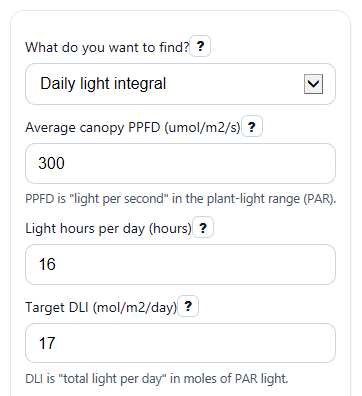
If Average canopy PPFD is 300 umol/m2/s and Light hours per day is 16, then:
DLI = 300 x 16 x 0.0036 = 17.28 mol/m2/day
If Target DLI is 17, then:
gap = 17 - 17.28 = -0.28 mol/m2/day
extra hours = 17 / (300 x 0.0036) - 16 = -0.2593 hours/day
That negative result means the current setup is already slightly above the target.
Assumptions behind the math
The conversion factor 0.0036 comes from 3600 seconds per hour divided by 1,000,000 micromoles per mole. DLI and photoperiod are standard light-planning concepts in horticulture [1][2].
This simple model assumes a steady average canopy PPFD for the entered light period. Real grows can differ because of fixture spread, plant shape, dimming, sunlight variation, shading, and measurement error.