
Estimate your kitten's likely adult weight from age and current weight, with a range and confidence note that show how rough the guess is.
Advanced options
How to use our How Big Will My Cat Get Calculator
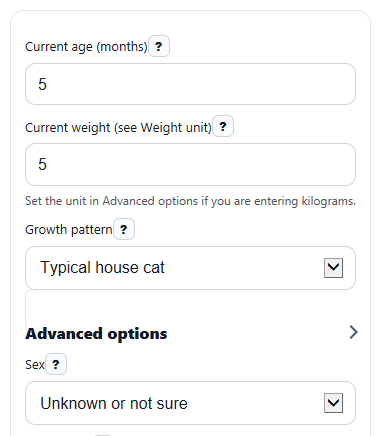
- Enter Current age (months) and Current weight (lb), then choose the right Growth pattern for your cat.
- Open Advanced options if needed to set Weight unit or add Sex for a little more context.
- Click Calculate to see the Estimated adult weight, Likely adult weight range, and notes about certainty and growth timing.
- Sanity-check the result: if the estimate looks unusually low or high for your cat, recheck age, weight unit, and growth pattern before using it.
Definitions
Current age (months): Your kitten's age in months right now. Younger kittens are harder to predict.
Current weight (lb): Your cat's body weight at the time you enter it. If you use kilograms, change Weight unit first.
Growth pattern: The growth style used for the estimate. Typical house cat fits most cats, while Large slow-growing breed is for cats that may mature later.
Estimated adult weight: The main single-number guess for adult body weight. It is a rough prediction, not a goal weight.
Likely adult weight range: A lower-to-higher band around the estimate that shows normal uncertainty.
How certain this estimate is: A plain-language note about confidence. Estimates are usually less stable at very young ages.
Expected full-growth timing: A note about when cats with the chosen growth pattern often finish growing or filling out.
Body condition: How lean, ideal, or overweight a cat looks and feels. This matters more for health than weight alone [1].
Common mistakes and quick fixes
Mistake: Entering weeks instead of months in Current age (months) .
Fix: Convert the age to months first. A 10-week-old kitten is about 2.5 months old, not 10 months.
Mistake: Typing kilograms into Current weight (lb) while Weight unit is still set to Pounds (lb).
Fix: Change Weight unit to Kilograms (kg) before you calculate, or enter the weight in pounds.
Mistake: Picking Large slow-growing breed in Growth pattern for a cat that is probably a typical mixed-breed house cat.
Fix: Use Typical house cat unless you have a good reason to expect a later-maturing large breed pattern.
Mistake: Treating Estimated adult weight like an ideal or healthy target weight.
Fix: Use it as a size estimate only, and read the Important note because body condition matters more than one number alone.
Mistake: Ignoring the Likely adult weight range and focusing only on one exact number.
Fix: Use the range for planning, especially for younger kittens, because early estimates are less certain.
Mistake: Using an old weight from weeks ago in Current weight (lb) .
Fix: Weigh your cat as close to today as possible on the same scale for a better estimate.
Limitations & Key Assumptions / Boundary Conditions
- This calculator is most useful for kittens and young cats that are still growing. It becomes less helpful once a cat is already near adult size.
- The math gives a rough size estimate, not an ideal weight, healthy weight goal, or medical assessment.
- Very young kittens, especially under 2 months, can grow at very different rates, so the estimate range is intentionally wider.
- The Large slow-growing breed setting is a simple later-growth adjustment, not a breed-by-breed growth model.
- Sex changes the interpretation text only slightly and does not override age, current weight, or individual genetics.
- Real adult size can differ because of frame size, neuter status, nutrition, illness, and body condition.
- If the estimate is unusually low or high, recheck Current age (months), Current weight (lb), and Weight unit before trusting the result.
Methodology
How the estimate is calculated
First, the calculator converts the entered weight to pounds if needed. Then it applies one of two simple growth rules based on Growth pattern.
adult_lb = current_lb * 12 / age_months
This is the baseline rule for Typical house cat. It scales the current weight by how far the kitten is from 12 months.
adult_lb = (current_lb * 18 / age_months) * 0.9
This is used for Large slow-growing breed. It assumes later growth and keeps the result broader rather than overly precise.
How the range is built
After the point estimate is found, the calculator makes a likely range using age bands. Younger kittens get a wider range because early growth varies more.
range_low = adult_lb * low_factor
range_high = adult_lb * high_factor
The factors are:
under 3 months = 0.75 to 1.25, 3 to under 6 months = 0.80 to 1.20, 6 to under 9 months = 0.85 to 1.15, and 9 to 12 months = 0.90 to 1.10.
Unit conversion
If you enter weight in kilograms, the calculator converts it to pounds for the estimate, then also shows the main estimate in kilograms.
kg = lb * 0.45359237
Mini example
If a typical kitten is 5 months old and weighs 5 lb, the estimate is:
adult_lb = 5 * 12 / 5 = 12 lb
At 5 months, the range band is 0.80 to 1.20, so the likely adult weight range is 9.6 lb to 14.4 lb.
Interpretation notes
The How certain this estimate is note depends mainly on age. Very young kittens get lower-confidence wording, while older kittens get steadier wording. The Expected full-growth timing note uses a typical maturity window of about 12 months for most cats and a longer window for some large slow-growing breeds.
Assumptions used
This method assumes steady average growth and uses a simple rule-of-thumb approach, not an individual growth chart. It does not diagnose whether a cat is underweight or overweight, and body condition matters more than weight alone for health [2].