
Estimate your dog's daily food calories and turn them into cups, grams, ounces, cans, and per-meal portions using your food label.
Advanced options
How to use our Dog Food Calculator
- Enter your dog's current Dog weight, choose the matching Weight unit, and pick the best fit under Dog stage.
- Under Food calorie entry, choose the calorie format printed on your food, then enter that value in Food calories.
- If needed, open Advanced options and add Treat calories per day, Meals per day, and an optional Target weight for a weight loss or weight gain plan.
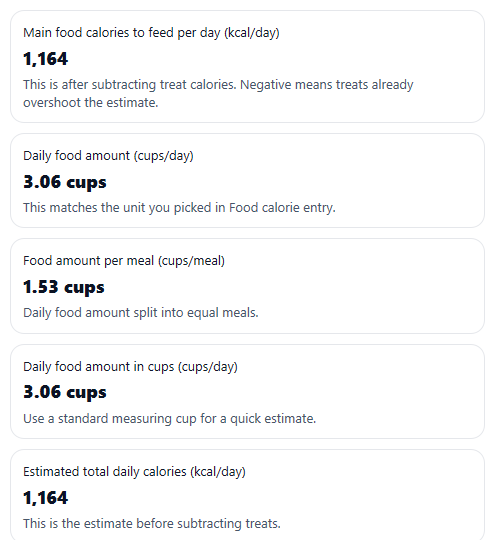
- Click Calculate, then read Main food calories to feed per day first and use Daily food amount plus Food amount per meal for portioning.
- Sanity-check the result: if Main food calories to feed per day is negative or the cup amount looks very different from your bag label, recheck treats, calorie density, and whether your food was entered per cup, gram, ounce, or can.
Definitions
Dog stage: The life stage or goal that changes the calorie multiplier used after resting calories.
Food calorie entry: The unit printed on the label for calorie density, such as per cup, per gram, per ounce, or per can.
Food calories: The calorie density of the food, entered in the same unit you picked under Food calorie entry. Pet food labels commonly show calories as kcal [1].
Resting calories: The base calories your dog needs for basic body function before stage or goal adjustments.
Factor used: The multiplier applied to resting calories for maintenance, growth, weight loss, or weight gain.
Estimated total daily calories: The full daily calorie estimate before subtracting treats.
Main food calories to feed per day: The calories left for the main food after Treat calories per day is subtracted. A negative number means treats alone already exceed the estimate.
Food amount per meal: The daily food amount split evenly by Meals per day.
Common mistakes and quick fixes
Mistake: Entering Dog weight in pounds while Weight unit is set to kg, or the other way around.
Fix: Make sure the number in Dog weight matches the selected Weight unit before you calculate.
Mistake: Typing a cups value into Food calories after choosing Food calorie entry as calories per gram, ounce, or can.
Fix: Match Food calories to the exact unit chosen in Food calorie entry .
Mistake: Leaving out snacks, chews, or training rewards from Treat calories per day .
Fix: Add all extras to Treat calories per day so Main food calories to feed per day is not too high.
Mistake: Using Target weight for a regular adult plan and expecting it to change the result.
Fix: Target weight is only meant for Dog stage choices like weight loss or weight gain, so use the matching stage if that is your goal.
Mistake: Setting Meals per day to 0 or forgetting to change it from the default when your dog eats more often.
Fix: Enter the real number of daily feedings in Meals per day so Food amount per meal is useful.
Mistake: Expecting Daily food amount in ounces or Daily food amount in grams from calories per can without enough can details.
Fix: If you use cans, enter Food calorie entry as calories per can and add Can size when you want ounce-based help too.
Limitations & Key Assumptions / Boundary Conditions
- This tool gives an estimate, not an exact prescription. Real needs can differ with breed, body condition, illness, pregnancy, nursing, weather, and unusually high or low activity.
- The calorie estimate depends on the selected Dog stage. Picking the wrong stage can change the answer a lot.
- For Weight loss plan or Weight gain plan, an entered Target weight is used only in those goal-based modes.
- If Treat calories per day is high, the calculator can show a negative food amount. That means treats already go over the estimate; the tool does not force the result back to zero.
- Converted units are shown only when the math is supported by the entered calorie format. For example, calories per can cannot safely become grams per day unless enough can information is provided.
- Cup-based feeding is less precise than gram-based feeding because foods pack differently into a cup.
- Very young puppies, sick dogs, underweight dogs, and dogs on medical diets may need veterinary guidance beyond a simple factor-based estimate.
Methodology
Calculation steps
The calculator first converts body weight to kilograms when needed, then estimates resting calories with the standard veterinary-style resting energy equation. Next it multiplies that value by the selected life-stage factor, subtracts daily treat calories, and converts the remaining calories into food amount using your food label.
weight_kg = weight_lb / 2.2046226218
RER = 70 x (weight_kg ^ 0.75)
DER = RER x factor
main_food_kcal = DER - treat_calories
daily_amount = main_food_kcal / calorie_density
per_meal_amount = daily_amount / meals_per_day
Factors used
The calculator uses these fixed multipliers from the selected Dog stage: adult, neutered = 1.6; adult, intact = 1.8; puppy 0 to 4 months = 3.0; puppy 4 months to adult = 2.0; senior or lower activity adult = 1.2; weight loss plan = 1.0; weight gain plan = 1.2.
Conversion logic
If you enter calories per cup, the main daily amount is shown in cups per day. If you enter calories per gram, ounce, or can, the main daily amount follows that same unit. Extra converted outputs are shown only when the needed information is available. For example, calories per ounce can also convert to grams using 1 oz = 28.349523125 g, but calories per can cannot safely convert to ounces unless Can size is provided.
grams_per_oz = 28.349523125
Mini example
Suppose a neutered adult dog weighs 50 lb, eats a food with 380 kcal per cup, gets 150 kcal per day from treats, and eats 2 meals per day.
weight_kg = 50 / 2.2046226218 = 22.68
RER = 70 x ((50 / 2.2046226218) ^ 0.75) = about 727.49 kcal/day
DER = RER x 1.6 = about 1163.98 kcal/day
main_food_kcal = DER - 150 = about 1013.98 kcal/day
daily_amount = main_food_kcal / 380 = about 2.67 cups/day
per_meal_amount = daily_amount / 2 = about 1.33 cups/meal
The example carries full precision through the calculation and rounds only the displayed answers. It illustrates the arithmetic, not an individual feeding prescription.
Assumptions and practical notes
This method assumes the food label calorie value is correct and entered in the same unit you selected [1]. It also assumes the chosen life-stage factor is a reasonable fit for your dog. Results can differ from bag feeding charts because foods vary a lot in calories per cup, and dividing the daily total across meals changes only portion size per meal, not total daily calories [2][3].