
Enter your roof measurements and shingle bundle coverage to estimate bundles, roofing squares, and optional starter-strip and ridge-cap lengths.
Advanced options
Table of contents
How to use our Roofing Calculator
- Choose "Flat building footprint" if you know the building length, width, and pitch, or choose "Measured roof surface area" if a roof report already gives the sloped area.
- Enter the measurements for the selected choice. For a 6/12 roof pitch, enter 6 because the roof rises 6 inches over a 12-inch horizontal run.
- Enter the waste allowance and copy the coverage per shingle bundle from the wrapper, product page, or supplier quote for the shingles you will buy.
- Open Advanced options if you know the combined eaves and rakes or the combined ridges and hips. These give separate linear-foot planning lengths for starter strip and ridge cap.
- Check that the sloped roof surface area before waste is close to your roof report or plan estimate. Confirm final package coverage and ordering rules with the supplier before buying.
Definitions
Roof pitch: Vertical rise over a 12-inch horizontal run. A 6/12 pitch rises 6 inches for every 12 inches across.
Sloped roof surface area: The actual roof surface to cover before waste is added.
Waste allowance: Extra field-shingle area allowed for cuts, layout, and damaged pieces.
Roofing square: A roofing trade area equal to 100 square feet. [1]
Coverage per shingle bundle: The square feet covered by one bundle of the specific field shingles being purchased.
Eaves plus rakes: Roof-edge lengths used to plan starter strip. Eaves are lower horizontal edges, and rakes are sloped gable edges.
Ridges plus hips: Roof lines used to plan ridge cap. A ridge is a top meeting line, while a hip is a sloped meeting line.
Common mistakes and quick fixes
Mistake: Entering building floor area as measured roof surface area.
Fix: Check How do you know the roof size? and then recalculate. Use total sloped roof area from a roof report or contractor. Otherwise, choose the footprint method and enter roof pitch.
Mistake: Applying pitch after entering measured roof surface area.
Fix: Check How do you know the roof size? and then recalculate. A measured roof surface already follows the slope. Choose that method and do not enter a second pitch adjustment.
Mistake: Guessing coverage per shingle bundle from a common bundles-per-square rule.
Fix: Check How do you know the roof size? and then recalculate. Copy the square-foot coverage from the exact field-shingle bundle you plan to order.
Mistake: Treating the field-shingle bundle count as a complete material list.
Fix: Check How do you know the roof size? and then recalculate. Enter eaves plus rakes and ridges plus hips when known, then check the starter-strip and ridge-cap package instructions separately.
Mistake: Using a negative waste allowance to reduce the order.
Fix: Check How do you know the roof size? and then recalculate. Enter 0 or a positive percentage. Choose an allowance that fits the cuts and layout of your roof.
Mistake: Typing an area such as 1,01.
Fix: Check How do you know the roof size? and then recalculate. Use commas only for thousands, such as 1,500, and use a decimal point for fractions.
Limitations & Key Assumptions / Boundary Conditions
- The footprint method assumes one rectangular roof section with one pitch. Calculate additions, dormers, irregular shapes, and sections with different pitches separately.
- Measured roof surface area is used directly, so applying pitch to it again would overstate the material quantity.
- The calculator estimates field-shingle quantity. It does not calculate underlayment, flashing, drip edge, valleys, vents, fasteners, ice barrier, labor, tear-off, disposal, delivery, permits, or repairs.
- Starter-strip and ridge-cap results are linear-foot planning lengths, not package counts. Product exposure, overlap, and package coverage affect the amount to order.
- Waste allowance is a planning choice, not a code requirement or a guaranteed final quantity.
- Bundle coverage varies by product. Use the coverage for the specific shingles selected, and follow manufacturer instructions, local code, and supplier ordering rules for the final order.
Methodology
Roof area
In footprint mode, the calculator turns a flat rectangular footprint into an estimated sloped roof surface using the pitch. In measured-area mode, it uses the supplied sloped area directly, so no pitch adjustment is made.
pitch_multiplier = sqrt(1 + (pitch_rise / 12)^2)
roof_surface_area_sqft = footprint_length_ft * footprint_width_ft * pitch_multiplier
roof_surface_area_sqft = measured_roof_area_sqft
Field-shingle quantity
The calculator adds the chosen waste percentage to roof surface area. It divides that adjusted area by 100 square feet for roofing squares, then divides by coverage per shingle bundle. Only the final bundle count is rounded up, because stores sell whole bundles.
adjusted_shingle_area_sqft = roof_surface_area_sqft * (1 + waste_percent / 100)
roofing_squares = adjusted_shingle_area_sqft / 100
bundle_count = ceil(adjusted_shingle_area_sqft / bundle_coverage_sqft)
Accessory planning lengths
Eaves plus rakes and ridges plus hips are direct linear-foot takeoffs. If entered, each is shown separately. Neither length is added to roofing squares or converted into packages because starter-strip and ridge-cap products have their own overlap and coverage instructions.
starter_strip_length_ft = edge_length_ft
ridge_cap_length_ft = ridge_length_ft
Worked example
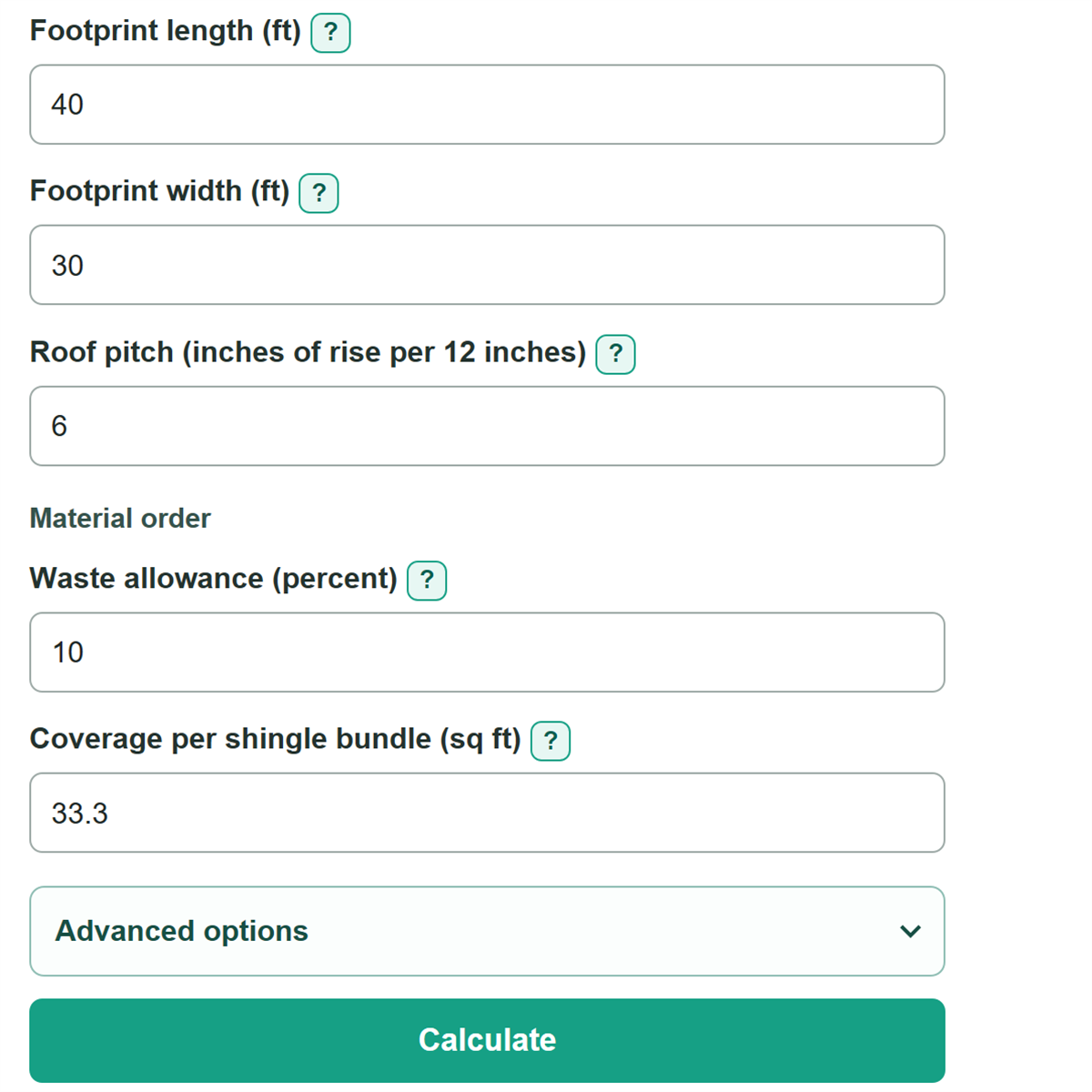
A 40 ft by 30 ft footprint with a 6/12 pitch has a pitch multiplier of about 1.1180. Its estimated sloped area is about 1,341.6 sq ft. Adding 10% waste gives about 1,475.8 sq ft, or about 14.8 roofing squares. With coverage of 33.3 sq ft per bundle, the calculator rounds the order up to 45 bundles.
Validation
Zero pitch is allowed and has a multiplier of 1. The calculator rejects negative pitch or waste, nonpositive roof area, nonpositive bundle coverage, and negative accessory lengths. Blank accessory measurements do not change the field-shingle calculation.