
Enter the finished-floor height, target step height, and tread depth to calculate equal risers, stair run, and approximate stringer length for a straight stair.
Advanced options
Table of contents
How to use our Stair Calculator
- Choose the measurement units that match your tape measure or plans.
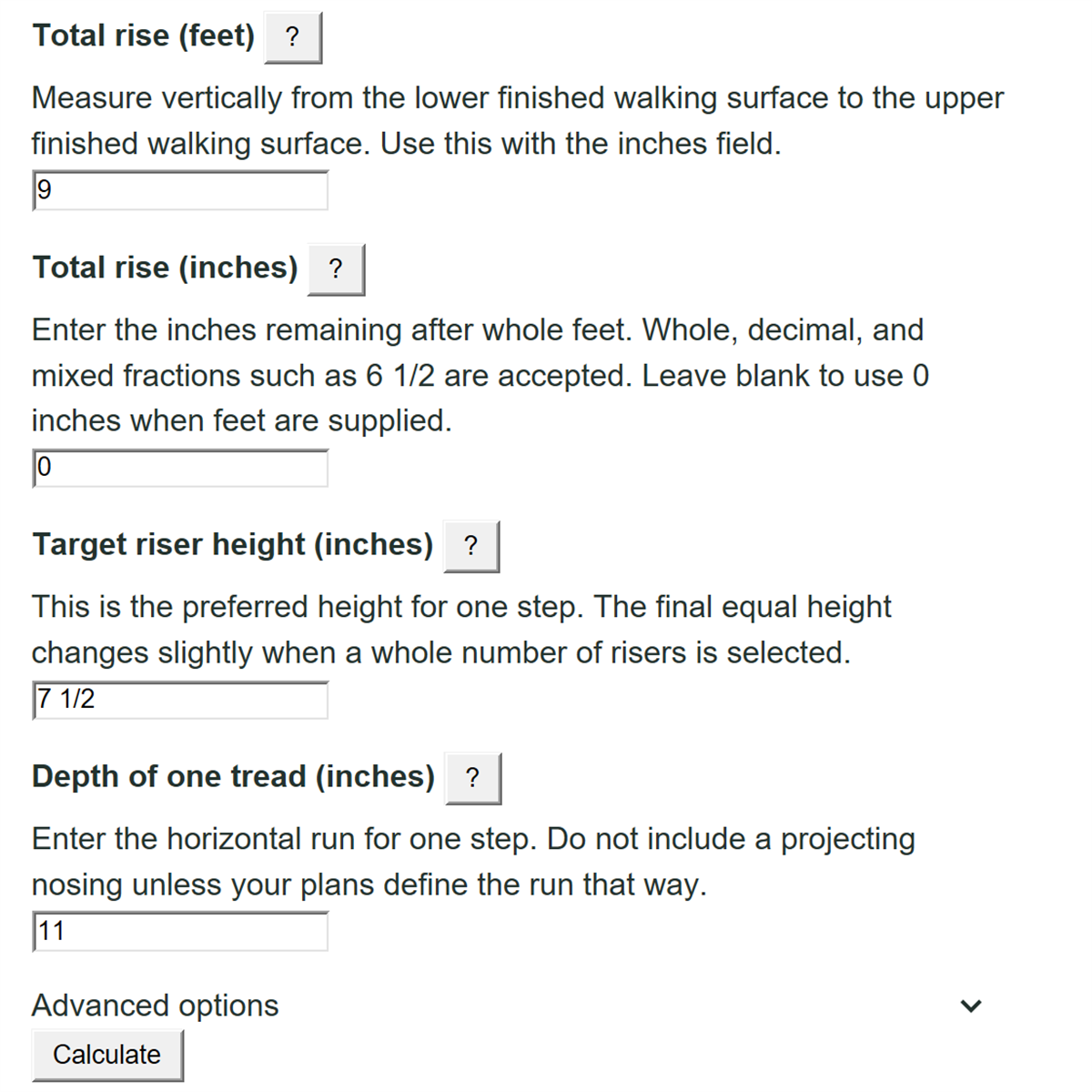
- Enter total rise from the lower finished walking surface to the upper finished walking surface. In US customary units, enter feet and the remaining inches; the inches field can be blank when feet are entered.
- Enter your target riser height and the horizontal depth of one tread. For tread depth, use the same nosing convention shown on the plans.
- Click Calculate. Use the displayed actual equal riser height for layout marks because it may differ from the target riser height.
- Check that the total horizontal run fits the available space and that one fewer tread than risers makes sense for a stair ending at the upper floor.
Definitions
Total rise: The vertical distance from the lower finished walking surface to the upper finished walking surface.
Target riser height: The preferred height of one vertical step. It is used to select a whole number of risers.
Actual equal riser height: Total rise divided by the selected whole number of risers. Use this value for equal layout marks.
Riser: One vertical rise between walking levels.
Tread: One horizontal step surface. This model treats the upper floor as the final walking surface, so it has one fewer tread than risers.
Total horizontal run: The horizontal distance made by all treads combined.
Stringer: A sloped structural member that follows the stair profile. The calculator reports its straight geometric slope length.
Bottom cut reduction: An optional amount subtracted from the first vertical stringer cut when the project detail requires it.
Common mistakes and quick fixes
Mistake: Measuring total rise from unfinished framing or a subfloor.
Fix: Check Measurement units and then recalculate. Measure vertically from the lower finished walking surface to the upper finished walking surface.
Mistake: Entering 12 or more in the US inches part of total rise.
Fix: Check Measurement units and then recalculate. Add whole feet to the feet field and keep the inches field from 0 to less than 12.
Mistake: Cutting every riser at the target riser height.
Fix: Check Measurement units and then recalculate. Use the calculated actual equal riser height after the whole riser count is selected.
Mistake: Entering the full stair length as the depth of one tread.
Fix: Check Measurement units and then recalculate. Enter the horizontal run of one tread only, without changing the nosing convention used by the plans.
Mistake: Applying a bottom cut reduction without a confirmed detail.
Fix: Check Measurement units and then recalculate. Leave it blank or enter 0 unless the tread, finish, and connection detail gives a specific reduction.
Limitations & Key Assumptions / Boundary Conditions
- This calculator models one straight stair flight. It does not lay out winder, curved, spiral, or multi-flight stairs.
- It treats the upper floor as the final walking surface, so tread count is one less than riser count.
- Results are geometry estimates, not building-code approval. Local requirements can affect riser height, tread depth, landings, handrails, headroom, and other details.
- Finished flooring, tread thickness, framing changes, and connection details can change the final layout.
- The approximate stringer length does not include end cuts, bearing length, waste, structural sizing, or connection details.
- Bottom cut reduction is not automatic. Use it only when the actual tread, finish, and connection detail establishes the required correction.
Methodology
Calculation method
The calculator uses only the fields for the selected measurement system. In US customary units, it converts feet to inches and adds the remaining inches. A blank inches field counts as zero only when a feet value is entered.
Total rise = (feet x 12) + inches
It divides total rise by the target riser height and rounds to the nearest whole riser count. A value exactly halfway between two whole counts rounds upward.
Number of risers = floor((total rise / target riser height) + 0.5)
The total rise is then divided by that whole count to get the actual equal riser height. The upper floor is the final walking surface, so tread count is one less than riser count.
Actual equal riser height = total rise / number of risers
Number of treads = number of risers - 1
Total horizontal run = number of treads x depth of one tread
The stringer length is the straight diagonal across the total rise and total horizontal run. Stair angle is measured above a level floor.
Approximate stringer length = sqrt((total rise x total rise) + (total horizontal run x total horizontal run))
Stair angle = atan2(total rise, total horizontal run) x 180 / pi
Worked example
A 9-foot rise is 108 inches. With a 7.5-inch target riser, 108 / 7.5 = 14.4, so the calculator selects 14 risers. Each actual riser is 108 / 14 = 7.71 inches. With 11-inch treads, there are 13 treads and the total run is 13 x 11 = 143 inches. The approximate stringer length is 179.20 inches and the angle is 37.06 degrees.
Bottom cut calculation
A blank or zero bottom cut reduction makes the bottom vertical cut equal to the actual equal riser height. Otherwise, the calculator subtracts the entered reduction and rejects a reduction that would make that cut zero or negative.
Bottom vertical cut = actual equal riser height - bottom cut reduction