
Compare the same solar setup at 12V, 24V, and 48V to see battery size, DC amps, and controller amps side by side.
Advanced options
Performance assumptions
Recommendation warning levels
| Planning result | 12V | 24V | 48V |
|---|---|---|---|
| Battery bank size | Ah | Ah | Ah |
| Inverter-side DC current | A | A | A |
| Controller output estimate | A | A | A |
| Within both warning levels |
Table of contents
How to use our 12V vs 24V vs 48V Solar System Calculator
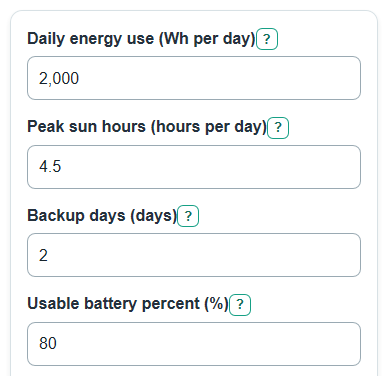
- Enter Daily energy use in Wh per day. If your load list is in kWh per day, multiply by 1000 first.
- Enter Peak sun hours, Backup days, Usable battery percent, and Inverter size to compare using the continuous inverter watt rating.
- Open Advanced options only if you want to change Solar system losses, Inverter efficiency, Controller planning margin, High-current warning level, or Large battery-bank warning level.
- Click Calculate and read Recommended system voltage first, then compare the 12V, 24V, and 48V rows for battery Ah, inverter-side DC amps, and charge controller output amps.
- Sanity-check the table: 24V should be about half the amps and Ah of 12V, and 48V should be about one quarter, for the same energy and inverter watts.
Definitions
Daily energy use: The total energy your loads use in one day, measured in watt-hours. A 100 watt load running for 5 hours uses 500 Wh.
Peak sun hours: The number of full-strength sun hours that would make the same solar energy as the changing sunlight over a day.
Backup days: The number of days the battery should run the loads when solar charging is too low.
Usable battery percent: The share of the battery bank you plan to use before recharging. A lower percent means a larger battery bank.
Battery bank energy needed: The nominal stored energy needed before choosing exact battery models, shown in kWh.
Amp-hours: A battery capacity number that depends on voltage. The same stored energy needs fewer Ah at higher voltage.
Inverter-side DC amps: The battery-side current estimate when the inverter supplies the wattage you entered.
Charge controller output amps: The estimated controller current on the battery side after the planning margin is applied.
Common mistakes and quick fixes
Mistake: Entering 2 for Daily energy use when you mean 2 kWh per day.
Fix: Enter 2000 for Daily energy use because this field uses Wh per day.
Mistake: Using a yearly or monthly average for Peak sun hours when you are sizing for a darker season.
Fix: Enter the Peak sun hours for the season you need the system to survive.
Mistake: Setting Usable battery percent to 100 for a battery bank you do not plan to drain fully.
Fix: Use the usable share you actually want, such as a lower number for a larger reserve.
Mistake: Entering the inverter surge rating for Inverter size to compare.
Fix: Use the continuous watt rating so Inverter-side DC amps at 12V, 24V, and 48V are not overstated by a short surge number.
Mistake: Treating Recommended system voltage as a final wire, fuse, breaker, or product choice.
Fix: Use Recommended system voltage as a planning flag, then verify equipment manuals and electrical code requirements.
Mistake: Leaving High-current warning level or Large battery-bank warning level at defaults when your project has different comfort limits.
Fix: Change those warning levels in Advanced options before trusting the voltage recommendation.
Limitations & Key Assumptions / Boundary Conditions
- This is a planning calculator for comparing 12V, 24V, and 48V. It is not a final electrical design.
- Battery voltage is treated as nominal. Real battery voltage changes with state of charge, load, temperature, chemistry, and charger settings.
- Solar array watts are shown before rounding. Real panel choices, shading, roof angle, seasonal weather, and local rules can change the needed array size.
- Controller amps are estimated from array watts divided by nominal battery voltage, then multiplied by Controller planning margin. Final controller selection must follow the controller maker's input voltage, output current, and temperature rules.
- Inverter-side DC amps use the entered Inverter efficiency and continuous inverter watts. Motor starts and surge loads can require much higher short-term current.
- The recommendation only checks High-current warning level and Large battery-bank warning level. It does not check wire size, voltage drop, fuse size, breaker rating, disconnects, grounding, permits, or battery manufacturer limits.
- If none of 12V, 24V, and 48V stays under both warning levels, the calculator still shows 48V because it is the lowest-current option among the three, not because it fully passes your limits.
Methodology
How the comparison is calculated
The calculator sizes one load case, then converts the same battery energy, inverter watts, and solar array watts across 12V, 24V, and 48V. Higher nominal battery voltage usually lowers current for the same power because power is voltage times current [1].
usable_fraction = usable_battery_percent / 100
battery_bank_kwh_needed = daily_energy_wh * autonomy_days / usable_fraction / 1000
solar_array_watts_needed = daily_energy_wh / peak_sun_hours / (1 - system_loss_percent / 100)
controller_amps_V = solar_array_watts_needed / system_voltage_V * controller_margin
inverter_dc_amps_V = inverter_watts / (system_voltage_V * inverter_efficiency_percent / 100)
battery_bank_ah_V = battery_bank_kwh_needed * 1000 / system_voltage_V
recommended_voltage_volts = first V in 12, 24, 48 where inverter_dc_amps_V <= max_dc_current_a and battery_bank_ah_V <= max_battery_bank_ah; if none pass, use 48
Mini-example
For 3000 Wh per day, 5 peak sun hours, 2 backup days, 80 percent usable battery, 20 percent losses, a 2000 W inverter, 90 percent inverter efficiency, and a 1.25 controller margin, the battery energy is 7.5 kWh. The solar array estimate is 750 W before rounding. At 24V, battery size is 312.5 Ah, inverter-side DC current is about 92.6 A, and charge controller output current is about 39.1 A. With warning levels of 100 A and 400 Ah, 12V fails both checks, so the recommendation moves to 24V.
Calculation choices
Inputs must be positive where required. Usable battery percent and Inverter efficiency must be greater than 0 and no more than 100. Solar system losses must be at least 0 and less than 100, because 100 percent losses would make solar sizing impossible. The calculator rejects malformed comma numbers such as 1,01 because commas are only accepted as thousands separators.
The recommendation is only a comparison shortcut. Electrical plans often require conductor sizing, overcurrent protection, disconnects, grounding, labels, equipment listings, and local review items that are outside this calculation [2].