
Enter the Zener diode voltage and current to calculate its power dissipation in milliwatts and watts at that operating point.
Table of contents
How to use our Zener Diode Power Calculator
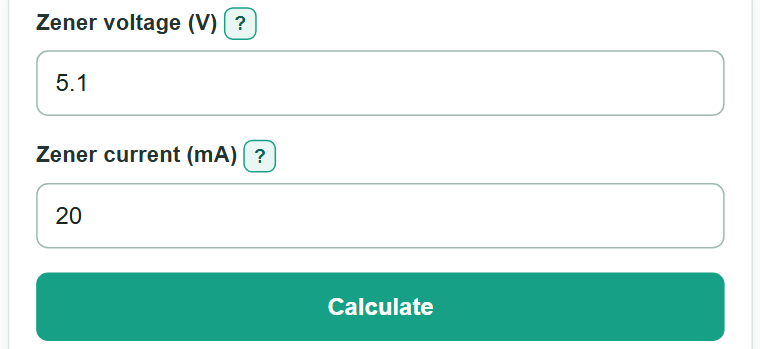
- Enter the voltage across the diode in "Zener voltage (V)." Use a measurement or the datasheet voltage that applies at the current you are checking.
- Enter the current through the diode in "Zener current (mA)." Enter the diode branch current, not total supply current if another branch powers a load.
- Select "Calculate" to see Zener power dissipation in mW and the same power in W.
- Compare the result with the diode's datasheet power rating for the actual temperature, mounting, and pulse conditions. A 5.1 V diode carrying 20 mA dissipates 102 mW, or 0.102 W.
Definitions
Zener voltage: The voltage across a Zener diode while it operates in reverse breakdown.
Zener current: The current flowing through the Zener diode itself. This calculator uses milliamps (mA).
Power dissipation: Electrical power converted to heat by the diode. It is shown in milliwatts (mW) and watts (W).
Operating point: One specific combination of diode voltage and current.
Common mistakes and quick fixes
Mistake: Entering amps in "Zener current (mA)." For example, 0.02 A does not mean 0.02 mA.
Fix: Convert amps to milliamps before entering the value. Enter 20 for 0.02 A.
Mistake: Using total supply current when a load branch also draws current.
Fix: Enter only the current through the Zener diode. Measure that branch or calculate it from the circuit.
Mistake: Treating the calculated dissipation as proof the diode is safely rated.
Fix: Compare the operating-point power with the applicable datasheet rating, including temperature, mounting, and pulse limits.
Limitations & Key Assumptions / Boundary Conditions
- This calculates power at one entered voltage and current only.
- It does not determine whether the diode is within its rated power, temperature, mounting, derating, or pulse-energy limits.
- It does not model Zener-voltage tolerance, dynamic impedance, supply changes, load-current changes, or temperature effects.
- When a separate load branch is present, the entered current must be the current through the Zener diode, not the total supply current.
Methodology
Power calculation
The calculator multiplies the voltage across the diode by the current through it. Volts times milliamps gives milliwatts directly.
P (power in mW) = V (Zener voltage in V) * I (Zener current in mA)
It then converts milliwatts to watts.
P (power in W) = P (power in mW) / 1000
Worked example
At 5.1 V and 20 mA, power is 5.1 * 20 = 102 mW. Dividing by 1000 gives 0.102 W. A current of 0 mA is valid and gives 0 mW.
How to interpret the result
The result is the heat dissipated at the entered operating point. A Zener diode operates in reverse breakdown, but its allowed current and power depend on the specific device and its datasheet conditions.[1]