
Estimate diode voltage drop, resistor current, or resistor size for a simple series diode circuit.
Table of contents
How to use our Diode Voltage Drop Calculator
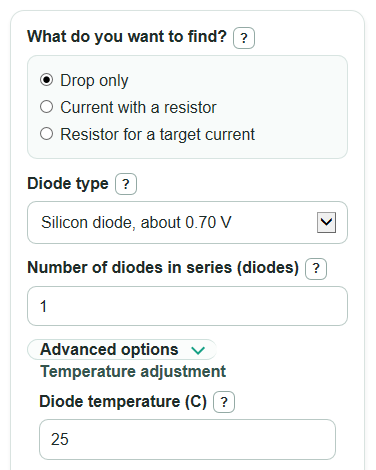
- Choose What do you want to find? based on the value you need: drop only, current with a resistor, or resistor for a target current.
- Select Diode type, or choose Custom forward voltage per diode if you have a datasheet or measured value.
- Enter Number of diodes in series, then add Supply voltage, Series resistor, or Target current only when that mode asks for them.
- Use Advanced options only if you know Diode temperature and Forward voltage change; otherwise leave the default room-temperature settings.
- Check the Circuit check and Voltage left for the resistor before using the Answer. If voltage left is zero or negative, the simple series circuit will not drive forward current as entered.
Definitions
Forward voltage: The voltage across one diode when it is conducting in the forward direction.
Diodes in series: Diodes connected one after another so the same current flows through each diode and their voltage drops add.
Supply voltage: The battery, adapter, or circuit voltage feeding the diode string and resistor.
Series resistor: A resistor in the same current path as the diode string. It limits current by using the voltage left over after the diode drop.
Target current: The current you want through the diode string, entered in milliamps.
Voltage left for the resistor: Supply voltage minus total diode drop. A negative value means the estimated diode string drop is higher than the supply.
Forward voltage change: The temperature slope in mV per C. A negative value means the diode forward voltage gets smaller as it gets warmer.
Common mistakes and quick fixes
Mistake: Using Diode type when the real part has a different forward voltage.
Fix: Choose Custom forward voltage per diode and enter the datasheet value at your planned current.
Mistake: Putting the total drop into Custom forward voltage per diode.
Fix: Enter the voltage for one diode only, then set Number of diodes in series to the count in the string.
Mistake: Reading a negative Voltage left for the resistor as a usable resistor voltage.
Fix: Raise Supply voltage, reduce Number of diodes in series, or choose a diode with a lower forward voltage.
Mistake: Entering Target current in amps instead of mA.
Fix: Convert amps to milliamps first. For example, 0.02 A is 20 mA.
Mistake: Ignoring Power used by the resistor after choosing a Needed resistor.
Fix: Pick a resistor power rating higher than the calculated Power used by the resistor.
Mistake: Typing a positive Forward voltage change when your datasheet says the forward voltage drops as temperature rises.
Fix: Enter the negative sign, such as -2 mV per C, so Diode temperature adjusts the drop in the right direction.
Limitations & Key Assumptions / Boundary Conditions
- This is a fixed-forward-voltage estimate. Real diode voltage changes with current, temperature, part number, and manufacturing spread.
- The calculator models one series path only. It does not model parallel diode branches, current sharing, pulse current, or switching behavior.
- Preset Diode type values are beginner planning estimates. Use Custom forward voltage per diode from a datasheet or meter when accuracy matters.
- If Supply voltage is less than or equal to Total diode drop, the tool keeps the signed Voltage left for the resistor but does not treat negative current or negative resistance as real operating values.
- Power used by the diode string and Power used by the resistor are steady DC estimates. Actual safe ratings depend on package, airflow, temperature, and duty cycle.
- Temperature adjustment is linear. It is useful for a rough correction only when Diode temperature and Forward voltage change match your part and current.
Methodology
Model used
The calculator treats each diode as a fixed voltage drop, then applies the series circuit idea that voltage rises and drops around a loop balance each other [2]. For modes with a resistor, it uses Ohm's law, which relates voltage, current, and resistance [1].
vf_adjusted_v = vf_base_v + (diode_temperature_c - 25) * (temp_coefficient_mv_c / 1000)
total_diode_drop_v = diode_count * vf_adjusted_v
voltage_left_for_resistor_v = supply_voltage_v - total_diode_drop_v
The voltage-left value is signed on purpose. A positive value means the supply is above the estimated diode string drop. Zero means no voltage is left for a resistor in this model. A negative value means the estimated diode string drop is higher than the supply.
Current and resistor formulas
For Current with a resistor mode, the current is the voltage left for the resistor divided by the series resistance, then converted from amps to milliamps.
estimated_current_ma = (voltage_left_for_resistor_v / series_resistance_ohm) * 1000
For Resistor for a target current mode, the target current is first converted from mA to A, then the needed resistor is found with resistance equals voltage divided by current.
needed_resistor_ohm = voltage_left_for_resistor_v / (target_current_ma / 1000)
Power is calculated only when a valid positive current is available.
diode_power_mw = total_diode_drop_v * current_a * 1000
resistor_power_mw = voltage_left_for_resistor_v * current_a * 1000
Mini example
Suppose you choose two Red LED, about 2.0 V diodes on a 9 V supply with a 330 ohms Series resistor. The total diode drop is 2 * 2.0 V = 4.0 V. The voltage left for the resistor is 9 V - 4.0 V = 5.0 V. The current is 5.0 V / 330 ohms = 0.01515 A, or about 15.15 mA. Diode power is 4.0 V * 0.01515 A * 1000 = about 60.61 mW, and resistor power is 5.0 V * 0.01515 A * 1000 = about 75.76 mW.