
Convert yards to feet fast with decimal or fraction-style input, plus optional feet-and-inches and inches for easy checking.
Advanced options
Table of contents
How to use our Yards to Feet Converter
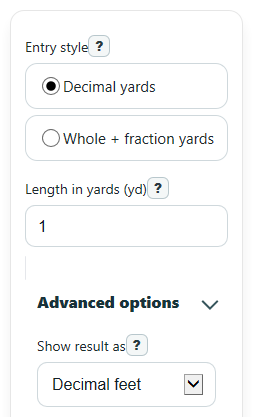
- Choose Entry style: use Decimal yards for values like 2.5, or Whole + fraction yards for values like 1 and 1/2.
- Enter the visible yard fields only: either Length in yards (yd) or the combination of Whole yards (yd), Fraction top number, and Fraction bottom number.
- Pick Show result as if you want decimal feet, feet and inches, or both, then click Calculate.
- Read Length in feet as the main answer, and use Same length in inches or Same length in feet and inches to sanity-check that the conversion matches how you plan to measure.
Definitions
Yard (yd): A customary unit of length. In this converter, yards are the starting input value.[1]
Foot (ft): A customary unit of length equal to one-third of a yard.[2]
Inch (in): A smaller customary unit of length. There are 12 inches in 1 foot.
Decimal yards: A yard value written with digits and a decimal point, such as 2.5 yd.
Whole + fraction yards: A yard value split into a whole number and a fraction, such as 1 yard plus 1/2 yard.
Fraction top number: The numerator, or the number above the fraction bar.
Fraction bottom number: The denominator, or the number below the fraction bar. It cannot be 0.
Common mistakes and quick fixes
Mistake: Typing a fraction like 1/2 into Length in yards (yd) while Entry style is set to decimal.
Fix: Enter 0.5 in Length in yards (yd) , or switch Entry style to whole + fraction and use Fraction top number and Fraction bottom number .
Mistake: Leaving Fraction bottom number as 0.
Fix: Use a nonzero value such as 2, 3, 4, 8, or 16 so the fraction can be calculated.
Mistake: Filling in Length in yards (yd) and also the mixed-number fields, then expecting both to be used.
Fix: Only the fields for the chosen Entry style are used. Check which style is selected before you calculate.
Mistake: Reading Length in feet as inches.
Fix: Watch the unit in the label. If you need inches, use Same length in inches instead.
Mistake: Thinking a negative Length in feet means the converter is broken.
Fix: A negative result means the entered yard value was below zero. Recheck the minus sign in Length in yards (yd) or Whole yards (yd) .
Limitations & Key Assumptions / Boundary Conditions
- This converter uses the exact rule 1 yard = 3 feet and 1 foot = 12 inches.
- If Entry style is set to decimal, the mixed-number fields are ignored; if it is set to whole + fraction, Length in yards (yd) is ignored.
- The feet-and-inches display rounds leftover inches to a practical display value, so the split format can differ slightly from the full decimal value at the last decimal place.
- If rounding makes the inches part reach 12.00, the result carries up to the next whole foot.
- Negative values are allowed and stay negative because they can represent a signed difference, not a physical measured length.
- Very large values are formatted for readability, but they still represent the same exact unit conversion rule.
Methodology
How the converter works
The calculator first turns your entry into a single yard value. Then it converts that value to feet and inches using exact customary unit relationships.
Formulas used
feet = yards * 3
inches = yards * 36
whole_feet = floor(feet)
remaining_inches = (feet - whole_feet) * 12
yards = whole_yards + fraction_num / fraction_den
Worked mini-example
If you choose whole + fraction and enter Whole yards (yd) = 1, Fraction top number = 1, and Fraction bottom number = 2, the yard value is 1 + 1/2 = 1.5 yd.
feet = 1.5 * 3 = 4.5 ft
inches = 1.5 * 36 = 54 in
For feet and inches, 4.5 feet becomes 4 feet plus 0.5 x 12 = 6 inches, so the same length is 4 ft 6 in.
Interpretation
Length in feet is the main answer. Same length in inches is a quick double-check, and Same length in feet and inches is useful when you are reading a tape measure or planning cuts.
Assumptions used
This method assumes standard customary units, uses the exact relationship 1 yard = 3 feet, ignores hidden input fields for the inactive entry style, and rejects a fraction with a bottom number of 0 as an error.