
Enter feet, a fraction, or separate feet and inches to find the full length in total inches.
Table of contents
How to use our Feet to Inches Calculator
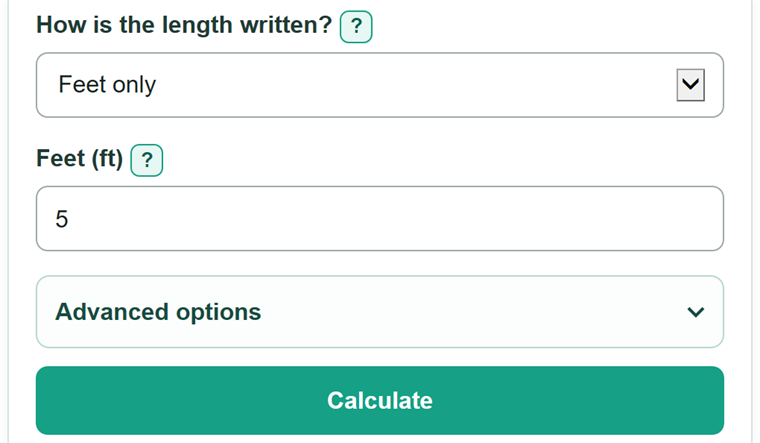
- Choose whether your measurement is written as Feet only or Feet and inches.
- For Feet only, enter a decimal such as 5.5, a fraction such as 1/2, or a mixed fraction such as 5 1/2.
- For Feet and inches, enter the whole feet, whole inches, and any remaining inch fraction, such as 3/8.
- Click Calculate to see the total inches first, followed by the same length in decimal feet.
- Sanity-check the result: multiply the feet by 12, so 5.5 feet should equal 66 inches.
Definitions
Foot (ft): A US customary unit of length equal to exactly 12 inches.
Inch (in): A US customary unit of length used for smaller parts of a measurement.
Decimal feet: A length written as one number of feet. For example, 5.5 feet equals 5 feet 6 inches.
Mixed fraction: A whole number plus a fraction, such as 5 1/2.
Extra inch fraction: The part of an inch left after the whole feet and whole inches, such as 3/8 inch.
Common mistakes and quick fixes
Mistake: Entering 5.5 when the measurement is 5 feet 5 inches.
Fix: Choose Feet and inches and enter 5 for whole feet and 5 for whole inches. Decimal 5.5 feet means 5 feet 6 inches.
Mistake: Typing 5 6 into the Feet (ft) field.
Fix: Choose Feet and inches, then enter 5 in Whole feet and 6 in Whole inches.
Mistake: Entering 12 or more in Whole inches.
Fix: Move each group of 12 inches into Whole feet. Whole inches must be from 0 through 11.
Mistake: Entering 1 1/2 in Extra inch fraction.
Fix: Put the 1 in Whole inches and enter only 1/2 in Extra inch fraction. This field must be less than 1 inch.
Mistake: Using a zero denominator, such as 3/0.
Fix: Use a fraction with a nonzero bottom number, such as 3/8. Division by zero is undefined.
Limitations & Key Assumptions / Boundary Conditions
- The calculator accepts nonnegative physical lengths only; negative entries are rejected.
- In Feet and inches mode, whole inches must be an integer from 0 through 11. Put any remaining amount below one inch in Extra inch fraction.
- Fractions need a nonzero denominator. The calculator rejects entries such as 1/0, ranges, formulas, and multiple unrelated numbers.
- The selected decimal places affect display rounding only. The conversion uses the unrounded entered value.
- This is a unit conversion, not a measurement-quality check. It does not account for tape-measure accuracy, reading error, or construction tolerances.
Methodology
Conversion method
One foot equals exactly 12 inches. The calculator keeps the entered length unrounded until it formats the displayed results. [1]
total inches = feet x 12
For a measurement entered in separate parts, the calculator changes the feet to inches, then adds the whole inches and the remaining fraction.
total inches = whole feet x 12 + whole inches + extra inch fraction
The decimal-feet result comes from the unrounded inch total.
decimal feet = total inches / 12
Worked example
For 5 feet 6 3/8 inches, 5 x 12 is 60 inches. Add 6 inches and 3/8 inch to get 66.375 inches. Then 66.375 / 12 = 5.53125 decimal feet.