
Compare a window heat pump with a window AC and space heater using your electricity rate, use hours, prices, incentives, and replacement plans.
Window heat pump
Window AC plus space heater
Advanced options
Active running time
Equipment life assumptions
Future replacement costs
Table of contents
How to use our Window Heat Pump vs AC and Space Heater Cost Calculator
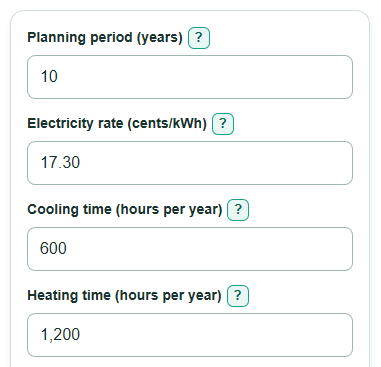
- Enter the Planning period and your Electricity rate in cents per kWh. Use only charges that change with kWh, not a fixed monthly customer charge.
- Estimate separate Cooling time and Heating time for one year. Enter the hours the equipment is switched on.
- Copy electrical input watts from each product label or manual into the power fields. Do not enter cooling or heating capacity in BTU/hr.
- Enter purchase, installation, accessory, and confirmed incentive amounts for both setups.
- Open Advanced options if needed to adjust active time, expected equipment life, or future replacement costs. Check that the signed lifetime cost gap agrees with the lower-cost setup: a positive gap means the heat pump costs less.
Definitions
Electricity rate: The variable price of electricity in cents per kilowatt-hour (kWh). Fixed monthly utility charges are not included.
Watt (W): A measure of electrical power being used at a moment. Use input watts from the product specifications, not BTU/hr.
Kilowatt-hour (kWh): A unit of electricity use. A 1,000-watt appliance running for one hour uses 1 kWh.
Active time: The share of switched-on time when the equipment is actually drawing the listed cooling or heating power.
Incentive: A confirmed one-time rebate or credit that reduces the initial purchase cost.
Lifetime cost gap: Window AC plus space heater lifetime cost minus window heat pump lifetime cost. A positive gap means the heat pump costs less.
Common mistakes and quick fixes
Mistake: Entering BTU/hr in Heat pump heating power or Window AC cooling power.
Fix: Enter electrical input watts from the label or manual. BTU/hr is output capacity, not the electricity input used by this calculator.
Mistake: Using the full electric bill divided by kWh for Electricity rate.
Fix: Exclude fixed monthly customer charges and use the variable supply and delivery charges per kWh.
Mistake: Using the same estimate for Cooling time and Heating time without checking seasonal use.
Fix: Estimate each season separately from past use, thermostat history, or a plug-in electricity monitor.
Mistake: Treating time switched on as time at full power when the equipment cycles.
Fix: Reduce Cooling active time or Heating active time in Advanced options if the entered hours include time when the compressor or heater is off.
Mistake: Entering an incentive larger than the related equipment and installation costs.
Fix: Check Heat pump incentive or AC and heater incentive against the eligible costs entered for that setup.
Mistake: Reading a negative Lifetime cost gap as an error.
Fix: Keep the sign. A negative value means the Window AC plus space heater lifetime cost is lower under the entered assumptions.
Limitations & Key Assumptions / Boundary Conditions
- The calculator assumes both setups provide the same amount of useful heating and cooling. It does not test room size, insulation, comfort, capacity, or cold-weather performance.
- Enter the actual heating input watts for the window heat pump. A unit with resistance-only heat can use much more electricity than a reverse-cycle heat pump.
- Annual electricity use is held constant across the planning period. Utility rates, weather, equipment condition, and household habits can change.
- Replacement purchases occur when an assumed equipment life ends before the planning period ends. A replacement exactly at the endpoint is excluded.
- Future replacement costs are entered in today's dollars. The calculation does not include financing, inflation, resale value, maintenance, repairs, or disposal costs.
- The electricity rate is a single average rate. Time-of-use pricing, demand charges, and changing seasonal rates are not modeled.
Methodology
Electricity use and cost
Cooling and heating are calculated separately because they can have different hours and power draws. Active-time percentages convert switched-on hours to estimated full-power hours.
active cooling hours = Cooling time x Cooling active time / 100
active heating hours = Heating time x Heating active time / 100
annual kWh = cooling watts x active cooling hours / 1000 + heating watts x active heating hours / 1000
annual electricity cost = annual kWh x Electricity rate / 100
The starter Electricity rate of 17.30 cents/kWh is a 2025 US residential planning estimate. Replace it with the variable per-kWh charges from your own bill. [1]
Initial, replacement, and lifetime costs
Initial cost adds equipment, installation, and accessories, then subtracts a confirmed incentive. Incentives are not repeated when equipment is replaced.
replacement count = MAX(0, CEIL(Planning period / equipment life) - 1)
lifetime cost = initial cost + annual electricity cost x Planning period + replacement costs
lifetime cost gap = AC plus heater lifetime cost - heat pump lifetime cost
A positive lifetime cost gap means the window heat pump costs less. A negative gap means the window AC plus space heater costs less.
Mini-example
With 600 cooling hours, 1,200 heating hours, 100% active time, and a 17.30 cents/kWh rate, a heat pump using 700 W for cooling and 900 W for heating uses 1,500 kWh per year. Its annual electricity cost is $259.50. With the same cooling watts and a 1,500 W space heater, the other setup uses 2,220 kWh and costs $384.06 per year.
What the math holds constant
The comparison uses the same entered cooling and heating service hours for both setups, uses a single electricity rate, and keeps annual use unchanged over time. It does not estimate appliance capacity, heat loss, maintenance, weather changes, or future utility-price changes.