
Compare WaterSense and standard RO costs, reject water, water savings, and estimated payback using your household use and utility rates.
Advanced options
Table of contents
How to use our WaterSense vs Standard RO Lifetime Cost Calculator
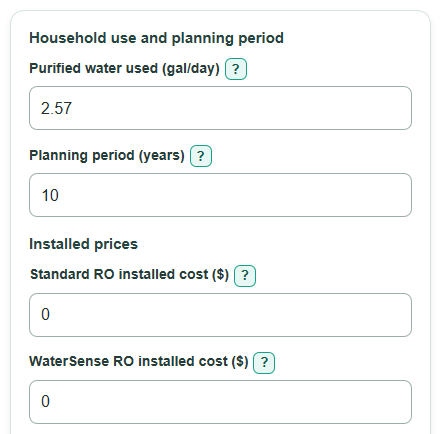
- Enter the purified water your household actually uses each day and the number of years you want to compare.
- Enter installed quotes for both systems, including the unit, installation, and one-time plumbing work.
- Choose how your bill lists rates, then enter either the combined rate or separate water and wastewater rates.
- Open Advanced options to replace efficiency defaults and add filter or membrane costs from each product's manual.
- Check the signed Lifetime cost saved with WaterSense: a positive amount means WaterSense costs less, while a negative amount means the standard system costs less.
Definitions
Water efficiency: The percent of incoming water that the RO system delivers as purified water. Higher efficiency means less incoming water is needed for the same use.
Incoming water: All water drawn by the RO system, including purified water and reject water.
Reject water: Incoming water not delivered as purified water by the RO process.
WaterSense RO: A point-of-use reverse osmosis system that meets the applicable WaterSense specification requirements. [1]
Installed cost: The one-time cost of the unit, installation, and plumbing work entered for each system.
Break-even month: The estimated month when lower average WaterSense operating costs recover a higher WaterSense installed cost.
Common mistakes and quick fixes
Mistake: Entering a system's rated capacity as Purified water used.
Fix: Enter the gallons your household drinks and cooks with each day, not the maximum gal/day the system can produce.
Mistake: Adding a combined bill rate to Water supply rate and Wastewater or sewer rate.
Fix: Choose one rate method and enter only the fields for that method.
Mistake: Treating Standard RO water efficiency as a reject-water ratio.
Fix: Enter the percent of incoming water that becomes purified water, such as 15 for 15 percent.
Mistake: Leaving Standard RO membrane life blank after entering a Standard RO membrane replacement cost above $0.
Fix: Enter the manufacturer's years between replacements so the calculator can schedule replacement costs.
Mistake: Reading a negative Lifetime cost saved with WaterSense as a calculator error.
Fix: A negative value means the standard system costs less over the chosen Planning period.
Limitations & Key Assumptions / Boundary Conditions
- This is a planning comparison, not a product performance test. Actual efficiency can change with water pressure, temperature, water quality, membrane condition, and system settings.
- The default purified-water use, utility rate, and efficiency values are US planning values. Replace them with your household use, bill rates, and product specifications when available.
- Utility cost includes only usage-based water and wastewater charges for incoming RO water. Fixed monthly utility charges are excluded.
- Filter costs are treated as the same amount each year. Membrane replacements are scheduled by the entered interval, excluding a replacement due exactly at the end of the Planning period.
- The break-even month uses average annual operating costs, so it is not an exact month-by-month cash-flow schedule.
- Electricity, repairs, service calls, financing, resale value, taxes, and changes in future utility rates are not included.
Methodology
Water and utility calculation
The calculator gives both systems the same purified-water demand, then calculates how much incoming water each efficiency needs.
annual purified water = Purified water used x 365
annual incoming water = annual purified water / (water efficiency / 100)
annual reject water = annual incoming water - annual purified water
For the utility rate, it uses the Combined water and wastewater rate when that entry method is selected. Otherwise, it adds Water supply rate and Wastewater or sewer rate.
annual utility cost = annual incoming water x effective utility rate / 1000
Lifetime cost comparison
Each lifetime cost includes installed cost, yearly filters, scheduled membrane replacements, and utility cost across the Planning period.
membrane replacements = CEIL(planning years / membrane life) - 1
lifetime cost = installed cost + yearly filter cost x planning years + membrane cost x replacements + annual utility cost x planning years
Lifetime cost saved with WaterSense = Standard RO lifetime cost - WaterSense RO lifetime cost
A positive savings value means WaterSense costs less. The calculator keeps negative values because they show when the standard system costs less.
Worked water example
With 2.57 gal/day of purified water, annual purified water is 938.05 gal. At 15 percent efficiency, the standard system needs about 6,254 gal/year of incoming water. At 30 percent efficiency, the WaterSense system needs about 3,127 gal/year, saving about 3,127 gal/year before costs are added. The 15 percent planning estimate and WaterSense efficiency requirement are based on EPA WaterSense material. [1]
Break-even calculation
The break-even estimate applies only when WaterSense costs more upfront and has positive average operating savings.
estimated break-even month = CEIL(12 x WaterSense upfront premium / annual operating cost savings)
If the WaterSense installed cost is no higher, the result is immediate. If operating savings are not positive, or recovery would occur after the Planning period, the calculator shows N/A.