
Estimate how long a whole-house leak detector and automatic shutoff system may take to recover its net installed cost.
Advanced options
Recurring ownership costs
Optional risk scenario
The 1.5% United States 2019-2023 claim-period estimate, published in 2026, is a planning estimate. Replace it with your home condition, records, or professional estimate.
Number display
Calculation details
Table of contents
How to use our Whole-House Leak Shutoff Payback Calculator
- Enter the device quote in "Device hardware cost ($)" and the labor, fittings, and permit total in "Installation work and permit cost ($)."
- Enter only a confirmed program amount in "Rebate or incentive ($)," then add your expected usage-based savings and a written insurance discount if you have one.
- Open Advanced options to include "Monthly monitoring or app subscription ($ per month)" and "Annual maintenance and supplies ($ per year)" if they apply.
- For the risk estimate, enter your five-year event chance, deductible, uninsured loss, and the share of personal loss likely avoided. Keep unknown optional dollar amounts at $0.
- Compare "Risk-adjusted payback time (years)" with "Cash-only payback time (years)." If the gap is large, your decision depends heavily on the risk assumptions rather than certain cash savings.
Definitions
Net upfront cost after rebate: Device hardware plus installation work and permit cost, minus the rebate or incentive.
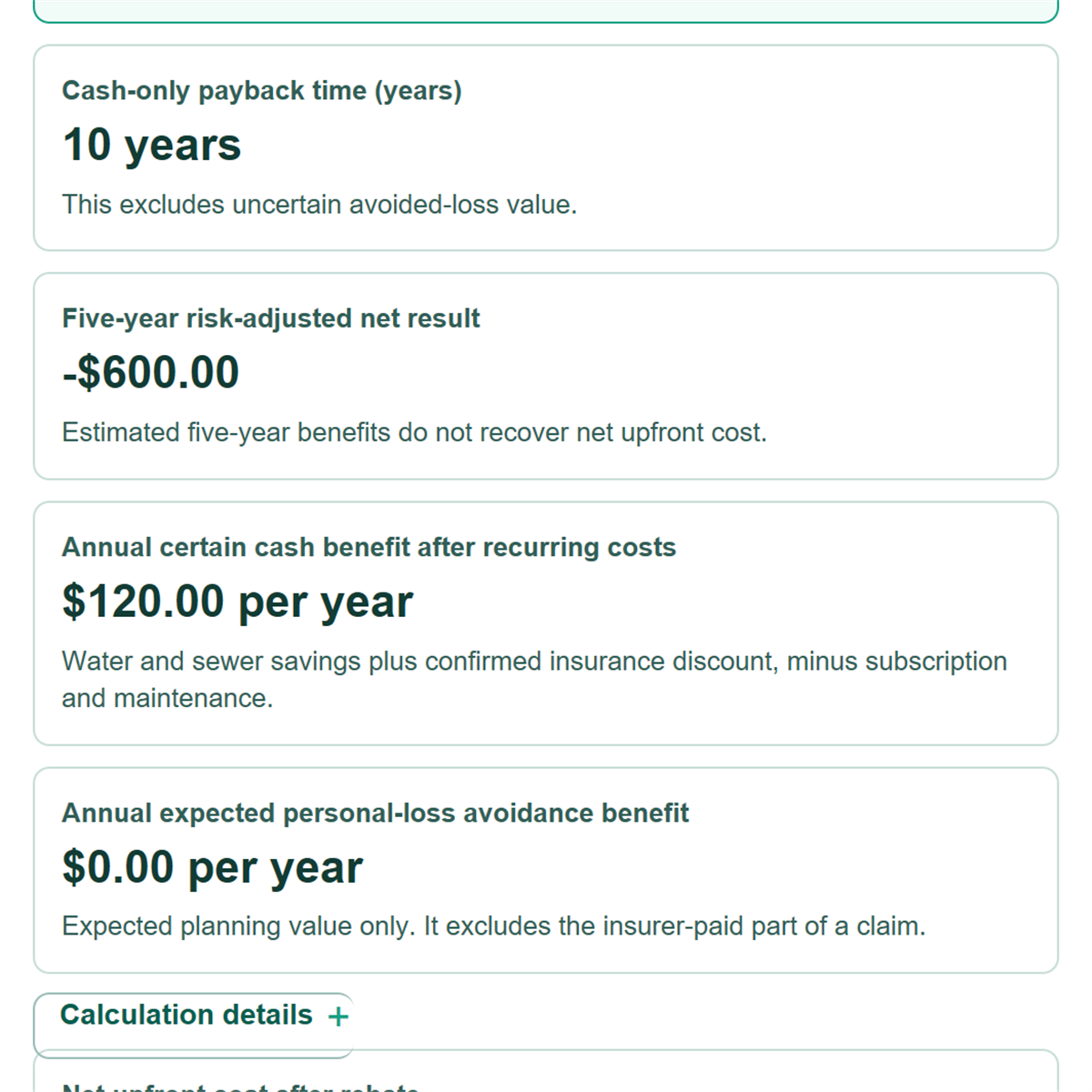
Annual certain cash benefit after recurring costs: Water and sewer savings plus a confirmed insurance discount, minus subscription and maintenance costs.
Personal loss: The water-damage deductible plus other uninsured loss that you may pay if a qualifying event happens. It excludes the insurer-paid share.
Annual expected personal-loss avoidance benefit: A planning estimate that combines the five-year event chance, personal loss per event, and share of loss likely avoided.
Cash-only payback time: The time needed for certain annual cash benefit alone to recover net upfront cost.
Risk-adjusted payback time: The time needed to recover net upfront cost when estimated avoided personal loss is added to certain annual cash benefit.
Common mistakes and quick fixes
Mistake: Entering the full water bill in "Expected monthly water and sewer savings ($ per month)." Fixed service, meter, drainage, or minimum charges may remain.
Fix: Enter only the part of the bill you expect lower leak-related use to save.
Mistake: Adding an unconfirmed insurer offer to "Confirmed annual insurance discount ($ per year)."
Fix: Keep it at $0 until your insurer or agent confirms that your policy and device qualify.
Mistake: Treating "Chance of a qualifying water-damage event in 5 years (percent)" as a yearly percent.
Fix: Enter the chance for the full five-year period, from 0 to 100 percent.
Mistake: Putting the insurer-paid portion of a claim into "Other uninsured loss ($ per event)."
Fix: Include only expenses you expect to pay yourself, such as unreimbursed repairs, contents, or temporary living costs.
Mistake: Assuming "Share of personal loss likely avoided (percent)" is a manufacturer rating.
Fix: Use your own scenario based on system coverage, shutoff response, connectivity, occupancy, and leak types the system may miss.
Mistake: Reading "Annual expected personal-loss avoidance benefit" as money guaranteed each year.
Fix: Treat it as a probability-weighted planning value and use "Cash-only payback time (years)" for the certain-cash view.
Limitations & Key Assumptions / Boundary Conditions
- This is a planning estimate, not a device compatibility check, insurance coverage decision, or guarantee of savings.
- The five-year event chance is converted to a simple annual planning value by dividing by five. It is not a personal actuarial forecast.
- Automatic shutoff systems may not detect, stop, or limit every water-damage source. Coverage depends on plumbing scope, installation, power, connectivity, leak location, and response time.
- Only personally borne loss is counted in the risk benefit. The insurer-paid part of a claim is excluded.
- Water and sewer savings should exclude fixed charges that do not change with water use.
- The five-year net result does not include inflation, utility-rate changes, insurance premium changes, taxes, financing costs, investment returns, repair downtime, or resale value.
- If annual certain cash benefit or annual risk-adjusted benefit is zero or negative while net upfront cost is positive, that payback lane has no payback under these inputs.
Methodology
Calculation method
The calculator keeps certain cash savings separate from risk-based value. Net upfront cost is the amount the annual benefits must recover.
net upfront cost = device hardware cost + installation work and permit cost - rebate or incentive
Annual certain cash benefit includes savings that can appear as cash flow, then subtracts recurring ownership costs.
annual certain cash benefit = expected monthly water and sewer savings x 12 + confirmed annual insurance discount - monthly subscription x 12 - annual maintenance cost
Expected personal-loss avoidance uses only the deductible and other uninsured loss. The initial 1.5 percent five-year event chance is an editable US planning estimate based on EPA WaterSense reporting for the 2019-2023 claim period. [1]
annual expected personal-loss avoidance benefit = five-year event chance / 100 / 5 x (water-damage deductible + other uninsured loss) x share of personal loss likely avoided / 100
annual risk-adjusted benefit = annual certain cash benefit + annual expected personal-loss avoidance benefit
If net upfront cost is positive, each payback time equals net upfront cost divided by its matching positive annual benefit. If the matching annual benefit is zero or negative, the calculator shows no payback instead of a misleading negative number.
five-year risk-adjusted net result = annual risk-adjusted benefit x 5 - net upfront cost
Worked example
With $800 hardware, $400 installation, and a $100 rebate, net upfront cost is $1,100. Monthly savings of $10, a $100 annual insurance discount, a $5 monthly subscription, and $40 annual maintenance produce a $120 annual certain cash benefit. A 1.5 percent five-year chance, $1,000 deductible, $500 uninsured loss, and 50 percent loss avoidance add $2.25 per year of expected risk benefit. The risk-adjusted annual benefit is $122.25, risk-adjusted payback is about 9.00 years, and the five-year risk-adjusted net result is -$488.75.
Calculation boundaries
A rebate cannot exceed hardware plus installation in this model. Optional recurring costs, deductible, and uninsured loss can be blank and count as $0. The event chance and loss-avoidance share must be entered from 0 to 100 percent. A negative five-year net result means the estimated five-year benefits do not recover the net upfront cost.