
Estimate usable graywater, landscape and soil limits, annual bill savings, and simple payback for an early home project plan.
Calculation details
Table of contents
How to use our Graywater Recycling System Size and Payback Calculator
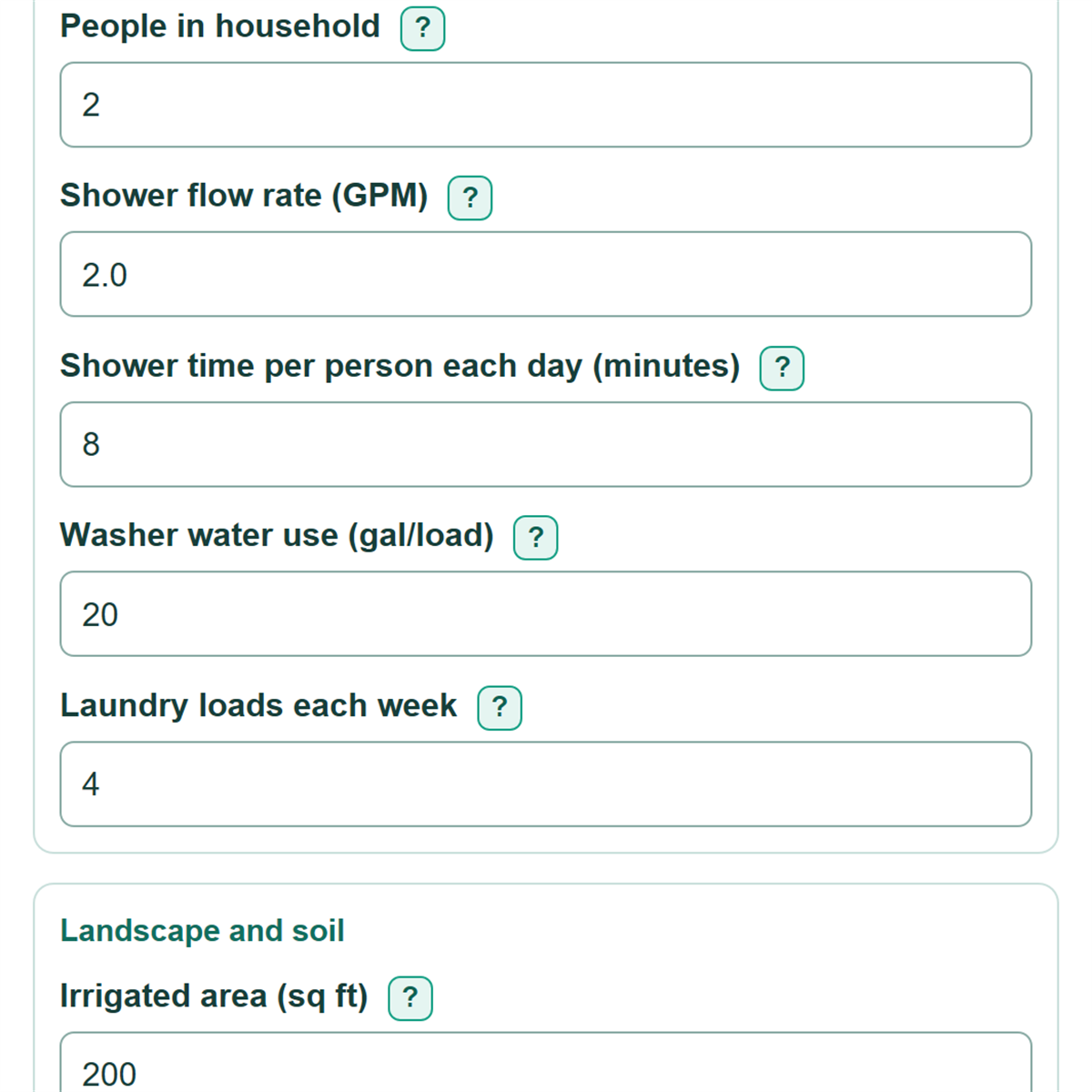
- Enter the number of People in household whose showers will connect, then copy the Shower flow rate (GPM) from the fixture label and estimate normal shower time.
- Enter Washer water use (gal/load) and Laundry loads each week only for laundry that will feed the planned system.
- Measure the Irrigated area (sq ft), then use local peak-season guidance for Peak ETo (inches/week), plant factor, root-zone delivery, and soil absorption.
- Copy variable charges into Water usage charge ($/CCF) and, if applicable, Sewer usage charge ($/CCF). Enter a sewer credit only when your utility policy allows it.
- Enter project costs, click Calculate, and check that Graywater usable for this plan does not exceed supply, peak landscape demand, or soil capacity before relying on the payback estimate.
Definitions
Graywater: Used water from sources such as showers and laundry. This calculator includes only the shower and laundry sources entered.
GPM: Gallons per minute, the flow rate commonly shown on a showerhead label. The 2.0 GPM starting value is a US EPA WaterSense planning reference. [1]
ETo: Reference evapotranspiration, or weather-based water loss from a reference plant surface. Peak ETo helps estimate the highest landscape water need.
Plant factor: A decimal that adjusts ETo for the type and density of landscape plants.
CCF: One hundred cubic feet of water, a utility-bill volume unit equal to 748 gallons. [2]
Soil absorption rate: The entered daily volume of water each square foot of receiving soil can take for planning purposes.
Simple payback: Net one-time project cost divided by positive yearly net savings, stated in years.
Common mistakes and quick fixes
Mistake: Entering a fixed service fee in Water usage charge ($/CCF).
Fix: Copy only the variable, volume-based water charge from the bill. Fixed monthly fees are excluded from Annual avoided variable utility charges.
Mistake: Treating Sewer charge avoided (%) as automatically 100%.
Fix: Check local billing rules and enter only the credited share. Use 0% if diverted water does not reduce the sewer charge.
Mistake: Using average annual weather for Peak ETo (inches/week).
Fix: Use the peak-week ETo for the season being planned, because Peak landscape water demand is a high-demand planning value.
Mistake: Using the whole yard as Irrigated area (sq ft).
Fix: Count only planted areas that will actually receive graywater, not patios, paths, or disconnected beds.
Mistake: Assuming Soil absorption rate (gal/sq ft/day) is a permit-approved site value.
Fix: Use a local soil report or qualified design value, then compare Required infiltration or distribution area with the actual receiving area.
Mistake: Reading Simple payback time as a guaranteed return date.
Fix: Update Installed system cost ($), Yearly maintenance cost ($/year), and optional project adjustments with quotes and expected costs.
Limitations & Key Assumptions / Boundary Conditions
- This is an early planning estimate, not a plumbing, health, irrigation, or permit design.
- Only entered shower and laundry water is counted. It excludes baths, sinks, toilets, kitchen water, leaks, and fixtures that will not connect.
- Peak landscape water demand uses a peak-week ETo, while graywater supply is an average daily estimate. Actual supply and irrigation needs can vary by season and household behavior.
- The entered soil absorption rate controls the required area result. Local codes, soil testing, slope, setbacks, groundwater conditions, mulch basins, and distribution design can require a different design.
- Savings include only avoided variable water charges and the entered credited share of variable sewer charges. Fixed fees, tier changes, taxes, rate changes, financing, and replacement costs are excluded.
- Simple payback is shown only when annual net savings are positive. It does not predict whether a rebate will be approved or whether installation is allowed locally.
Methodology
Water available and site limits
Daily shower supply is based on household size, fixture flow, and shower time. Daily laundry supply spreads weekly loads across seven days.
shower_supply_gpd = people * shower_flow_gpm * shower_minutes_per_person_day
laundry_supply_gpd = washer_gal_per_load * laundry_loads_per_week / 7
graywater_supply_gpd = shower_supply_gpd + laundry_supply_gpd
Peak landscape demand converts inches of water over the entered area to gallons, adjusts for plants, and divides by root-zone delivery efficiency.
irrigation_demand_gpd = peak_eto_in_per_week * irrigated_area_sqft * 0.623 * plant_factor / 7 / (water_reaching_roots_percent / 100)
soil_capacity_gpd = irrigated_area_sqft * soil_absorption_rate
daily_usable_reuse_gpd = min(graywater_supply_gpd, irrigation_demand_gpd, soil_capacity_gpd)
Required infiltration or distribution area divides usable graywater by the entered soil absorption rate. For example, 2 people using a 2.0 GPM shower for 8 minutes each produce 32 gal/day of estimated shower graywater before laundry is added. The 2.0 GPM starting value is a WaterSense planning reference. [1]
required_infiltration_area_sqft = daily_usable_reuse_gpd / soil_absorption_rate
Bill savings and payback
Annual reused water is daily usable graywater multiplied by 365. The calculator converts gallons to CCF using 748 gal/CCF, then applies the entered variable water charge and credited sewer charge. [2]
gross_annual_bill_savings = daily_usable_reuse_gpd * 365 / 748 * (water_rate_per_ccf + sewer_rate_per_ccf * sewer_credit_percent / 100)
annual_net_savings = gross_annual_bill_savings - annual_maintenance_cost - annual_pump_electricity_cost
net_project_cost = installed_cost + permit_design_cost - rebate_amount
simple_payback_years = net_project_cost / annual_net_savings
Blank optional permit, rebate, and pump-electricity entries count as $0. Payback is displayed only when annual net savings are above $0.
Planning choices
Usable graywater is limited by the smallest of supply, peak landscape demand, and soil capacity. A positive Graywater not used by this plan means the current landscape or soil capacity cannot use all estimated supply. A positive Peak landscape water still needed means other irrigation water may still be needed during the peak week.